
This article is part of our Design special section on retrofits.
They were a quintessential New York City artist duo — united by decades of looking, creating and refining — in search of a rural home where they could live and work from morning to night. Zeroing in on northwest Connecticut, Janis Provisor and Brad Davis made many trips from their loft in Tribeca to inspect, but ultimately rule out, nearly 50 properties.
Three-story houses in town had too many stairs for a couple in their 70s. Farmhouses had barns that could be converted into studios — if only the couple had the budget.
Then they spotted a real estate listing for a 1950s ranch house in Litchfield, about 30 miles west of Hartford. A friend was dispatched to check it out. The residence sat in a housing tract just up the street from a gas station and a liquor store. “Absolutely no,” the friend called to report. “You do not want this house.”
On a hunch, they drove up to see it for themselves. Entering through a side door, they walked into a room dressed like an English pub, with a drinks bar and faux-Tiffany lamps suspended over a pool table, then wandered through a warren of cramped spaces carpeted in white wall-to-wall shag. They liked that the house was on a single level, and the cedar-plank ceilings reminded them of traditional Japanese homes.
But other features puzzled them, including a double-sided fireplace that blocked the flow of the main living area and a closet and small room equipped with panic buttons. “This is not great,” Provisor recalled thinking. “Another failure.”
Then they found what had intrigued them in the listing: an indoor swimming pool encased within a 2,500-square-foot atrium. Skylights flooded the space with natural light, while sliding doors to the outside were large enough to haul oversize canvases in and out. The pair, whose early work is in the collections of the Museum of Modern Art and the Buffalo AKG Art Museum, looked at each other and simultaneously exclaimed, “Studio!” Recalled Davis, “It was instantaneous. It was love.”
The house, he said, “had good modern bones.” But taking the plunge on a pool-to-studio retrofit — and renovating the ranch house into a home where they would feel at ease — was going to be a project. Provisor, who turns 80 on Thursday, and Davis, who is 84, were determined to get back into the studio as soon as possible. “We both thought we had one more house in us, but we felt the necessity to get it done quickly,” he said. “We moved in four years ago, on my 80th birthday.”
In fact, they had only recently returned to painting full time after a significant detour. Both were successful artists when they met in the 1970s through their Manhattan gallerist, Holly Solomon. Davis painted in the avant-garde style known as Pattern and Decoration, while Provisor produced abstract works with thickly sculpted surfaces.
They married in 1983 and, after many years exploring a shared interest in Chinese art, moved to Hangzhou, southwest of Shanghai, in the early 1990s with their son, Alec. There, they worked with Chinese artisans to create hand-knotted silk rugs based on their artworks. Their company, Fort Street Studio, soon had clients like Madonna and Brad Pitt. Provisor also introduced a jewelry line, mixing gems she sourced in Jaipur, India, with sculptural, rock’n’roll-tinged settings.
Throughout their marriage, they continued to make art and set up studios wherever they lived — from a space in the award-winning postmodern house they built in Colorado in the 1980s (Davis painted the stucco facade with purple pigment from an art supply store) to a small studio in a run-down industrial building in Hong Kong’s Wong Chuk Hang neighborhood.
Five years ago, they published a coffee-table memoir of sorts, “A Tale of Warp and Weft: Fort Street Studio,” then sold the business a quarter-century after founding it. They were coming off a Covid year in which they were shut out of their studio in Industry City, Brooklyn — “although still required to pay rent,” Provisor noted — and brought their materials home to their downtown loft.
By June, they were “cabin crazy” and rented a converted Connecticut barn for the summer, living downstairs and making art on the second floor. “By the time we had to leave, we were hooked,” she said.
After closing on the ranch house in April 2021, they focused full time on the renovation, with a goal of finishing within a year. A team was assembled: Provisor’s cousin, Cassie Spieler of the Brooklyn-based Tabula Studio, oversaw the architecture, while Richard McCue, a local contractor who has worked on homes and studios for artists including Terry Winters, Alexis Rockman and Carroll Dunham and Laurie Simmons, managed the renovation.
Eager to get back to their art, they moved into an apartment next to the garage and made the studio makeover their first priority. Spieler proposed that the retrofit be reversible in case they wanted to restore the swimming pool in the future. “I said, ‘Let’s frame a floor over it,’” McCue recalled, “and it was happily ever after.”
In truth, it was a bit more complicated. Once emptied of water, the pool cavity was injected with high-end spray insulation to protect against moisture and underground vapors. It was then spanned with I-joists and topped with exterior-grade plywood. Architectural lighting was mounted on the ceiling.
Finally, a partial-height plywood wall was placed in the center of the room, giving each artist a sense of privacy without detracting from the openness of the space. “We flipped a coin to see which side of the studio would be for each of us,” Provisor said.
Turning to the rest of the house, a concept emerged: to make the squat, busy interior feel more like a loft. Once the central fireplace was removed, the main living area became a single room that stretched from the kitchen at one end to the living area at the other.
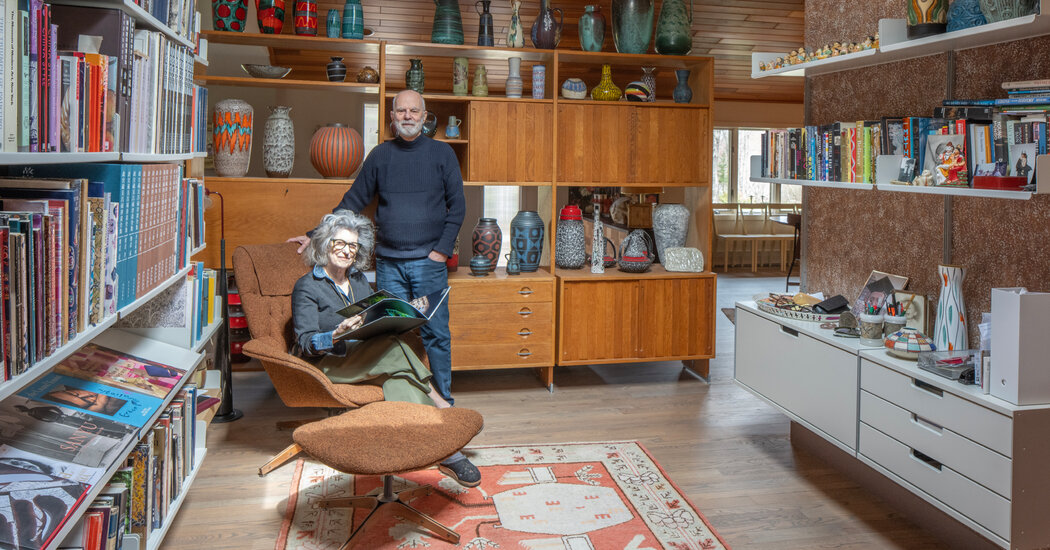
The house was emptied of its contents — furniture and appliances filling two semi-trucks were donated to Habitat for Humanity — and the couple began ordering tile, bidding on vintage furniture at auctions worldwide and reimagining every corner as though they were painting a canvas. The door was removed from a panic room, creating a space where they display paintings and ceramics. “It’s like a Japanese tokonoma alcove where they put a vase and a painting,” Davis said.
Provisor made sure the house would have the walk-in closet she always wanted, while Davis, who loves to cook, designed his dream kitchen by mixing and matching three different lines from the Danish company Reform — one in brushed aluminum, one in ash and a third in pink cast plastic. They also designed several custom rugs, including a Thai silk one in the living area consisting of overlapping, multicolored shapes based on a Provisor watercolor.
For now, they are holding on to their New York loft, heading into the city for doctors’ appointments and gallery openings — frequently, their own. The pool studio has catalyzed their creativity. Last year Provisor displayed her large-scale watercolor canvases in solo shows at Magenta Plains in New York and Fahrenheit Madrid in Spain, while Davis privately exhibited his eight-foot-tall works at Schwartman& in Manhattan. But for the most part, the ranch house is now their full-time home. Their days begin and end in the studio.
“At night we have dinner, watch TV and then go back into the studio before bed to look at the day’s work,” Provisor said. “Just last night, I said to Brad, ‘I finished that painting. Come with me. Come and let’s just sit and look at it.’”
In a room once built for swimming, it is their artwork that keeps them fully immersed.

