
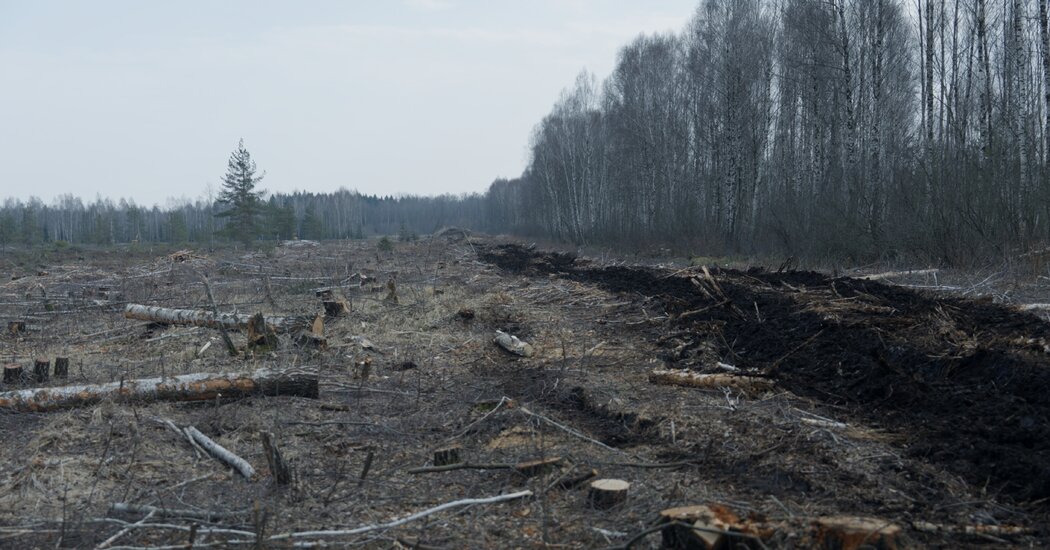
In a scrubby forest an hour outside the Lithuanian capital on a recent day this spring, excavators were digging ditches and tree harvesters were whirring in an effort to restore a waterlogged, mosquito-infested ecosystem that was drained in the Soviet era.
The reason is twofold: to help the climate and to defend the country from invasion.
The area was once a vast peat bog, and peat bogs are highly efficient at storing planet-warming carbon dioxide. They also happen to be very good at stopping tanks, because the spongy soil can’t support the weight of armored vehicles. The tanks get stuck and sink, often permanently.
Tomas Godliauskas, the Lithuanian vice minister of defense, said the bogs would form “an integral defensive line” when combined with other military tactics. The project also has the advantage of being relatively cheap compared with other measures like tank ditches and minefields, he added.
Lithuania isn’t the only European Union country using bogs to deter a Russian invasion. Latvia and Finland, for example, are also seeking to restore bogs for both environmental and defense purposes. And Ukrainian bogs helped to delay Russian troops in a failed push toward Kyiv in 2022.
Richard Hooker, a former director at the National Security Council who’s now a senior fellow at the Atlantic Council, a research organization based in Washington that focuses on international security, said peatland restoration could play an important role in Lithuania’s defense against an invasion from the east.
He noted that only one major highway runs from Minsk, in Byelorussia, to the Lithuanian capital, Vilnius, and that the Russian Army is heavily mechanized, without the kind of light infantry units that the U.S. Army has. That means restored, impassible peat bogs would force invading troops onto roads and trails, where they would be more vulnerable.
“The idea that you can use natural obstacles to tie in with man-made obstacles to slow down an attacker is an excellent one,” Mr. Hooker said. “A lot more could be done than has been done, but the early signs anyway are promising.”
The hazards of the bogs were illustrated in March last year, when a 70-ton M88 armored recovery vehicle from the U.S. Army sank during a training exercise near Pabrade, a city in eastern Lithuania near the border with Belarus. Four crew members died.
The bog restoration project is part of Lithuania’s total defense doctrine, a security strategy mobilizing the military, civilian and private sectors to be prepared in case of Russian aggression. The country is looking to restore 6,000 hectares of peatlands, Mr. Godliauskas said.
But it’s about more than just defending the border. It’s also about carbon capture.
Peat bogs form when oxygen-poor conditions in wetlands prevent bacteria and fungi from fully breaking down organic matter like plants and dead animals. In Lithuania, some of the resulting peat was extracted by the Soviet authorities to burn in power plants and to expand agriculture.
The restoration effort is a priority across multiple agencies in the government, said Aira Paliukenaite, Lithuania’s vice minister of the environment. The ministry is planning for restoration to continue for the next 30 years as a part of its policy of aligning with the European Union’s Nature Restoration Law.
That measure requires every country in the bloc to implement a plan, with targets, to mitigate carbon emissions and restore biodiversity and habitats in the coming decades.
Lithuania appears to be in a good starting position. The country still has large quantities of undisturbed peat underground. By rewetting it, officials said they could transform the land back into a what’s known as a carbon sink, or storage system, because peat can lock away carbon for much longer than forests can.
It’s not a simple process, though. The technical planning and site preparation can take years. The projects are still in the early stages, especially those along the border, but they are starting to work with nongovernmental groups like the Foundation for Peatland Restoration and Conservation.
While some in the country are skeptical about the restoration process and its efficacy, others are welcoming the plan.
Albertas Lakstauskas, 52, a teacher and politician, has lived his whole life in Zasliai, a small town near one of the foundation’s projects, the restoration of about 150 acres of drained land where peat was extracted to supply energy to the Soviet Union.
Mr. Lakstauskas said he, like some others in the town, was doubtful that peat bogs alone could stop a Russian invasion, but he said he thought supporting the environment was a matter of national pride.
“If we can do some things to do better, I think that’s a good opportunity,” he said. “And I choose to participate.”

