
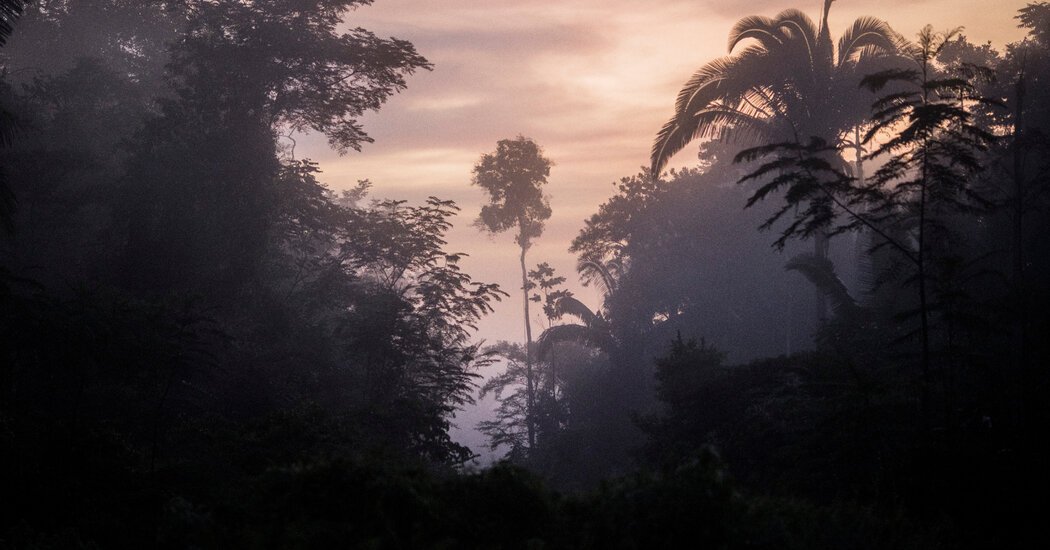
Over centuries, the Amazon’s hundreds of Indigenous societies have built up an abundance of knowledge about the rainforest’s thousands of plant species and how to use them.
This vast library of botanical know-how is under growing threat from climate change, according to a new study in the journal Nature.
In the coming decades, global warming could kill off roughly 30 percent of the Amazon’s useful plant species within the communities that use them, the study found. These areas could suffer such extensive losses even if nations manage to restrain worldwide warming to moderate levels, the study found, showing how vulnerable the region’s flora are to higher temperatures and sharper swings between deluge and drought.
The species at risk include yoco, a woody vine that the Secoya people of the northwest Amazon make into a strong, finger-tingling morning brew. Ibapichuna, a deep-violet fruit that is cooked by the Cubeo people of Colombia to prepare an after-dinner drink. And wingimonkawe, a tree whose bark is processed by the Waorani people of Ecuador to treat infected wounds.
“This pool of species and cultural richness is part of who we are as humanity,” said Jordi Bascompte, a professor of ecology at the University of Zurich who worked on the study. It is also a deep well of scientific possibility that has barely been tapped, he added. Within the Amazon’s cornucopia may lie the next wonder compound, the next medical breakthrough akin to quinine, the malaria treatment that was first isolated from the bark of a rainforest tree.
Climate change driven by industrialized nations is already having major effects on the Amazon, with consequences that spill well beyond the forests’ borders.
Wildfires have devastated huge areas in recent years. Droughts are becoming more intense. Scientists are working to understand whether the Amazon could soon cross a tipping point that causes swaths of forest to transform into grasslands once too many trees have died off or been razed to make room for pastures and crops. Because these trees release so much moisture into the atmosphere, such a vast degradation could disrupt weather patterns far and wide.
Within the Amazon, the damage cuts to the heart of how the region’s Indigenous peoples live.
“Climate change has clearly been noticed on a large scale,” said Yadira Kasent, the deputy mayor of the canton of Morona in Ecuador. For Ms. Kasent’s people, the Shuar, native plants are central to daily life: the fruits and tubers they eat, the barks and succulents with which they treat stomach conditions and other ailments, the leaves they use as cosmetics.
“We’ve learned to live alongside them, and their use has been passed down over time for countless needs,” Ms. Kasent said.
To understand how this knowledge might be imperiled in a warmer future, the new study’s lead author, Rodrigo Cámara Leret, first set out to catalog it all: Which plant species have been used by which Amazonian societies, and how?
Dr. Cámara Leret, an assistant professor in the Department of Systematic and Evolutionary Botany at the University of Zurich, hit the archives. He scoured books, scholarly papers and field reports. He combed 1950s monographs on fish poisons, studies from the ’60s and ’70s on the hallucinogenic brew known as ayahuasca, and modern inventories of plants used by midwives and traditional healers.
He read the chronicles of some of the earliest Europeans to travel the Amazon: missionaries, explorers, naturalists commissioned by colonial powers. He trudged through archaic language and untangled species names from the time before biological classifications were standardized.
All in all, Dr. Cámara Leret drew upon 700 sources, from the 1500s to the present, to build a database of more than 90,000 references to services provided by specific plants. He found that Amazonian societies had made use of at least 5,800 or so species, or roughly a third of the 15,600 seed-plant species that are known to grow in the region.
Among the plant services he documented, three-quarters were found to be associated with just one Amazonian culture, making them exceptionally vulnerable to being lost.
The next step for Dr. Cámara Leret and his colleagues was to assess the possible fates of these species as humans continue heating the planet over the next half century. Using computer models, the researchers found that, for 82 Indigenous societies whose plant use is well documented, the environments where these communities live could become unsuitable for 28 percent to 34 percent of the plant species they use, depending on how much the world does to curb warming.
Many of these threatened plants live in the lowland rainforest, where no hills or mountains offer refuge from a hotter climate, Dr. Cámara Leret said. Even if some pockets of forest remain shielded from heat and drought by geographic happenstance, they may be too far away for many species to establish themselves without help from humans, said Hans ter Steege, a professor of ecology at Utrecht University in the Netherlands.
“The climate is changing so fast now that species will not be able to reach those safe sites in the time that they have,” Dr. ter Steege said.
Many communities in the Amazon are already working to stop their botanical riches from sliding into oblivion.
Ms. Kasent, the deputy mayor in Ecuador, has proposed an ordinance that would classify ancestral knowledge as intangible heritage and allow it to guide local environmental planning. She is also working on a project to bring back endemic fruit species that have disappeared and to create opportunities for local women to sell them at scale.
Oreme Ikpeng is a director of the Xingu Seeds Network, a project to collect native seeds and restore degraded forests in the Xingu River Basin of the Amazon. Since the network was started two decades ago, he has already seen marked shifts in the climate of the Xingu territory, Mr. Ikpeng said.
Wildfires, once rare, have cut into seed production. Warmer temperatures limit the hours that seed collectors can work.
One tree species, the cumaru, is used by Indigenous people for cosmetics and medicine. Its growth is shaped by the delicate balance of water and sun, and as that balance shifts, the tree responds by producing smaller or fewer fruits, Mr. Ikpeng said.
At first, the elders in his community, the Ikpeng, could scarcely believe that such changes could unfold within their lifetimes, he said.
“For us, the forests, rivers, animals, everything was infinite,” he said. “No one thought it was possible to destroy it.”

