
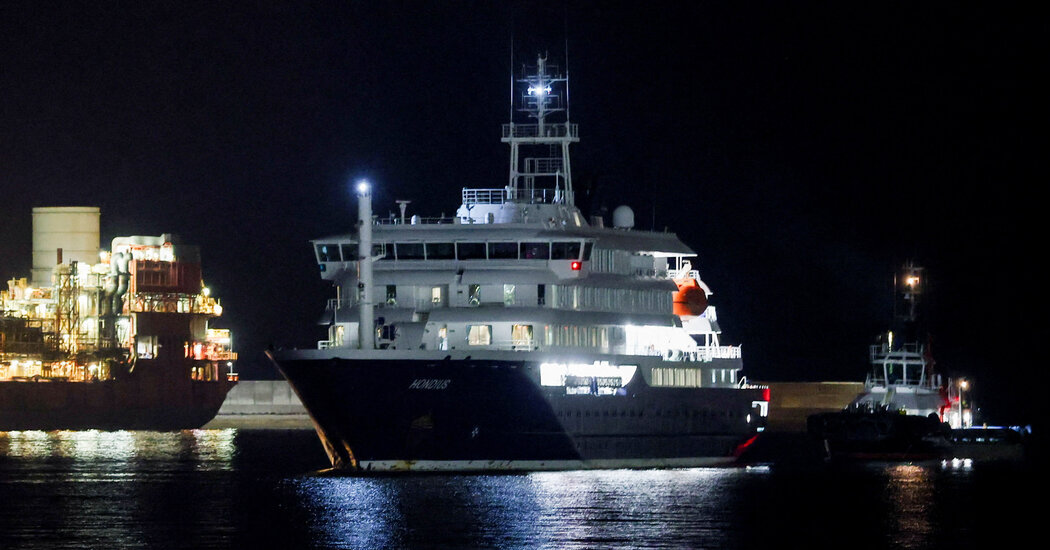
The cruise ship at the center of a deadly outbreak of hantavirus anchored off Spain’s Canary Islands on Sunday, officials said.
After more than a month at sea, the ship, the MV Hondius, arrived at the port of Granadilla de Abona in Tenerife, the largest of the islands, in the early hours of Sunday morning, according to Spain’s health minister and its secretary of state for health.
Since April 11, three passengers who were aboard the vessel have died and five other people have fallen ill after showing symptoms of hantavirus, a rare family of viruses carried by rodents, according to the World Health Organization. The pathogen was also confirmed in six people, the W.H.O. said, including a Dutch woman who died in South Africa, as well as two British citizens and a man hospitalized in Switzerland.
All 147 crew members and passengers arriving in Tenerife were asymptomatic, said Oceanwide Expeditions, the cruise operator company. Also among them are four medical staff members, who boarded the vessel when it was anchored off the coast of Cape Verde, an island archipelago in the Atlantic Ocean.
In Tenerife, the ship will anchor offshore, close to an industrial port with no people nearby. The Hondius passengers will be taken from ship to shore in small boats and then led to an airport, from where they are expected to be sent to their home countries, according to Spanish officials.
Once all passengers have left the ship, the MV Hondius will sail to the Netherlands to be disinfected, the interior minister of Spain, Fernando Grande-Marlaska, said in a news conference on Saturday.
“Spain can assure the entire world that this will be handled properly and that there will be no additional contact beyond what has already occurred on the ship,” Mónica García, the health minister, said at the conference. The body of one of the three deceased passengers remains on the ship, she added.
Many countries are working together with Spain and the Netherlands to return the passengers home, Maria Van Kerkhove, the W.H.O.’s director of epidemic and pandemic preparedness and prevention, said in a briefing on social media on Saturday. The risk to the general public remains low, and health workers who traveled with the ship from Cape Verde have assessed each passenger’s level of exposure, she added.
“We classify everybody on board as what we call a high-risk contact,” Dr. Van Kerkhove said. Any passenger who displays symptoms will be flown to the Netherlands on a separate aircraft for treatment. The W.H.O. also recommended “active monitoring and follow-up of all the passengers and crew who disembark for a 42-day period.”
Health officials in a growing list of countries are scrambling to trace people who may have been exposed to the virus after the ship set sail from Argentina in early April before stopping at islands in the south Atlantic Ocean. In Canada, Denmark, France, Singapore, South Africa, Spain, Switzerland, Turkey and the United States, health officials were monitoring people who were on the ship or had contact with sickened passengers.
While the W.H.O. and other medical experts said the risk to the general population remained low, the outbreak and the ensuing public anxiety have been reminiscent of the coronavirus pandemic. Although human-to-human transmission of the hantavirus is rare, W.H.O. officials confirmed that the strain that has infected patients from the ship, called the Andes strain, is the only one known to spread among humans.
As the ship neared the Spanish territory, Dr. Tedros Adhanom Ghebreyesus, the head of the W.H.O., moved to allay residents’ fears.
“I know that when you hear the word ‘outbreak’ and watch a ship sail toward your shores, memories surface that none of us have fully put to rest,” he said in a statement addressed to Tenerife. “But I need you to hear me clearly: This is not another Covid.”

