
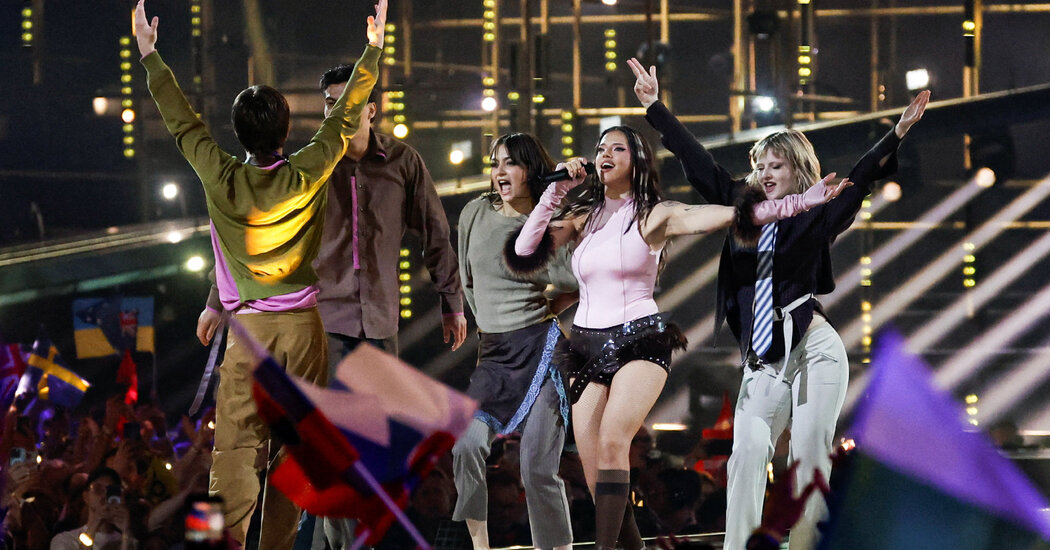
Bulgaria has just broken a glass ceiling in European popular culture: winning the Eurovision Song Contest.
And it is hoping that the victory — in a year in which the country also adopted the euro and elected a government that pledged to clean up corruption — can show that the country is a serious player on the European stage.
“Dara is yet another reminder that Bulgaria can win,” Prime Minister Rumen Radev wrote on Facebook about the 27-year-old singer who claimed the Eurovision title for the country on Saturday night. Radev, who was sworn in this month, called it a “Bulgarian victory with global resonance.”
The Eurovision win, Bulgaria’s first, capped a period of domestic upheaval and change for the country, which joined the European Union as a member state in 2007.
“This does reflect a certain cultural alignment with the European project,” said Dimitar Keranov, a visiting fellow at the German Marshall Fund of the United States in Berlin. He called it “the symbolic closure of Bulgaria’s deep European integration” after almost two decades at the margins of the bloc.
Keranov, who is from Bulgaria and is an expert in Bulgarian politics, pointed to other recent moves toward the European center.
Bulgaria joined the Schengen free travel area in 2025, which European officials heralded as a major step. And in recent months, crowds of mostly young people took to the streets in the country to protest a political culture of corruption — demonstrations that led the previous prime minister to resign.
Now, as this year’s Eurovision winner, Bulgaria has a year to prepare to host the song contest’s 2027 edition, an event that will come 20 years after the country joined the European Union.
Whether it can deliver a complex global event will be a real test for the country and its institutions, Keranov said.
Still, he said, it’s “a rare chance that Bulgaria hasn’t gotten in a while now to just showcase itself,” and to show other Europeans: “‘Hey, we’re here. And we exist. And we have something to offer.’”
Mimi Shishkova-Petrova, a Bulgarian political influencer popular among young people, said that people were “ecstatic” over the Eurovision win, adding, “It feels like we have finally found our breakthrough moment.”
The victory, she said, might give pro-European young people in the country an important boost to their momentum.
“Sometimes we do need that push from the outside and for someone to tell us that ‘You, too, do belong,’” she said. “I think this will make us as a society braver to stand for European values, the values of democracy, freedom, basic human rights.”
The victory came as a surprise in Eurovision circles.
Bulgaria, which has long been one of the bloc’s poorest member states, had sat out the last three Eurovision contests, citing high costs. And its entry this year, the club-style track “Bangaranga,” had not been one of the preshow favorites.
But Dara, whose real name is Darina Yotova, prevailed with 516 points — way ahead of second-place Israel, which scored 343 points, and third-place Romania, with 296.
Bulgaria erupted in celebration, said Elena Rosberg, a Eurovision commentator for Bulgaria’s public broadcaster, who wrote her doctoral dissertation on the competition.
People are “genuinely euphoric,” Rosberg wrote in an email: “For many Bulgarians, this felt like an injection of national self-confidence.”
Rosberg said her phone had “exploded” after the victory and her social media feeds filled with reactions from people who typically would never pay attention to the song contest. “Friends were calling each other,” she wrote. “People from completely different generations suddenly found themselves discussing the same thing.”
After so much time feeling like they were on Europe’s periphery, Bulgarians were suddenly right at the center. The victory came after a major cultural shift, Rosberg added, and the adoption of the euro, which, she wrote, “represents confirmation that Bulgaria belongs firmly inside the European democratic space.”
“For me, this victory is not really only about Eurovision,” Rosberg added. “It is about visibility, recognition and confidence,” she wrote.
Dara herself was visible to the masses as she returned to Sofia, Bulgaria’s capital, on Sunday: Crowds thronged the airport, and Bulgaria’s main television stations broadcast her arrival live, making changes to regular programming to stream the celebration to the country of about 6.5 million people.
The singer, who became a star in Bulgaria in part by regularly taking part in national talent competitions, hoisted the Eurovision trophy overhead as the cheering almost drowned out the playing of her song on loudspeakers. Glittering golden confetti filled the air. Some people waved Bulgarian flags. Others were holding children on their shoulders to help them see over the crowd.
Dara told the British newspaper The Independent that she was trained in traditional Bulgarian vocal technique and folklore singing, and that winning Eurovision was a chance for Bulgaria to be “really seen” on the international stage.
“If ‘Bangaranga’ can be the song that makes someone in Manchester or Edinburgh or Brighton pull out their phone and look up Bulgaria — look up its music, its coast, its literature, its people — then I’ve already achieved something real,” she said.
Young people, like Viktoria Spasova, 24, love her music. So does Spasova’s grandmother, who also celebrated the win — and stayed up until 2 a.m. to watch the final.
“She hasn’t stopped talking about Dara ever since,” said Spasova, a marketing and social media expert from Sofia. “She told me that she adores Dara.”
Now, she said, “Bangaranga” is everywhere — people are talking about the song on the street, on television, on the subway. “The word has taken on a life of its own,” Spasova said.
“Bulgaria is rarely in the international spotlight for good reasons,” she added, “so it feels special to see the country celebrated on a stage this big.”

