
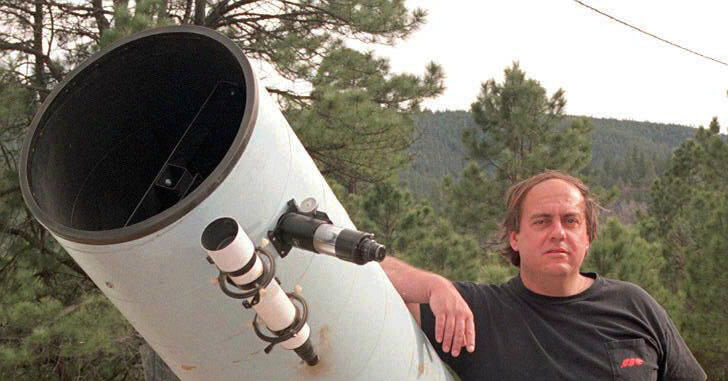
Alan Hale, who wheeled a telescope out of his New Mexico garage on July 23, 1995, and spotted a fuzzy object in the constellation Sagittarius, discovering what may be the most-viewed comet in human history — known as Hale-Bopp, after Dr. Hale and Thomas Bopp, another sky watcher who saw it the same night — died on June 6 at his home in Cloudcroft, N.M. He was 68.
The cause has yet to be determined, though Dr. Hale had experienced complications from a recent surgery, his wife, Vickie Hale, said.
Dr. Hale had a Ph.D. in astronomy, but he was running a small education company in 1995, when he aimed his telescope at a tightly packed cluster of stars known as M70 from his driveway in Cloudcroft. The village, at an elevation of 8,676 feet in the mountains of southern New Mexico, is popular with telescope buffs for its dark skies.
“I turned the scope to M70 and — that’s funny — there was something kind of weird nearby,” he recalled in a 2025 interview with ICQ Comets (and Cousins), a YouTube astronomy channel. “I followed it for the next three hours.”
During that time the fuzzy object moved, suggesting to Dr. Hale, a dedicated observer of comets since the age of 11, that he might have discovered one of his own — a rarity for someone just making visual observations.
He fired off an email reporting the object’s first and last positions to the Central Bureau for Astronomical Telegrams, a clearinghouse for sky sightings in Cambridge, Mass.
Coincidentally, Mr. Bopp had observed the same object from Arizona and contacted the organization a few hours later by Western Union telegram. (Mr. Bopp died in 2018.)
The next morning, experts confirmed that a new comet had been found and officially identified as C/1995 O1. Popularly, the comet was known as Hale-Bopp, following a naming tradition that dates to the early 1700s, when the English astronomer Edmond Halley identified Halley’s comet.
Astronomers calculated that Hale-Bopp was extraordinarily large and bright — 80 miles across, much larger than Halley’s comet, whose return every 75 years or so makes it the celebrity of comets — and that Hale-Bopp’s orbit would bring it unusually close to the solar system.
It was anticipated that in two years’ time, when the comet reached perihelion (its closest distance to the sun), it would be one of the brightest ever seen from Earth.
Public excitement grew, fueled by news headlines and websites on the newly popular internet, which shared spectacular photographs of the approaching celestial beauty.
By May 1996, Hale-Bopp had become visible to the naked eye. It remained so for 18 months, even in cities awash in light pollution.
“I remember driving home from work for weeks on an expressway in Boston with car lights and streetlights, and Hale-Bopp was — boom! — up there in the sky out the window,” Daniel Green, one of the two astronomers at the Central Bureau who received Dr. Hale’s email and calculated the comet’s orbit, said in an interview.
Dr. Hale traveled widely to speak about his discovery. He joined Vice President Al Gore and his wife, Tipper, to watch the comet from the U.S. Naval Observatory in Washington, whose grounds include the vice-presidential residence.
“That was kind of cool,” Dr. Hale recalled in the 2025 interview. “The weather wasn’t all that cooperative, but we did get to see the comet, and I complimented the vice president on the nice telescope he had in his garage — or, pardon me, his backyard.”
According to NASA, Hale-Bopp came within about 120 million miles of Earth. (For comparison, the sun is 93 million miles away.) At its closest, in March 1997, it appeared in the night sky of the Northern Hemisphere with a short but obvious tail.
One thing not trailing in its wake: the spaceship that a religious cult, Heaven’s Gate, believed was slipstreaming behind the celestial body.
The group preached sexual abstinence and believed that their bodies were mere vessels for spirits that would ascend to a higher plane — beamed up to the alien craft supposedly flying behind Hale-Bopp. That March, as the comet approached Earth, 39 Heaven’s Gate members donned matching clothes and new sneakers, swallowed poison and lay down in a suburban mansion in Southern California in an act of mass suicide.
“According to material the group posted on its internet site,” The New York Times reported, “the timing of the suicides was probably related to the arrival of the Hale-Bopp comet, which members seemed to regard as a cosmic emissary beckoning them to another world.”
Alan Hale was born on March 7, 1958, in Tachikawa, Japan, the youngest of three sons of Ruth (Schroeder) Hale and Nile Hale, who was stationed there with the United States Air Force. Soon after, Nile Hale was transferred to Holloman Air Force Base near Alamogordo, N.M., where Alan spent his childhood. His mother worked as a secretary at the base.
Books on astronomy that his father checked out for him from the base library led to a lifelong interest. Alan made his first astronomical observation at 8, when his father woke him before dawn to see a spectacular display of the Leonid meteor shower in 1966. After much pleading, his father bought him a telescope from Sears when he was 11.
“As soon as I got my telescope, I wanted to see all the objects that were out there,” he recalled in 2025. “I mean, I wanted to see the spiral galaxies, I wanted to see the clusters, the diffuse nebulae, and — I’d seen pictures — I wanted to see a comet.”
He graduated from Alamogordo High School in 1976 and entered the U.S. Naval Academy, receiving a bachelor’s degree in physics in 1980.
After serving in the Navy, he left in 1983 to work at the Jet Propulsion Laboratory in Pasadena, Calif., where he was an engineering contractor on spacecraft projects, including Voyager 2’s mission to observe Uranus.
He went on to pursue graduate studies at New Mexico State University, earning a master’s degree in astronomy in 1989 and a doctorate in 1992.
Dr. Hale was briefly the staff astronomer at the Space Center (now the New Mexico Museum of Space History) in Alamogordo. In 1993, he founded the Southwest Institute for Space Research (now the Earthrise Institute), which focused on regional education and research activities.
His marriage to Eva Budzinski ended in divorce. In addition to Ms. Hale, whom he married in 2024, Dr. Hale is survived by two sons from his previous marriage, Zachary and Tyler; three grandchildren; and a brother, Barry.
Comet hunters are used to taking the long view. Halley’s comet won’t appear in the night sky again until 2061. Hale-Bobb’s next visit to the inner solar system will occur around 4385.
The brevity of human memory, by contrast, sometimes shocked Dr. Hale. He noted in the YouTube interview that his namesake comet was periodically the subject of a question on “Jeopardy!” but that recently, a quarter-century after its spectacular flyby, it seemed to have been forgotten.
“The frustrating thing was that none of the contestants got it,” Dr. Hale said, shrugging. “That’s life. That’s the way it goes.”

