
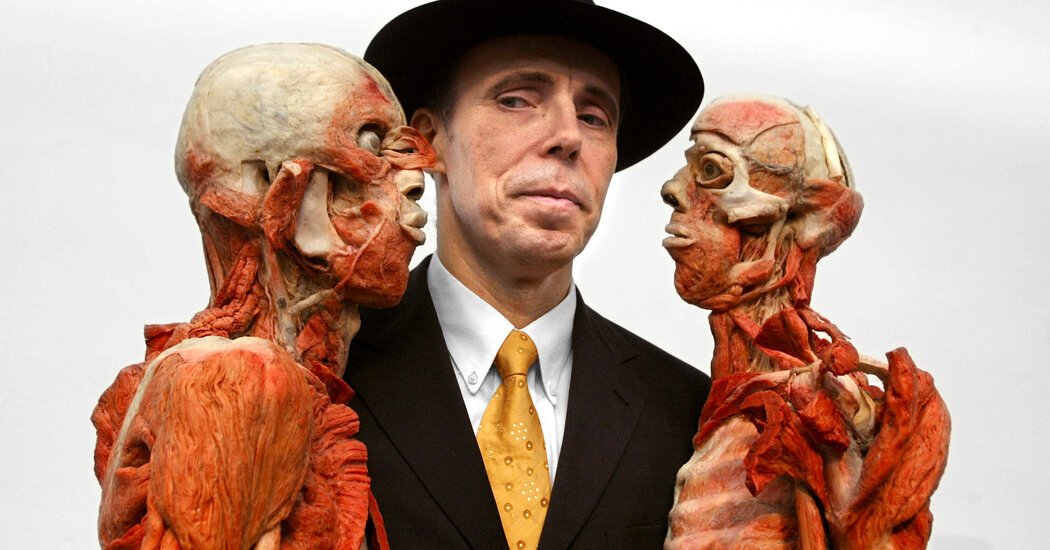
Gunther von Hagens, a German scientist whose traveling exhibitions of human corpses, flayed to expose bones and muscles and positioned as if caught in the middle of everyday activities — dancing, running, copulating — drew tens of millions of eager viewers along with vociferous criticism from religious and human rights groups, died on July 24 in Heidelberg, Germany. He was 81.
Rebecca Brewer, his personal assistant, said the death, in a hospital, was from a cerebral hemorrhage. Dr. Von Hagens had been diagnosed with Parkinson’s disease in 2008.
Since his first show, “Body Worlds,” debuted in Tokyo in 1995, Dr. Von Hagens’s exhibits have drawn more than 50 million visitors — to traveling presentations in dozens of countries and to permanent installations in Germany, the Netherlands and the United States.
Using a process called plastination, which he developed in the late 1970s, Dr. von Hagens removed a body’s skin and fat; replaced its fluids with a sturdy plastic material; arranged it in a lifelike position; and finally hardened it with heat, light or gas in a specialized chamber.
It took Dr. von Hagens and his team hundreds of hours to process each body, a procedure carried out across a constellation of sites that he maintained in Germany and China. Along with humans, he also worked on large animals — one of his most famous figures, “Horseman,” involves a rider atop a rearing horse, both skinless.
Early on, Dr. von Hagens acquired bodies through medical schools. Later, as his fame grew, he attracted thousands of donors eager to see their bodies preserved for the public good.
“There are times during this exhibition when you even feel a deep appreciation,” the critic Edward Rothstein wrote in a 2013 review of a “Body Worlds” show for The New York Times. “You are actually seeing the forces of life on display in this dead matter, and those forces are extraordinary.”
Not everyone agreed. Whether the public good was actually being served was a central piece of the controversy that dogged Dr. von Hagens.
There was, of course, a basic squeamishness at the spectacle of a hall full of skinned corpses, one step removed from a horror film. At times, “Body Worlds” evoked intense reactions: One man attacked a body at a show in London with a hammer.
Many religious leaders objected as well — especially in Germany, where memories of human experiments and bodily desecration under the Nazi regime remained fresh.
“‘Body Worlds’ is possibly the logical conclusion of Nazi crimes,” Andreas Nachama, a rabbi and civic leader in Berlin, told The Independent in 2001, “when millions of bodies were burnt by their murderers into cinders or transformed into soap, and their skin into lampshades.”
He also faced accusations of accepting bodies of executed prisoners from China, though there was no evidence he knew the source. He later barred his team from using bodies from China and instituted a strict protocol for accepting donated specimens.
“Body Worlds” and its spinoffs are a for-profit enterprise, and while Dr. von Hagens insisted that he was “democratizing” anatomy and strengthening the public’s understanding of medical science, some people criticized his shows for being light on information and high on shock value.
He certainly had a flair for the limelight. In 2002, he staged Britain’s first public autopsy in almost 200 years, in defiance of government warnings that such a display was illegal. But he was not prosecuted, and the event was later broadcast on TV.
Critics nicknamed him Dr. Death and compared him to Josef Mengele, who conducted experiments on prisoners at the Auschwitz-Birkenau extermination camp. It may not have helped that, in his ever-present black fedora, Dr. von Hagens resembled Arnold Toht, the Nazi agent played by Ronald Lacey in “Raiders of the Lost Ark.”
Dr. von Hagens said he wore his signature hat as a homage to Rembrandt’s 1632 painting “The Anatomy Lesson of Dr. Nicolaes Tulp,” in which Dr. Tulp, shown examining the musculature of a corpse’s arm in front of colleagues, is also hatted.
And he insisted that his critics misunderstood his intentions.
“I do not see this as a room full of corpses or as a hall of death,” he told The Times in 1998. “What this does is build bridges back to your own body. When you look at the models, you can recognize yourself as a member of the human species. Your humanity becomes clear.”
Gunther Gerhard Liebchen was born on Jan. 10, 1945, in Skalmierzyce, a city in German-occupied Poland. When he was just a few days old, his parents — Gerhard, a cook for the SS, and Gertrud (Knaack) Liebchen — placed him in a laundry hamper and fled west, ahead of the advancing Soviet army. They settled in the city of Greiz, in what became East Germany.
When Gunther was 6, he hit his head on a door. He bled heavily, the result of undiagnosed hemophilia. He spent six months in the hospital, where he developed an interest in medicine. After high school, he worked as a nurse before studying medicine at the University of Jena.
He participated in protests against the East German Communist government and was imprisoned in 1969 for trying to flee into Austria. The next year, the West German government paid for his release and return, something it frequently did for political prisoners.
He finished his medical studies at the University of Lübeck in 1973 and, two years later, received a doctorate in anesthesia from the University of Heidelberg.
He married Cornelia von Hagens in 1975. Uncomfortable with his surname — Liebchen is an old-fashioned endearment in German — he took hers. They divorced in 1989. In 1992, he married Dr. Angelina Whalley, a physician and the creative director for “Body Worlds.”
Along with her, Dr. von Hagens is survived by three children from his first marriage, Rurik, Bera and Ton von Hagens; and six grandchildren.
When Dr. von Hagens revealed his Parkinson’s diagnosis, in 2011, he said that when he died, he wanted his body to be plastinated and put on display at the entrance to one of his exhibits — wearing his fedora, of course.

