
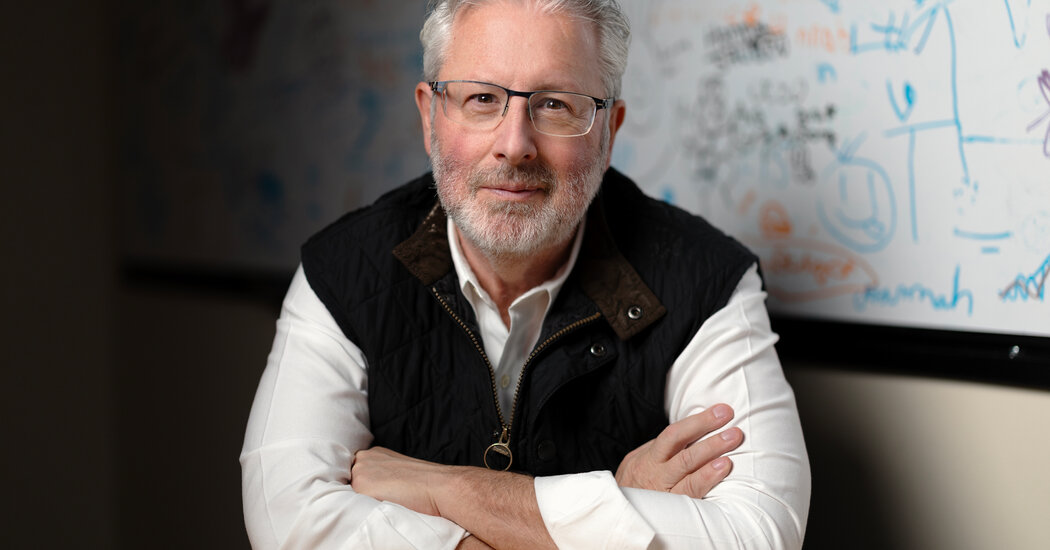
Neil Shubin, a renowned evolutionary biologist at the University of Chicago, will become the new president of the National Academy of Sciences on July 1, just as the Trump administration is slashing funding for research and seeking to impose greater political control over scientists and their work. He spoke to The New York Times about the state of American science and his hopes for his five-year term as president. This conversation has been edited for brevity and clarity.
In 1863, Abraham Lincoln signed a law to create the National Academy of Sciences, saying “the Academy shall, whenever called upon by any department of the government, investigate, examine, experiment, and report upon any subject of science or art.” What’s its mission today?
If you think about that moment when Lincoln founded the National Academy of Sciences, that was several months before the Battle of Gettysburg. That was at a real existential moment for the country. And here were Lincoln and his advisers looking forward.
What they did — and I think what’s relevant today, over a century and a half later — is that they defined an independent, nonpartisan resource for the government and the general public to weigh in on scientific advice and to say what the science says on any issue that the government finds important.
You have a busy schedule as a scientist, looking for fossils and studying how embryos develop. So why take on this new job?
This is a hugely consequential moment for American science and, by extension, American society. We’re seeing disruptions to our longstanding model of science, both through actions of the government as well as A.I. We’re seeing disruptions of how science is communicated in the public sphere, with algorithmic partitioning into tribal groups.
We’re living in an extraordinary time of disconnect. We rely on science and the advice that comes from science, yet the whole apparatus that enables us to do that is under unique challenges. And that, to be quite honest, is what has attracted me to this job. To some extent, taking this job is a bet, or maybe a hope, that the best science will drive the conversation over the long run.
So what are your goals as president?
One of my tasks is to really open ourselves up to the general public in a way that can inform the public conversation much more broadly.
And we could be a source for data that’s disappearing. I mean, 380 federal databases have been disappearing in the last year and a half.
We can be at the center of discussions for a new approach for the coming decades of discovery and innovation. What’s the ecosystem that’ll best promote discovery and innovation in our society? In an age of A.I., in an age of hyperpartisanship, what can we do? Those are the puzzles and challenges that we’re going to have to figure out as a society.
Last summer, you signed an open letter to Congress, along with over 1,200 other members of the National Academies of Science, Engineering and Medicine, calling on Congress to reject the Trump administration’s proposed cuts to science funding. The letter warned that the reductions might lead to “economic decline, weakened U.S. competitiveness, disruption of our educational system, loss of scientific talent and threats to public health and national security.”
Do you foresee acting on those concerns as president of the academy?
As an institution, we are — by charter and design and history — nonpartisan. But we are in a deeply partisan age. Just by doing our work, we will be viewed in a partisan light no matter what. So our job is to double down on the science. We need to be a trusted source of data.
The Environmental Protection Agency has rolled back the government’s position that climate change endangers human health. When the agency first announced its plans last year, the academy produced a detailed report reaffirming the threat. Representative James Comer, Republican of Kentucky, attacked the academy over its report, accusing it of having a “partisan bias.”
Will the academy be continuing to carry out this work even if they draw accusations of bias?
We have to — that is our job. We have to bring the best science to bear to the problems that our society faces. But we have to be fearless about calling the balls and strikes. And we have be fearless about the consequences derived from that.
Congress refused to pass the White House’s proposed cuts to science research into law. But the Trump administration is now stalling thousands of grants. It is laying off government scientists. And it is proposing deep cuts for next year’s budget. In your view, what’s the state of science as you take on this new job?
I would say the state of science is highly disrupted. There are definitely morale issues. I’m running a lab right now. I have young scientists. I talk to them every day. They’re worried about their future. And some days it’s hard for them to keep their head up. But most days they are keeping their head up, because they’re feeding their curiosity and learning about nature.
Earlier this month the administration released draft regulations that would give political appointees the final word on research grants, not scientific peer review. The White House says that from now on, grants must “demonstrably advance the president’s political priorities.”
The rules would also limit the subjects that scientists could investigate. American scientists would face hurdles working with foreign colleagues, and they would even have to get permission to go to some conferences. What do you think about the new rules?
Evaluating the quality of research needs to be based on merit, not politics. If you take the most extreme interpretation of this rule, it would put a layer of partisan alignment with a particular president’s agenda over any other assessment.
Do we really want research on Alzheimer’s or water quality or transportation safety to be evaluated by politics and partisanship, or on merit? I think it’s obvious that the more we dial up merit and dial down partisanship in the assessment of science, the better off we’ll all be.
With regard to the international piece, it would put scientists in a bind. So many of the breakthroughs that American scientists have done over the years have been with international collaborations. Other nations are investing in major infrastructure — telescopes and icebreakers and so forth. It would be tragic for U.S. scientists to lose access to those resources.
Your predecessor, Marcia McNutt, has urged scientists to focus on applied research and said universities need to better understand the needs of industry.
Your research is about fossils and embryos and evolution. So how do you see the balance between basic science, like the science you do, and the applied science that might make a practical difference in our lives in the near term?
Curiosity-driven research is really the seed corn for the major breakthroughs and applications. But it’s also important in its own right, because discovery and the expansion of knowledge are virtues in themselves.
Seeing the history of life, the structure of the universe or people going to the moon — that engenders wonder and awe, and in some cases, national pride. These forces are very powerful.

