
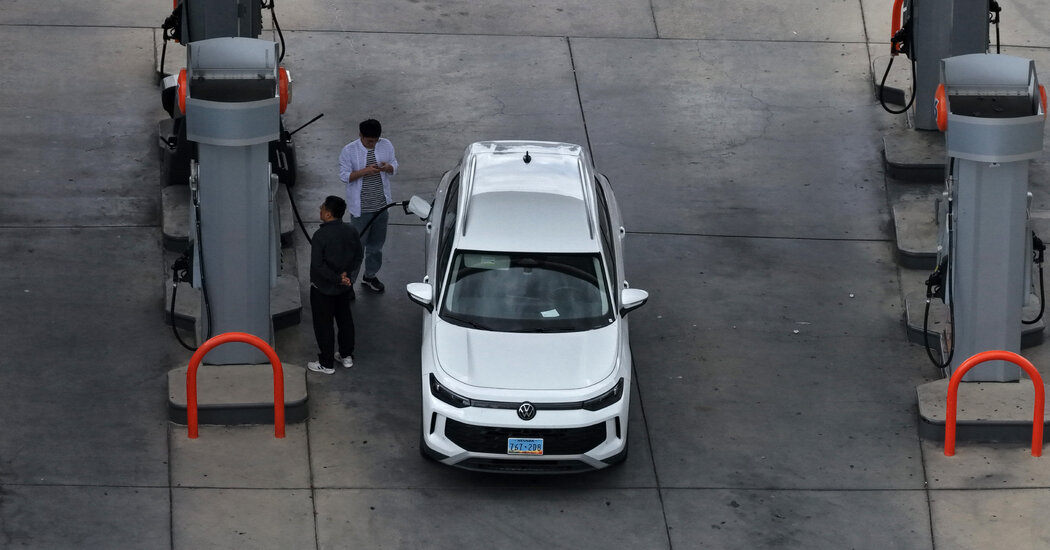
President Trump this week proposed suspending the 18.4-cent-a-gallon federal tax on gasoline in an attempt to bring down pump prices. But that is unlikely to rein in fuel costs by that much, and it’s not even clear that Congress would go for it.
The federal gas tax makes up a small amount of the total price that drivers pay at the pump — around 4 percent right now. The national average for regular gas was $4.50 a gallon on Tuesday, up more than 50 percent since the U.S.-Israeli war against Iran began.
Here’s what you need to know about Mr. Trump’s proposal.
What is the federal gas tax?
The federal fuel tax was meant to be temporary when President Herbert Hoover signed it into law in 1932 to help pay for national defense spending. But persistent budget deficits kept it in place, and the money it raises is used for road maintenance through the Highway Trust Fund.
The tax rate has not changed since 1993. The federal tax rate for diesel is slightly higher, at 24.4 cents a gallon.
Because the tax rates on gas and diesel have not changed for decades, the revenue they raise does not come close to meeting road maintenance needs. As a result, Congress often uses additional funds to pay for the federal government’s share of road maintenance.
“The idea is funding highway maintenance, but it doesn’t quite fund highway maintenance,” said Ted Kury, the director of energy studies at the University of Florida’s public utility research center. “Periodically, you’ll find that the government makes additional contributions.”
How much would it save drivers at the pump?
A suspension of the tax would not necessarily mean a gallon would cost 18.4 cents less for drivers.
The fuel is generally taxed at a terminal before it’s distributed to gas stations, which makes it easier for the federal government to collect.
If drivers see any relief, “it’s going to have to be because that producer is then reducing the price that it charges to the gas station,” said Michael Negron, an economics fellow at the Center for American Progress, a research group.
“I would think that there would be some reduction — it’s not clear that it would be in the exact amount” of the suspended tax, said Mr. Negron, who worked on economic policy in the Biden administration.
In March, the Institute on Taxation and Economic Policy, another research group, estimated that suspending the tax would reduce federal revenue by $2.4 billion a month, and save families earning less than $53,000 a year about $5 a month.
Mr. Trump acknowledged on Monday that the drop would be slight. “It’s a small percentage,” he said, “but it’s, you know, it’s still money.”
Suspending the tax could also have other consequences. If the federal government did not replace the forgone fuel tax revenue, there would be less money to repair highways, ultimately causing more wear on cars.
Have fuel taxes been suspended before?
While several administrations have proposed suspending the tax, presidents need Congress to approve the action — and that has never happened.
In 2022, when gas prices spiked after Russia’s invasion of Ukraine, President Joseph R. Biden Jr. asked lawmakers to temporarily remove the tax. But lawmakers in Congress said it was a bad idea.
“Like moving anything in this Congress, you’re going to need the votes to do it,” Mr. Negron said. “Nobody wants to create a hole in the Highway Trust Fund, and you also have the fact that you can’t guarantee that it’s going to result in lower prices.”
But, Mr. Negron added, lawmakers may decide to suspend the tax if prices keep rising.
What else is making gasoline expensive?
States can also tax gasoline, and federal and state taxes made up, on average, about 18 percent of the cost of regular gasoline in January, according to the Energy Information Administration. By far the biggest factor is the cost of crude oil, which accounts for more than half of the total.
But state taxes vary, and can add a huge burden for some drivers. As gas prices have soared, some states, including Indiana, have suspended their fuel taxes. States have also allowed for the sale of winter-blend gasoline, which tends to be cheaper than summer blends, at other times of the year. But many refiners had already switched to summer blends, which produce less pollution than winter blends when burned.
Local competition and refining and distribution costs also contribute to prices at the pump. The biggest factor, for now, is how long the war chokes off energy supplies from the Persian Gulf.
“The most important thing that could be done is just a speedy resolution of this conflict,” Mr. Negron said.

