
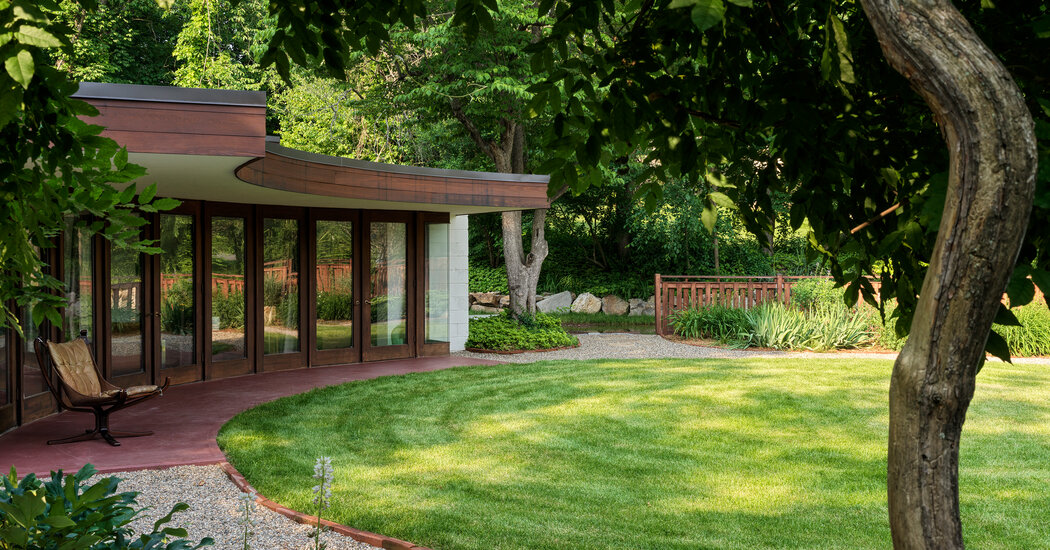
IN 1956, THE University of Massachusetts professor Verda Dale commissioned a local architect named John Bednarski to design a house for her in Amherst. Back then, Bednarski, who died two years ago at 96, was known for taking inspiration from the work of Frank Lloyd Wright, whose post-Depression Usonian homes helped give rise to a whole generation of single-story, energy-efficient, affordable houses around the country. For Dale, Bednarski envisioned a place modeled after Wright’s Solar Hemicycle, a south-facing, semicircular subtype that Wright built into a raised mound of land in Middleton, Wis., in the mid-1940s. In the winter, the house’s concrete floor would absorb sunlight through the glass facade, reducing heating costs; during the summer, the dramatic overhang of the rubber roof would keep the rooms shaded and cool.
Dale, who taught home economics, lived there alone for decades, hosting Christmas parties, practicing ikebana and growing orchids in the back greenhouse. In the 1970s, she taught for six years at the University of Hawaii; after returning to Amherst, she rehired Bednarski to redo the building’s roof (it had chronic rot issues) and continued to live there until her death nine years ago, at 101.
THAT WOULD’VE BEEN the end of the story if Eric Olsson hadn’t come across the property — his girlfriend discovered the listing online — and purchased it in the fall of 2022. A Brooklyn-based marketer with an interest in restoration projects, Olsson, now 59, soon obtained his general contractor’s license and then approached his new house like an archaeology project, trawling through the remnants and saving all that he could. Several walls and floors had been heavily damaged a few years earlier when a pipe burst and flooded the house, and “because nobody did anything about it, there was mold,” he says. “I basically stripped everything out,” salvaging Dale’s old Japanese ceramics and Hawaiian koa wood bowls. For the reconstruction that followed, Olsson consulted Bednarski’s blueprints as well as boxes of slides that documented changes made over the years. To preserve the original redwood planks that formed several interior walls, he numerically cataloged all the pieces so that, after replaning and refinishing them, he could puzzle the boards together in their precise order. “Anytime I could reuse the wood so it didn’t go to waste, I did,” he says.
Yet Olsson’s 1,250-square-foot, single-story, open-floor plan two-bedroom house is less a restoration than a reimagining, as he considered how someone might live in a midcentury home today. First he opened up the space between the living room and the kitchen by removing a dining table that once awkwardly jutted into the pathway. The dining area is now on the left side of the living room as you enter the home, where a sewing corner once was; he took out some walls to expand the eating space and added a built-in wooden banquette in a nod to Usonian living, which often integrated furniture into architecture.
The banquette, along with a bathroom vanity, a folding kitchen counter and an entryway bench and shelves, was made partly from redwood reclaimed from the house’s fascia, the long horizontal strip between the roof and the exterior wall, which had been damaged by carpenter bees and woodpeckers. Most of the other furnishings are a mix of Olsson’s own and midcentury pieces of Dale’s that he was able to preserve: An Arthur Umanoff spindle table in the primary bedroom that once belonged to Dale resembles the living room’s 1960s Andre Bus coffee table, which the current homeowner purchased himself; his old Plycraft chair in the living room complements Dale’s compact wooden outdoor chairs, which he recently restored.
“Everything is as period as I can get,” he says — except for the kitchen, which was completely damaged (“the original cabinets sucked up all the water”), and where he didn’t feel guilty about replacing the Formica countertops with granite ones, then installing modern appliances. A hallway to the left of the kitchen is flanked by two bedrooms: one for Olsson facing the 65-foot-wide circular front garden, and the other for guests. Next to the latter is the home’s one bathroom, where he installed glazed white tiles from Inax, the Japanese company that made similar ones for Wright’s 1923 Tokyo Imperial Hotel. At the end of the hallway is Olsson’s office.
Once the interior was finished, he turned his attention to the garden, where Olsson identified original plantings from Dale’s sketches that have survived to this day, including wisteria vines, an azalea and an ailing apple tree that he’s trying to save. He also replenished Dale’s lotus pond: The lotuses had died from neglect and the water was overgrown with cattails, but in 2024 his neighbor across the street told him to come collect some double-flowered pink lotus rhizomes that Dale had once given her.
As a contractor, Olsson doesn’t usually live in his projects — he recently renovated a downtown Manhattan loft for a client and is working on another — but after completing this one two years ago, he decided to move in. He’s currently learning how to grow his own plants in the greenhouse, and he recently found Dale’s handwritten recipe cards and wants to perfect her flaming peach pie. He uses her wooden salt and pepper shakers almost daily. “I feel like I’m living in somebody’s time capsule,” he says. “I’ve become very protective of it.”

