
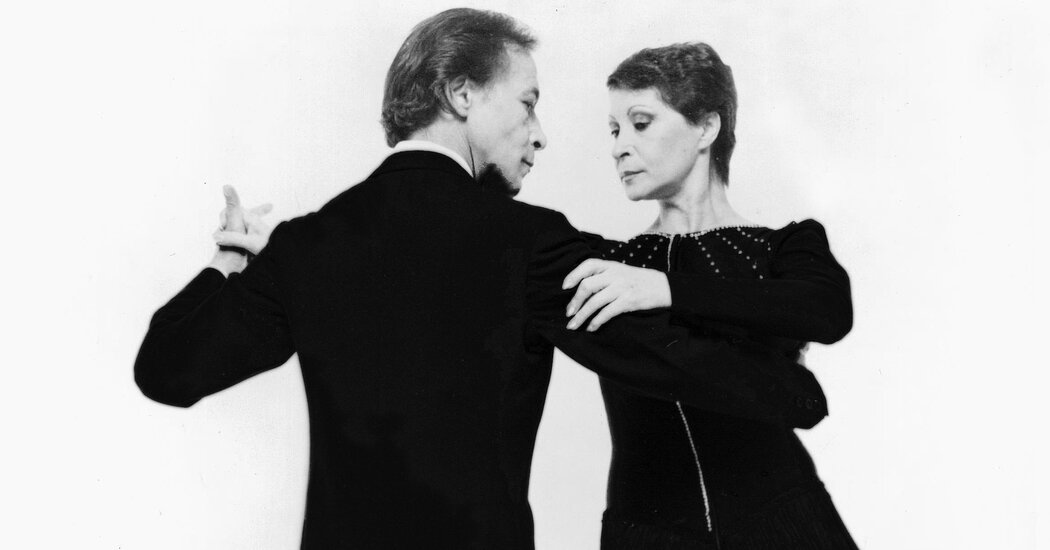
María Nieves Rego, who with her dance partner and onetime husband, Juan Carlos Copes, formed a duo that, despite their often painful personal relationship, helped spark a tango revival in Argentina that spread worldwide, died on April 19 in Buenos Aires. She was 91.
Her death was announced by the Argentine Association of Actors and Actresses, which did not specify a cause or say where in the Argentine capital she died.
The Fred Astaire and Ginger Rogers of tango, Mr. Copes and Ms. Nieves (who dropped her surname as a professional) began dancing together in the milongas — dance events or dance halls — of working-class Buenos Aires in the late 1940s.
With the ambitious, controlling Mr. Copes leading the way, they went on to develop a new style that became known as “estilo Copes-Nieves.” It blended the romance and elegance of tango — traditionally an intimate, improvisational social dance — into a choreographed, stage-worthy spectacle, complete with furious footwork and athletic lifts.
For roughly a half-century, Ms. Nieves and Mr. Copes were recognized as international ambassadors for the art form. They reached their pinnacle with “Tango Argentino,” a stage production that premiered in Paris in 1983 and became a sensation in Europe and Asia before landing on Broadway in 1985, where it earned critical raves and several Tony nominations.
The show featured several pairs of dancers exploring the history of tango and its varieties. But Ms. Nieves and Mr. Copes were the undisputed stars who, as the critic Anna Kisselgoff wrote in her New York Times review, “give us the tango as pure form.”
“Tango Argentino” shattered the old Hollywood stereotypes of tango — the “swoop-and-dip image or its cheek-to-cheek slinking variant,” Ms. Kisselgoff wrote. “Nothing could have prepared the lay audience for the entangled legs, the brilliant kicking and brisk footwork, the twists.”
The energetic production was credited with inspiring a worldwide renaissance for the genre, with tango clubs sprouting up in cities all over.
“It was like a revolution,” Ms. Nieves recalled in “Our Last Tango,” a 2015 documentary about her and Mr. Copes. “Tango-mania!”
But it wasn’t all triumphant for Ms. Nieves, as her initial love affair with Mr. Copes turned into a turbulent relationship, including a fraught nine-year marriage marked by her husband’s infidelities.
“All my anger, all my pride was thrown onstage,” she recalled in a 2003 interview with the website Todo Tango. “Many people who did not know what was happening told us, ‘It’s quite noticeable, your passion when you dance.’ Yes, the passion of hate.”
María Nieves Rego was born in Buenos Aires on Sept. 6, 1934, to poor immigrant parents from Galicia, in northwest Spain. Her father, a milkman, died of tuberculosis when she was young, and by 12 she had left school to work with her mother as a maid.
Her first exposure to tango was hearing the music on the radio; she began practicing steps by dancing with a broom. She was in her early teens when she first spotted Mr. Copes, who was three years her senior and studying to be an electrician, at a local dance hall.
He initially focused his attention on her older sister. Still, Ms. Nieves recalled: “I liked the way he looked. Butterflies in my stomach.”
Interviewed for the documentary, Mr. Copes was not quite so sentimental. “I realized she was what I was looking for, for my height and the way I moved,” he said. “At that moment I knew, I’d found my Stradivarius.”
They refused to be confined by the traditional parameters of tango. Instead, they found inspiration in the exuberant, athletic moves on display in exuberant Hollywood musicals like “Singin’ in the Rain.”
“We went at least five times,” Ms. Nieves recalled of that classic 1952 film. “We came out of there and thought we were Gene Kelly and Cyd Charisse.”
Although they lacked formal training, they excelled in competitions held throughout Argentina. In 1955, they scraped together enough money to rent a theater and mount their first revue, a forerunner of sorts to “Tango Argentino.” The success of that show led to an invitation to perform at a more prestigious theater in Buenos Aires.
But even as they made a name for themselves, tango itself was in crisis, losing popularity among Argentine youth to rock ’n’ roll and other modern forms. A new direction was needed.
Mr. Copes “always said that tango had to be about more than just going to a milango,” Ms. Nieves recalled in the documentary. He insisted “that it could be something worldwide.”
They created Compañía Argentina Tangolandia, known as Tangolandia, a traveling revue featuring music by the composer Astor Piazzolla that showcased Ms. Nieves and Mr. Copes’s new style of tango, which was also often called tango escenario, or stage tango.
By 1959, they were touring the world. In the early 1960s, they made multiple appearances on “The Ed Sullivan Show,” and over the years opened for the likes of Frank Sinatra and Danny Thomas.
They married in Las Vegas in 1964, although Mr. Copes, by his own admission, was not cut out to be a one-woman man.
“As a human being, I always respected her, totally,” he said in the documentary. “The fact that I had weaknesses on the other hand, I think that’s natural. Otherwise, I wouldn’t be a man.”
As the years passed, their personal relationship devolved, even as their professional life together flourished. “We cursed each other when we danced,” Ms. Nieves said, “but nobody noticed.”
She eventually learned that Mr. Copes had fathered a child with another woman. The marriage ended in 1973, and Ms. Nieves had to decide whether to continue with their dance partnership.
“I had to choose,” she said, “and I chose tango.”
Mr. Copes eventually started a family with the other woman, but he and Ms. Nieves continued to dance together until 1997, when he set out on his own. (They reunited in 1999 for a Broadway revival of “Tango Argentino.”) He died in 2021 from complications of Covid-19.
Complete information about her survivors was not immediately available.
Even during her most tumultuous stretches with Mr. Copes, Ms. Nieves found ways to channel her anger. “I was hurt,” she said, “but that helped me to rise a bit higher, because I was always beneath him. I said to myself: ‘I’ll show you. I’ll mop the floor with you onstage.’”

