
A popularity contest is replacing the Venice Biennale’s Golden Lion awards.
The event’s top awards, usually given by an expert jury, are typically thought to bestow a place in art history to winners. But this year the winners will be chosen by the public, because the panel of experts resigned last week after months of pressure on the Biennale for allowing some countries embroiled in violent conflicts to participate, including Israel and Russia.
The international art event hasn’t always given top awards: A 1968 student protest led to a nearly two-decade pause on the tradition. But winners have included Jasper Johns (1988), Marina Abramovic (1997) and Simone Leigh (2022). In the most recent edition, in 2024, a group of New Zealand artists known as the Mataaho Collective won a Golden Lion, as did the Australia pavilion’s exhibition for the artist Archie Moore.
Here’s what to know for this year’s prizes.
How does this year’s voting work?
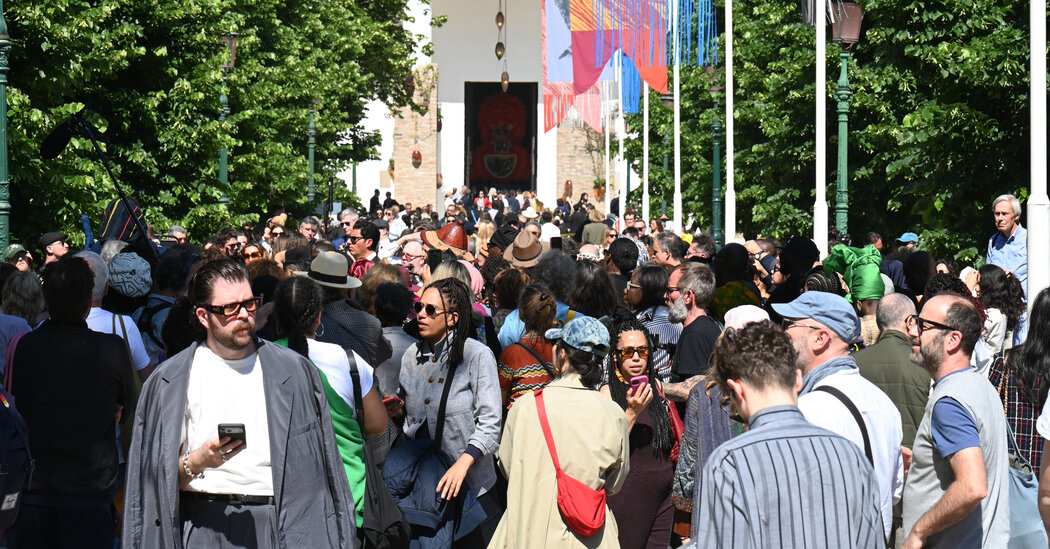
According to the Venice Biennale Foundation, which administers the awards, visitors are eligible to vote if they have visited both exhibition venues at the Giardini and Arsenale, which house the centerpiece exhibition and the national pavilions. Eligibility will be verified through a ticketing system, and each ticket holder may cast one vote for each of the two awards.
The Biennale said in a statement that it would present two Visitors’ Lions because of the jury’s resignation and “the exceptional nature of the current international geopolitical situation.”
The statement emphasized that all national participants included in this year’s Biennale are eligible for the awards, “following the principle of inclusion and equal treatment among all participants.”
Why did the jury resign?
Last week, the five-member prize jury resigned amid backlash over its decision to exclude artists from countries whose leaders were being investigated by the International Criminal Court for crimes against humanity, and after the artist representing Israel said he was considering legal action.
The Biennale often reflects the geopolitical state of the world, and during this year’s previews have already been demonstrations supporting Palestinians and protesting the inclusion of the Russia pavilion, which many European countries, including Italy, have criticized because of the continuing war in Ukraine.
What could go wrong?
The voting will use technology that was established for entry into the Venice Biennale, but this is the first time that the art event is administering a public choice award in this format.
There are concerns that it could be susceptible to vote rigging or to government influence, which has been an ongoing concern for the Eurovision Song Contest. Last year, Eurovision updated its voting rules to “discourage disproportionate promotion campaigns,” according to the European Broadcasting Union, which hosts the event, “particularly when undertaken or supported by third parties, including governments or governmental agencies.”

