
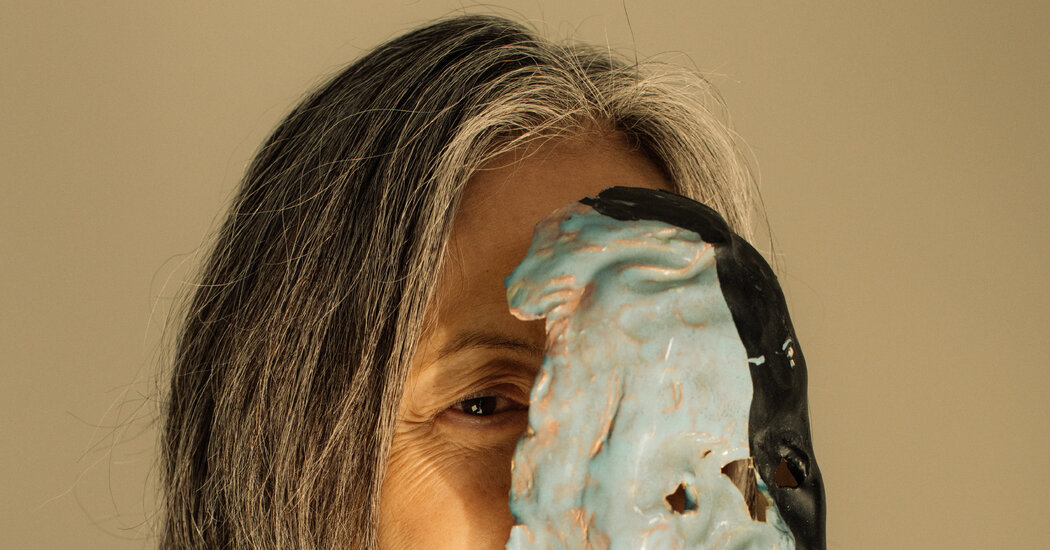
In October 2019, Matthew Wong, 35, was just gaining recognition as one of the most impressive painters of his generation when he took his own life. Afflicted by severe depression, Tourette’s syndrome and autism, Wong had relied on the constant support of his mother, Monita Wong, who procured his paints, found him a studio in Edmonton, Alberta, where he lived with his parents, and cajoled him into traveling with her when he seemed exhausted by too much work. She took it as her mission to run interference between him and the world.
“I was the first one to see the paintings,” she recalled in a recent video interview from Edmonton. “He would always say, ‘What do you think, Mom?’ His entire life, he needs reassurance every single day.”
Despite his insecurities, or perhaps because of them, Wong produced hundreds of extraordinary works in a painting career of not quite seven years. His artistic afterlife has soared, as his exuberantly colored works entered the collections of the Metropolitan Museum of Art, the Museum of Modern Art and the Guggenheim Museum, among others. And his auction prices have ascended to jaw-dropping heights: “River at Dusk” (2018), a vivid landscape with lollipop trees and a green path that twists toward a sunset sky, sold at auction in 2023 for a record $6.6 million.
From May 6 until Nov. 1, “Matthew Wong: Interiors,” a show of 39 paintings and drawings, many previously unexhibited, will be displayed at the 16th-century Palazzo Tiepolo Passi in Venice, alongside the Biennale, in the city where Monita Wong said her son decided to become a painter. (It will travel about a year later to the Louisiana Museum of Modern Art, near Copenhagen.)
As the title indicates, the exhibition concentrates on moody indoor scenes. “I felt it showed another side to his works that hadn’t been seen or celebrated or understood,” said John Cheim, an art dealer and the show’s curator, who had advised Wong. “They had a psychological edge to them. It shows the solitary, introspective aspect of his work.”
That feeling of loneliness is present in such landscapes as “End of the Day” (2019), a gift from the Wongs that entered the Met collection in 2023. It features a small figure standing by the waterside in front of a blue forest and beneath a jagged crescent moon that hangs in a sky of banded orange and black. Lesley Ma, associate curator of Asian art at the Met, recalled, “It quickly became a crowd favorite,” adding, “It’s mysterious. It gives off a feeling of yearning and longing that is something people can relate to.”
Confronted with the brutal fact of Matthew’s sudden death, his mother resolved to safeguard his legacy. Within a few months, she was scouting possible sites for a foundation headquarters in Edmonton with her husband, Raymond Wong, who is her partner in a successful textile business in China. She came upon an empty lot with two tall Colorado blue spruces that caught her attention, in part because a spruce, which she dubbed “Matthew’s tree,” towered outside the condominium where the family lived. It appears in many of his paintings.
The new two-story headquarters for the Matthew Wong Foundation was fully installed in June 2025. Although the foundation is already open by invitation to scholars and artists, in summer 2028 it will start to accept a limited number of people who apply on the website.
Along with a selection of Wong’s works, visitors will be able to see his studio, which Monita, anxious that the lease on the rented space might someday be terminated, moved to the foundation. She intended to have a curator oversee the transfer. “The minute she picked up a tube of paint, I felt uncomfortable, as if she was touching my body,” Monita recalled. “I figured I could move it all myself.”
“We took everything from the old studio,” she added. “The door, the light switch, the venetian blinds.” Inspired by the Louise Bourgeois townhouse in the Chelsea district of Manhattan, which looks as though the artist has just gone out to buy a cup of coffee, she brought over Matthew’s eyeglasses, razor, toothbrush, cigar-tasting competition trophy, golf clubs and bottles of iced tea — all placed as he left them. Although an outsider might see only random clutter, Monita said that her son knew where to find whatever he looked for. Autistic people often have exceptionally precise recall, she said. “They can remember a lot of things.”
Like Vincent van Gogh near the end of his life, Wong was extraordinarily productive, turning out at least one and as many as five paintings in a day. In addition, soon after waking, he would make a drawing in ink or gouache. “The works on paper are really his breakfast,” his mother said. Self-taught, he imbibed the influences of myriad artists: Western modernists such as van Gogh, Edvard Munch, David Hockney, Joan Mitchell, Yayoi Kusama and Peter Doig; and 17th-century Chinese masters, especially Bada Shanren and Shitao, whose custom of situating a small figure in a natural scene he adopted.
Wong is best known for his fantastic landscapes, for which he typically used brilliant, unmixed colors straight from the tube to compose stippled patterns that represent mountains, horizons, skies, fields and suns. In 2024, the Van Gogh Museum in Amsterdam mounted an exhibition of his canvases alongside those of van Gogh, one of his heroes.
“There are similarities in the brushstrokes, but also the deep personality that is communicated directly,” said Joost van der Hoeven, a research associate at the museum who organized the show. “There is a desolate loneliness that you feel in Van Gogh’s work, and also in Matthew’s. The border between their personal lives and what they turn out as artwork is super thin.”
Born in Toronto to natives of China, Matthew, an only child, moved with his parents to Hong Kong when he was 7. At 15, he returned with them to Canada in search of better treatment for Tourette’s. Upon graduation in 2007 from the University of Michigan, with a major in cultural anthropology, he went back to Hong Kong, where he wrote and performed poetry and studied photography. After successfully applying for a position as a docent at the Hong Kong pavilion of the 2011 Venice Biennale, he encountered the work of Julian Schnabel and Christopher Wool. Deeply moved, he resolved to become a painter.
His early work is abstract, first in ink drawings, then in acrylic and oil painting. Once his parents obtained a studio for him in mainland China, he was able to work on a larger scale. He began to show and discuss his art with others, through social media. That is how he conducted his friendships, including one with Cheim. In 2016, Matthew traveled to New York with his mother and showed his ink drawings to Cheim, who bought one.
“He was a very attractive, tall figure, very well spoken,” Cheim said. “It was very refreshing the way he talked about art in general and not of himself. He was very direct and clear. I had no idea he was depressed. I had no idea he was autistic.” (Wong was diagnosed with autism in 2017.)
After New York, Wong and his mother traveled to Edmonton, where a close friend of Monita had moved from Toronto. They decided to settle there. “It’s a very small and quiet city,” Monita said. “He cannot stand Toronto. It’s way too crowded.” He liked to sit on a park bench overlooking the North Saskatchewan River and smoke a cigarette. At night, he would usually walk five minutes from the condo to the Cactus Club restaurant and order dessert.
But really, all he wanted to do was paint. “When he paints, there is no tics,” his mother recalled. “He focuses.” In 2017, the Dallas Museum of Art purchased a painting, and the next year, he had his first New York solo show, at the Karma gallery, which drew effusive praise in The New York Times, The New Yorker and New York Magazine. He was planning a second exhibition at Karma of blue paintings when he died. It opened posthumously.
Many works in the Venice exhibition bear the influence of Munch, especially the late self-portrait, “Between the Clock and the Bed,” and of the richly patterned interiors of Henri Matisse. A number depict landscapes or people viewed through an opening, womb-like or cavelike. The human figures are solitary, except for the occasional depictions of a mother with her child. “There are suggestions of repression and longing, these things he was struggling with,” said Maria Bueno, a private art dealer and a staff member at the foundation.
Although the foundation occasionally sells works to support its operation, Monita Wong is distressed by the acute upturn of Matthew’s market value following his death, which she attributes to speculation. In one instance, the art adviser Allan Schwartzman sold at auction, for $1.8 million, “The Realm of Appearances” (2018), which he had purchased two years earlier for $22,000. “I was totally devastated, because it was so soon,” Monita said. “It’s not an appreciation of Matthew’s work. It’s all about greed.”
(Schwartzman, in an interview, said that he rarely sells works but was leaving Sotheby’s and raising funds to start his own business.)
Wong’s death was horrifyingly unexpected. “He was very happy when he began to sell work that generates money for him and he doesn’t depend on us,” Monita said. “For me, my son is my whole life. I cannot eat or drink for almost a week. I was shocked for a long time.”
She was helped by a photograph Cheim sent her of a red bird that came every day and sat outside his bedroom window on Long Island. “I still have the picture of a cardinal bird on my phone,” she said.
While devoting most of her time to her son, Monita Wong said she needs to maintain a little distance. On the second floor of the foundation building, she incorporated two small bedrooms, for Raymond and herself. “I am reluctant to go back to the condo,” she said. When the owner of the lot next to the condo chopped down the spruce that Matthew loved, she brought the stump to the foundation building. “I could not stop them,” she said. “But I thought it would be good to have it here. It is outside now.”
If you are having thoughts of suicide, call or text 988 to reach the 988 Suicide and Crisis Lifeline or go to SpeakingOfSuicide.com/resources for a list of additional resources.

