
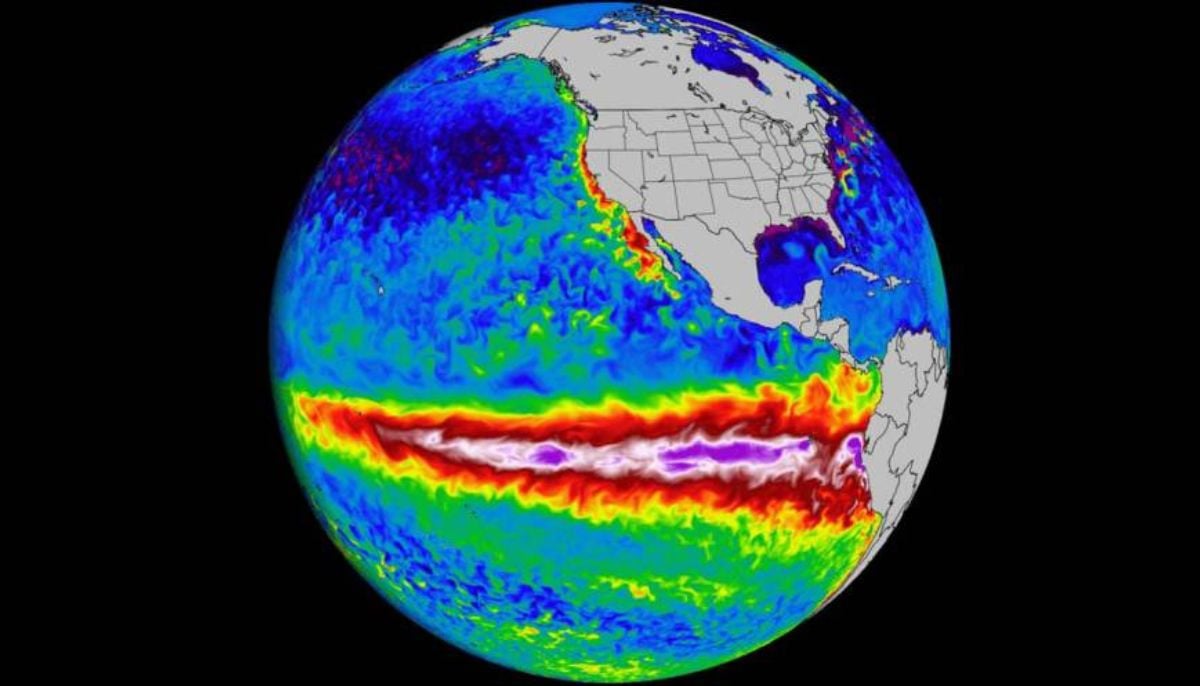
Meteorologists have warned that a rare “monster” El Niño is set to hit this summer, potentially becoming one of the most powerful such events since record-keeping began in the 1870s.
El Niño is a natural climate pattern that occurs when there’s an increase in the temperature of the sea surface in the tropical Pacific Ocean, recurring every two to seven years.
It is caused by the disruption of the usual pattern of air flow and the transport of warm water to South America’s coasts.
It usually happens when warm water from the western Pacific moves towards South America. Due to this shift, cold, nutrient-rich water from rising (upwelling) near Peru causes atmospheric temperature to rise, which ultimately changes atmospheric circulation and changes global weather patterns.
The data from the European Centre for Medium-Range Weather Forecasts (ECMWF) forecasts that there’s now a 100%% chance of a super El Niño forming by November.
The sea surface temperature is set to rise in the eastern Pacific to almost 3 degrees Celsius above average.
This threshold is the highest ever recorded. The planet has not seen an El Niño of such scale since 1877-78.
What this means for the weather
This super El Niño can trigger major global weather disruptions.
In New England, record-breaking summer warmth is anticipated, as well as more heat waves, higher humidity levels, and above-normal precipitation, owing to heavy rains from coastal storms.
During a typical El Niño period, hurricane formation in the Atlantic basin is limited by high wind shear, whereas storms increase in the eastern Pacific basin.
Winter conditions in the South may be wetter and snowier than average, while winter weather in the North may be milder and less humid.
Global Consequences
These weather disruptions can cause food shortages, water disruptions, and even civil conflict in vulnerable tropical countries.
New heat wave records are about to be set as potentially the biggest El Niño is about to hit.
