
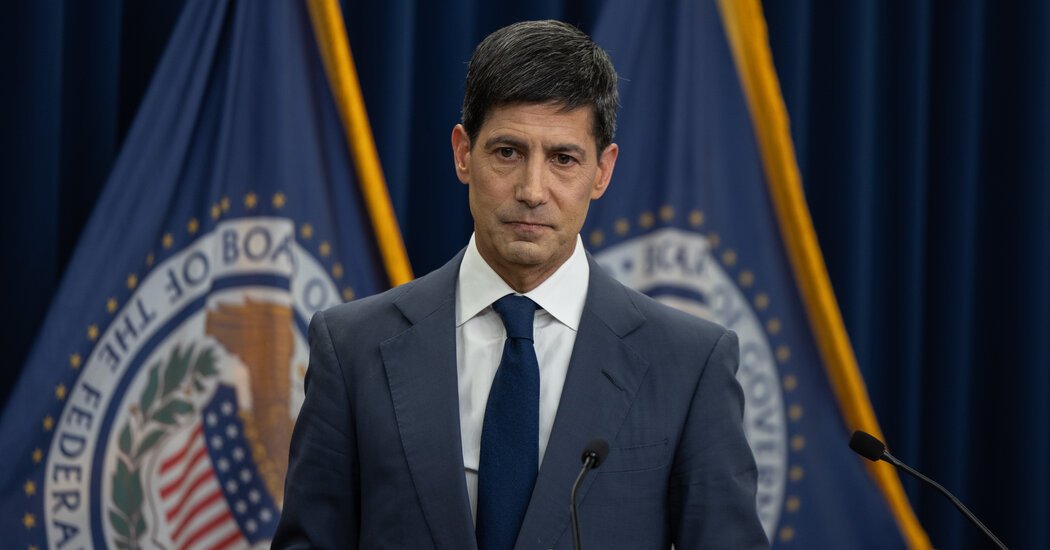
Kevin M. Warsh reiterated his commitment to bringing down inflation at his first congressional hearing since becoming chairman of the Federal Reserve. However, he has yet to indicate whether he supports higher interest rates to achieve that goal.
Mr. Warsh on Tuesday told lawmakers on the House Financial Services Committee that the central bank would set policy “right” such that “the inflation surge of the last five years will be a thing of the past.”
A pledge to deliver price stability was established last month at Mr. Warsh’s first policy meeting in the top job, at which officials voted unanimously to hold rates steady at a range of 3.5 percent to 3.75 percent.
“The members of our committee have no tolerance for persistently elevated inflation,” Mr. Warsh told lawmakers at Tuesday’s hearing. “And we share a resolute commitment to restoring price stability.”
During the hearing, Mr. Warsh explained that restoring price stability for Americans meant that “the change in prices is at such a level they don’t have to think about it, they don’t have to talk about it.”
“That is consistent with long-term Treasury yields being lower, and that’s also consistent with mortgages being more affordable,” he said.
But Mr. Warsh was less explicit about what it may take to effectively tame price pressures, even as he was pressed by Representative French Hill, the Republican from Arkansas who is chairman of the committee, about the risk of another policy error. Mr. Hill — who noted that the Fed had in the past wrongly assumed that it could ignore budding inflation, resulting in the post-pandemic surge — warned that while “upward pressure on prices may diminish on its own, it’s not a sure thing.”
Mr. Warsh acknowledged that the Fed could impact the trajectory of inflation over a longer time horizon by adjusting interest rates and making changes to its $6.7 trillion portfolio of government bonds and mortgage-backed securities. But he did not say how the Fed would use those tools in the coming months. Instead, he said that the Fed’s “resolute” commitment to making good on its promise would help the central bank fulfill it. He also said that the Fed would not “blame others” for missing on its inflation target.
“It’s a function of commitment, responsibility and tools,” Mr. Warsh said. “And we’re three for three, and we’ll deliver.”
Mr. Warsh’s first of two days of testimony this week coincided with the release of the latest measure of inflation, the Consumer Price Index report. The data showed that inflation in June cooled sharply as falling energy prices stemming from a temporary truce in the war with Iran dragged down the overall index. “Core” inflation, which strips out volatile food and energy items to give a better sense of the underlying trend, also eased by more than expected.
The data, which is among the final major releases ahead of the Fed’s next meeting at the end of the month, is unequivocally good news for the Fed. But it could prove to be short-lived now that fighting has resumed between the United States and Iran, resulting in oil prices again jumping higher.
On Tuesday, Mr. Warsh pushed back on the idea that the Fed should focus too much on one data point when asked about the latest inflation data. “There might be some who look at today’s data and say ‘mission accomplished,’” he said. “That is not my view.”
How inflation evolves in the near-term will have direct implications for how some officials think about the urgency around raising rates to get inflation back to the Fed’s 2 percent target. That target has been missed for half a decade.
The Fed’s focus on inflation stems partly from the fact that the labor market is on solid footing, as Mr. Warsh highlighted on Tuesday. “We’re seeing relatively few layoffs, only slight variance in the rate of job vacancies, and solid growth in nominal wages,” he said.
Expectations for a rate increase at the central bank’s meeting on July 28-29 fell sharply on Tuesday after the latest data. But the debate over the need for higher borrowing costs is likely to linger, partly because of Mr. Warsh’s unwillingness to provide explicit signals about the future path for policy.
During the hearing, Mr. Warsh was repeatedly pressed about his plans to scale back how much the Fed shares publicly. He sought to alleviate concerns that less transparency would mean less accountability, saying that any changes would not be about “hiding the ball.”
In the interim, however, Fed officials have instead filled the gap.
Christopher J. Waller, a governor, said on Monday that he would need to see several months of lower inflation data to feel confident in the trajectory of price pressures. If that pans out, he said, it would make sense for the Fed to continue holding rates steady. “Hot” or stronger than expected inflation data would buttress the case for imminent rate increases, he added.
Last week, John C. Williams, president of the Federal Reserve Bank of New York, suggested that monthly readings above 0.2 percent in the second half of the year for the Personal Consumption Expenditures price index, once volatile food and energy items are excluded, would point to a more persistent inflation problem that may necessitate the Fed taking action. That core index, which the Fed closely monitors, rose 0.3 percent in May.
An overarching concern for Fed officials is not just price pressures stemming from the war with Iran, which pushed inflation to a three-year high this summer. But it is also price gains stemming from soaring demand fueled by the build out of infrastructure for artificial intelligence. Prices for semiconductors, computer chips, servers and other items related to the proliferation of the technology have risen sharply this year.
Mr. Warsh has acknowledged these rising prices, but he has also previously argued that higher productivity in its wake will over time help to keep a lid on inflation even as economic growth accelerates.
On Tuesday, he described the rise of the technology as “perhaps the most significant change in our economy in my adult lifetime,” framing it as both a “huge opportunity” for the economy and one fraught with “risks and challenges.”
Mr. Warsh said it was not the Fed’s job to be “certain” about the exact ramifications of A.I., but he seemed overall upbeat about the impact.
“I don’t want to sound overly complacent about it,” he said, acknowledging some of the national security and other risks. “The long term can be quite far out, and we’ve got to monitor things month by month, quarter by quarter, as we get there.”
Mr. Warsh has directed a group of external advisers, which include the venture capitalist Marc Andreessen, to lead a task force looking into how A.I. is impacting productivity and the labor market. It is one of five such groups that he has created to examine issues core to the Fed, forming the backbone of his plans to enact regime change at the institution.
Task forces related to how the Fed communicates, its balance sheet, and the data sources upon which it relies have also been created, as well as one focused on the central bank’s understanding of inflation.
Mr. Warsh’s goal is for the task forces to complete their work by the end of the year, after which policymakers will weigh in on how to establish proposed changes.
Lawmakers on Tuesday also pressed Mr. Warsh on his willingness to defend the Fed’s independence after a series of attacks from President Trump and, most recently, the Supreme Court’s decision to differentiate the central bank from other independent agencies whose autonomy was gutted by a vote of 6-3.
When asked about what he would do if the president tried to oust him or his colleagues over policy disagreements, Mr. Warsh said: “I would continue to do my job.”

