
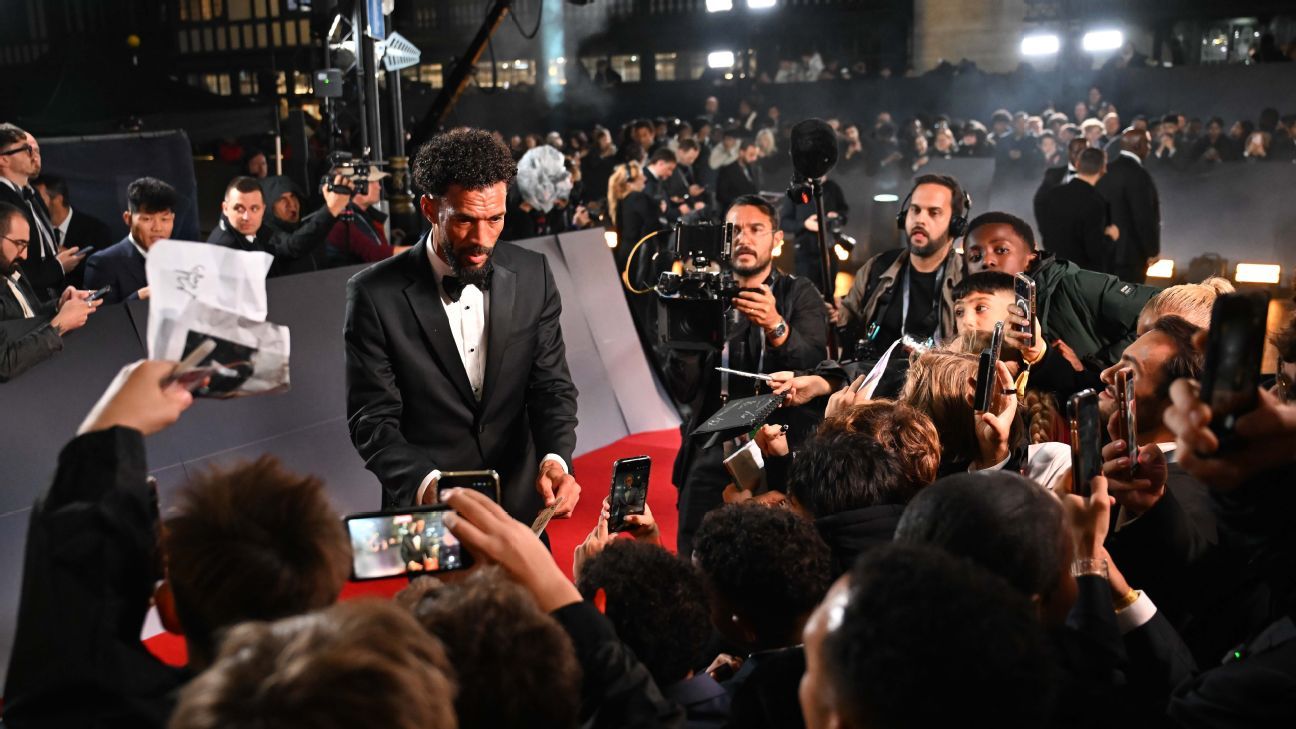
LONDON — Somehow, Vozinha made it.
Josimar José Évora Dias, born 40 years ago in little Mindelo, on the island of São Vicente, of the country of Cape Verde, a man whose late-blooming career has included stops in Angola, Moldova, Portugal, Cyprus, Slovakia and now Chile, arrived just in time at the London Palladium on Monday night under white lights and rain clouds to claim his unlikely place among the goalkeepers of the year.
His Yashin Trophy nomination at the Ballon d’Or was not for his club play, split between scattered appearances with Chaves in Liga Portugal 2 and his so-far mostly ceremonial arrival at Chilean titans Colo-Colo. It was an acknowledgment of his improbable star turn at this summer’s World Cup, when football fans saw someone like them — worn thin and overlooked — touched for two games by the fiercest form of grace.
Vozinha shut out eventual champions Spain in Cape Verde’s tear-streaked opener and later pushed eventual finalists Argentina to the brink in the round of 32. In the dizzying days between and after, his Instagram follower count ballooned from 56,000 to today’s 27.7 million, and he was voted the starting goalkeeper for FIFA’s Dream XI by his newly faithful fans around the world.
Vozinha, whose nickname is the Portuguese word for “granny,” had become the collective proxy for everyone who refuses to concede that their long-unrealized hopes won’t come true.
He still harbours his own ambitions, if now necessarily humbler than his achievements.
On Sunday afternoon, in a game he was expected to miss to attend the Ballon d’Or, he finally earned a league appearance for Colo-Colo, where he has been unable to overcome his teenage rival for the starting job, and shined. His side drew Palestino 1-1, but Vozinha made three spectacular saves that left his opponents with their hands on their heads and his manager with some decisions to make.
He then raced to the airport in Santiago to begin his expedition to London for Monday’s ceremony. Wearing a white track suit, he was escorted by a bodyguard who theatrically kept his arm around Vozinha’s waist for the walk through the terminal, as though he had handcuffed a briefcase full of diamonds to his wrist. Vozinha, whistling softly to himself, waved in response to the odd shout of encouragement from his fellow travellers.
Accompanied by club president Aníbal Mosa, he flew first to Madrid, where he boarded a private jet for the last leg of his marathon sprint, departing only six hours before the chase for the Ballon d’Or was set to begin.
Vozinha’s standard-issue tuxedo waited on a hanger in the back of the plane. He hurriedly put it on and made his way through London’s clogged streets and the Palladium’s crowds, arriving at last to an uncommon admiration and more familiar long odds. French Montana had already opened the festivities by rapping his hit “One Night” on top of a double-decker bus — “All I need is one night” — and Vozinha looked to have accepted the same bargain.
He stopped to sign more autographs than most. He also asked for pictures with Barcelona‘s star (and Ballon d’Or contender) Lamine Yamal and veteran manager Fabio Capello, acting more like a fan than a colleague, before he took the last of his steps between Santiago and his seat, flashing for hundreds of cameras the expression that had endeared him to millions of fans: a little wide-eyed, and a little wet-eyed, taking in the moment while also marveling at it.
In a recent interview with The Observer, Vozinha confessed that the burdens of his sudden fame have outweighed its gifts. “A lot of people want to be famous and have a public profile, but they only see the positive side of that reality,” he said. “To be honest, if I were offered the life I have today or the life I had before, I’d choose the one I had before.”
One day, almost inevitably, he will be granted the second of his wishes.
In September, Cape Verde lost twice in AFCON qualifying, and Vozinha resembled the protagonist of a “Flowers for Algernon”-like fable about the perils of temporary elevation. He had a howler in a 3-1 loss to Mali, and he failed to stop either of the two shots he faced against Rwanda, losing again, 2-1.
After his raucous arrival at Colo-Colo, he had told reporters: “Despite playing in smaller leagues for clubs that weren’t exactly giants, deep down I always told myself I was a ‘big club’ player.”
World-class goalkeepers do not escape the attention of big clubs. Vozinha is something less. As though to underscore the point, the Palladium’s video presentation of the nominees cut short before he was even included. He had come a long way not to hear his name or the cheering that would have followed it.
That was an unforgivable mistake, but it’s not an insult to suggest that his nomination will prove a parting gift rather than a portent of grander things to come. It makes what he did last summer only more special.
Vítor Martins, his manager at Chaves, put it best after Vozinha announced his departure from Portugal, before he did what he did against Spain and Argentina. Martins’ farewell proved prophetic. It also sounded, beautifully and achingly, like a eulogy.
“He’s at a very specific moment in his career and living a unique moment in his life, one he perhaps thought impossible, about to play in a World Cup at 40 years old,” Martins said. “He was a perfect professional until the end.”
All goalkeepers will admit that there are games when every fine margin miraculously tips their way. Spain hit the bar against Cape Verde, it is less well remembered, and they directed more chances at Vozinha than away from him. There are many ways that game could be replayed with a different result, Vozinha emerging valiant but vanquished.
That’s how his World Cup story ended, of course, after a delirious extra time against Argentina, after he stopped the unstoppable Lionel Messi more than once.
Monday night will be his last brush with a similar greatness. He knows this is true. When he found his seat, it was in the second row, far from an aisle, knowing that he wouldn’t need to make his way to the stage.
He knows he will never enjoy Harry Kane‘s sustained brilliance, or Kylian Mbappé‘s almost uninterrupted glories, or Yamal’s limitless future. He looked across at the kings of his noble profession — including David Raya and Unai Simón, the Yashin Trophy’s predestined winner — and knew that he would never share their riches, only some of their air.
He does, however, have an oversized heart, and somewhere in its expanses, he knows something else, something that his more blessed rivals will never know: He knows how it feels to be unchosen, and next to feel how it feels to belong, if only for a spell.
“The performance is a performance for everyone,” he had sobbed after his transcendence against Spain.
When his strange, glittering evening came to its bittersweet end, Vozinha got up and lingered in the aisle, as though uncertain of where he should go next, and he looked up at the Palladium’s chandeliers, a little wide-eyed and a little wet-eyed once again. He had taken such a long journey to be in London, in life and on the day, but for one night, at least, he could count himself among the giants of the game, and the rest of us could with him.
He was more than a perfect professional. He was the perfect surrogate for all of us who love the game unrequited, waiting for the moment when it decides to love us back.
One of us finally won.


