
It’s one of the oldest tricks in the book.
Shakespeare’s villains used it at the Globe, walking toward the groundlings to whisper their twisted truths.
Since then, it’s been supersized.
At big moments in musicals like “A Chorus Line” and “Ragtime,” the cast storms the footlights as if to mow them down — and then you.
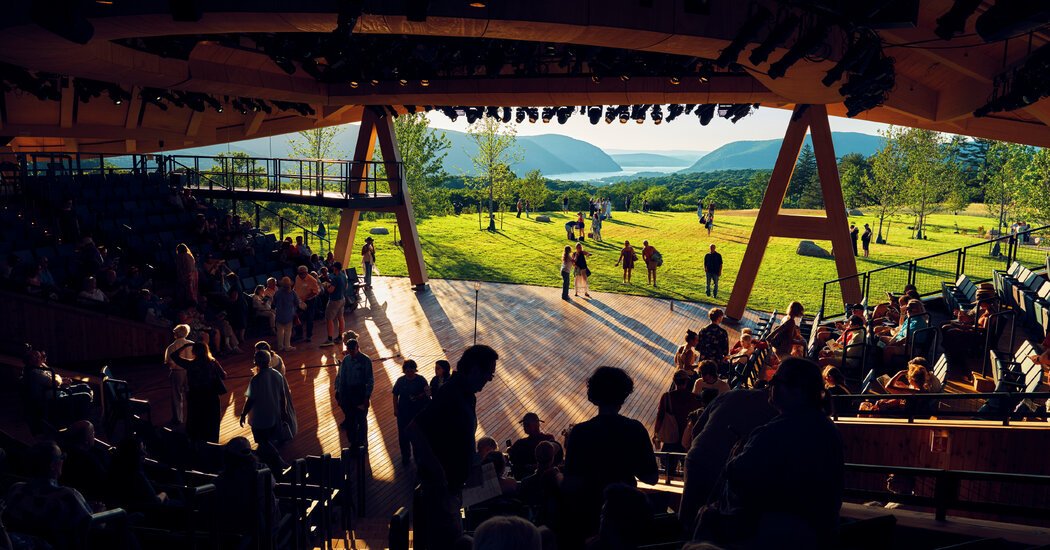
But I’ve never seen a full-company downstage cross as dramatic as the one now welcoming audiences to a former golf course about 80 minutes north of Times Square by car. First few by few, then in full formation, the 17 actors in Hudson Valley Shakespeare’s revival of “As You Like It” come at you from the far horizon, seeming to grow and loom as they rise from the landscape itself.
And what a landscape it is: Breakneck Ridge to the right, Storm King Mountain to the left, the Hudson turning westward between them, the Catskills glowering behind.
A play about escape from the city into nature never had as apt a backdrop.
What makes the coup de théâtre possible is the theater itself: a $41 million building designed for Hudson Valley Shakespeare by the architect Jeanne Gang and her colleagues at Studio Gang.
“As You Like It,” opening Saturday night, is the inaugural production in the timber-framed, open-sided, turtle-like structure, after years in which the company performed at leased locations under temporary tents. A stage made of sand on the banks of a marsh sometimes meant returning from a show encrusted with grit and pocked with mosquito bites.
But the new theater, formally the Samuel H. Scripps Theater Center, is not merely an aesthetic and customer-experience upgrade. It is a reflection of the company’s enhanced ambitions. So when the cast of “As You Like It” makes its downstage cross — a move used in many previous H.V.S. productions, if only from as far away as a parking lot — it says something new about tradition, change and resilience.
For Davis McCallum, the company’s artistic director, what it says is, “Here we come.”
The theater, part of a new H.V.S. campus on a high hill in Garrison, N.Y., embodies the convergence of two histories: the institution’s and the land’s.
For thousands of years, the land was part of the territory of the Wappinger people. The Dutch started farming in the 1700s, which in a way continued into the early 20th century, when the site became home to Bill Brown’s Health Farm, a retreat for New York gentlemen in want of pummeling by a former boxing promoter.
Next came the golf course, in 1961, with its clear-cutting and chemicals. To prevent the site’s further commercialization and environmental decline when it was sold to condominium developers in 1999, the billionaire investment manager Christopher Davis swooped in to buy it.
By then the land was profoundly damaged, he said: a mere “facsimile of a landscape.” For the next 20 years he sought a plan to remediate and restore it while also converting it to a loftier and more public use.
Unknown to him, in another part of the forest, the Hudson Valley Shakespeare Festival (as it was then called) had offered its first production in September 1987, a four-show run of “A Midsummer Night’s Dream” in a rainy meadow nearby. The following summer, production moved to a rent-a-tent in the gardens of Boscobel House, a 19th-century mansion on the Hudson: pretty but buggy.
Despite offering just one show a season, the company’s impact grew; in 1994, a second show was added and in 2008 a third. In between, the company acquired its own customized tent. By 2021, having been among the first New York theaters to reopen after the Covid shutdown — the open-sided tent was in that sense a blessing — H.V.S. could consider itself a well-regarded, smallish regional summer repertory theater with Shakespeare as its touchstone.
But lease renewal negotiations with Boscobel had by then broken down. H.V.S. would have to uproot.
There is something quite Shakespearean about the tale, with its seers, players, banishments and reversals. But seldom has a denouement been so magically devised. Two years earlier, in 2019, McCallum and the H.V.S. board, seeking a Plan B in case Boscobel fell through, had approached Davis to see whether the theater could temporarily pitch its tent on a corner of his property. They received a stunning response. Davis suggested that instead of a quick fix, why not build a permanent home there? It was just the adaptive reuse he was seeking.
What’s more, he would give them the entire 98 acres for free, including a wedding and restaurant business expected to throw off several hundred thousand dollars a year. Plan B became Plan A. “No strings,” McCallum recalled.
No strings does not, however, mean no ties.
Continuing to produce new seasons in their tent, now pitched in a dank hollow in a corner of the golf course, the H.V.S. team had to confront the enormous implications of the gift. Could they afford to build a theater worthy of the site? (Gang, whose firm designed the 101-story St. Regis Chicago and the 230,000-square-foot Richard Gilder Center at the American Museum of Natural History, called it “the biggest, most fabulous place I’ve ever worked.”)
Even if they could afford to build it, could they afford to run it? If so, would that mean raising prices, sidelining Shakespeare and cramming more people under the tent — thus destroying the soul they were seeking to save?
“We knew it was an historic opportunity, and we wanted to seize it with both hands,” McCallum said. “We didn’t want to assume we would operate the way we always have just because we always have.”
Part of his goal was to “graduate to the premier league”: to become a more influential cultural anchor for the region while “putting us on a much wider radar” of nationally known pilgrimage sites like Tanglewood and the Santa Fe Opera.
Still, some original elements were nonnegotiable. “We could have built a state-of-the-art indoor theater, indistinguishable from any in downtown Manhattan,” McCallum said. But the company decided to honor its traditional immersion in nature by sticking with one that “the wind and rain can blow through.” Perfect for “King Lear,” opening Tuesday.
And because intimacy has also been a hallmark, the space would have to stay small — indeed, it is now slightly smaller, with 451 seats instead of 500, none more than nine rows from the stage. The acoustics had to be intimate, too, allowing the company to remain one of the few to produce outdoor work without microphones.
But two elements that seemed sacrosanct — the sand and the tent — both disappeared during the four-year design and construction process.
Good riddance to the sand, but ditching the tent, which had been part of the company’s brand from the start, was a harder decision.
Gang worked on preserving it “probably too long,” she said. “We tried every different shape, but finally I was like, ‘you guys … ’ I mean, I’m all for lightweight structures, but when we started looking at the steel you’d need to make that span, the steel gets bigger and bigger just to support the one thing that’s very light. It wasn’t right for this place. And, well, a tent just made it feel like a circus.”
As the tent gave way to a timber grid shell supported by giant A-frames that open the stage to the view, the price doubled. Other parts of the plan — including, crucially, housing, so the company wouldn’t have to billet its artists at the Best Western in Fishkill for $750,000 a year — eventually brought the total goal of the capital campaign northward of $70 million. (So far, $66.8 million has been raised.) The operating budget rose too, to $5.5 million on the hilltop from $3.4 million by the marsh.
The circus was packing up.
The ribbon-cutting ceremony on May 14, a mere 596 days since groundbreaking, was a giddy, emotional affair, despite the usual program of dignitaries and donors. McCallum pointed out the theater’s resemblance to the Globe: “Shakespeare wrote for open skies and shifting light with a bare stage and audience packed in on three sides.” The cast of “As You Like It” made its full-company downstage cross through newly planted grasses and indigenous shrubs.
In a way, the cast and the landscape (by the firm Nelson Byrd Woltz) were now in tension if not competition. Kurt Rhoads, an actor in his 28th season — this year on the “old guys” track encompassing Lear and Old Adam — said he expected the sunset to be “an extra cast member.” Eric Berryman, in his first season, worried that the view might literally upstage the actors. “But these plays live in nature,” he said. “You can’t ignore it any more than you can ignore who you are.”
H.V.S. seems to have learned that lesson. It dropped “Festival” from its name when construction began, because it is not, after all, a circus. The minstrels aren’t coming to town for a few days before flying by night to the next one. The season, formerly constrained to the 14 weeks between Memorial Day and Labor Day, can now extend five more into fall, which may well benefit that Shakespearean epic “Les Misérables,” opening in August.
Moreover, the backstage is no longer a dirt floor. The actors’ shower is no longer a hose strapped to a piece of plywood. No one misses the sand, except Rhoads, and even he admits “you had to work to run on it or even just to stand.”
A theater company is like that. You can run or you can sink. Both are hard. When I first saw the site of the new theater, two summers ago, on what was formerly the 11th fairway of the decommissioned golf course, the scale of the ambition seemed risky.
Would it not have been enough, I asked McCallum, to remain a small, youthful, scrappy company forever?
“Why must we choose between growing up and holding on to the essence of what makes us us?” he replied. “There are artists in various media whose late work is quite different from their early work, but they are always the same person. Our resident playwright is a good example of that.”
He let that thought sink in for a moment, then delivered the curtain line. “Part of the reason I’m so thrilled with the building is not because it feels beautiful, but because it feels like us.”

