
Welcome to the T List, a newsletter from the editors of T Magazine. Each week, we share things we’re eating, wearing, listening to or coveting now. Sign up here to find us in your inbox every Wednesday, along with monthly travel and beauty guides, and the latest stories from our print issues. And you can always reach us at tmagazine@nytimes.com.
Covet This
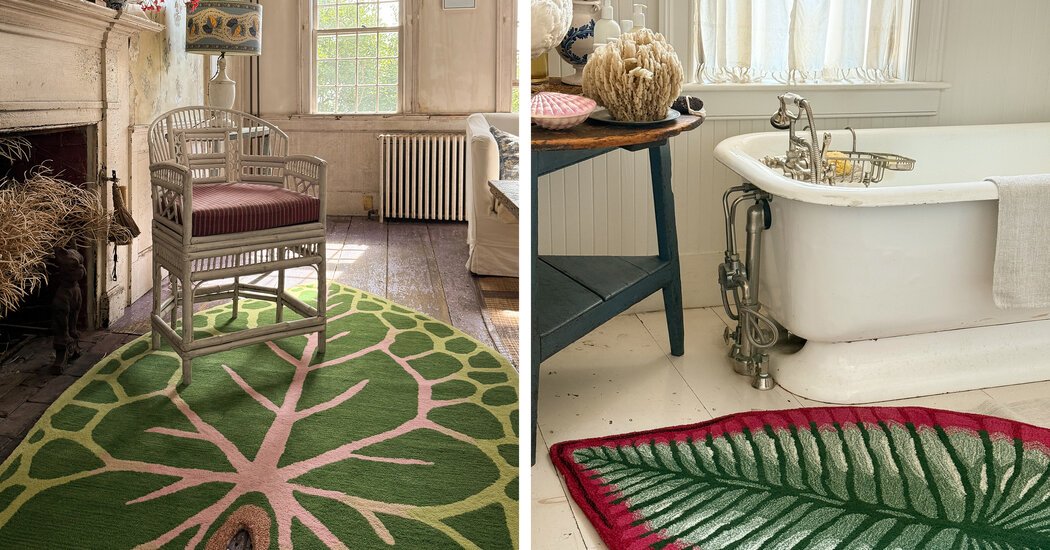
Home Décor Turns Over a New Leaf
The artist John Derian is known for his decoupage work that transposes 18th- and 19th-century imagery onto dishes and home décor, as well as for his layered New York shops that sell velvet stuffed animals and food-shaped candles alongside his own wares. Now, he’s collaborated with the Amsterdam-based home accessories brand Doing Goods to create a collection of five leaf-shaped rugs. The designs — from a pink-veined African mask leaf to a butterfly-like elephant ear — were drawn from decorations for hats in an early 19th-century milliner’s sample book. “Transforming them into vibrant handmade rugs feels both personal and exciting, giving new life and scale to something that captivated me years ago,” says Derian, who has worked with botanical imagery for over three decades. All of the rugs are handmade in India from New Zealand wool. From $290, johnderian.com.
— Abid Haque
Try This
New Takes on Kimbap, the Korean Rice Roll
Growing up in Oregon, Jihan Lee went on fishing trips with his family every Sunday, and his mother packed homemade kimbap (sometimes rendered as “gimbap”) for the long car rides. When he moved to New York to begin his career as a chef, he found a couple of restaurants offering the everyday Korean dish — comprising rice and fillings like egg, vegetables, meat and fish, wrapped in dried seaweed and sliced to reveal a colorful cross section — but none were particularly great, so he stopped eating it for a while. But lately, restaurants devoted to kimbap have taken off, each putting its own spin on the portable, kaleidoscopic dish. Lee’s own shop, TBD Gimbap, opened in the West Village in March; Roll Over Kimbap, from the chef Jun Hee Park (formerly of Jungsik), debuted in Union Square in June; and Gim, a London pop-up, launched last summer. Gim’s founders, Sophie Kim and Dom Sherrington, feature less common ingredients like garlic shoots and spicy fish cake alongside classics like bulgogi and tuna with mayo, while Lee sometimes runs extravagant specials like toro and caviar kimbap, a nod to his years working at high-end omakase restaurants, including Masa. At Jihee Kim’s banchan shop Perilla in Los Angeles, the chef offers kimbap that includes softly cooked egg, garlic chives and avocado and is served with a very hot mustard. Why the sudden surge? Both Lee and the Gim duo credit the film “KPop Demon Hunters,” in which kimbap is eaten in several scenes. Although many of their adult customers have never heard of kimbap, Sherrington says, “quite a lot of kids come by with their parents and go, ‘Oh, it’s kimbap!’”
— Emily Wilson
Three years ago, the curator Abby Bangser bought a 1930s cabin on Connecticut’s Lake Waramaug, a short drive from the town of New Preston. She was in the midst of building up Object & Thing, an art and design fair in New York, and found the area’s natural surroundings to be a respite in the summer, especially for her two young sons. She’s now combining her professional pursuits with the tranquil setting: Object & Thing the gallery opened last weekend in New Preston, in a former pharmacy on the banks of the East Aspetuck river. Its first show features new brass poppy sculptures by the Rhinebeck, N.Y.-based floral designer turned artist Ariel Dearie, as well as a brass headboard inspired by an Alexander Calder creation. Several pieces are arranged on a Charlotte Perriand table, while one four-and-a-half-foot-tall sculpture is installed in the garden. In addition to exhibitions, Bangser plans to collaborate with friends in the community to host occasional talks and events, such as a dye workshop. This fall, she’s planning a solo exhibition of micaceous clay vessels by the New Mexico-based artist and chef Johnny Ortiz-Concha. “Ariel Dearie: Brass Sculptures” will be on view through Sept. 13, object-thing.com.
— Gisela Williams
Between 2008 and 2020, the Thai photographer Chardchakaj Waikawee documented Bangkok’s youth culture. Many of the people he encountered were growing up in poverty, often without access to education or health care. Capturing brief interactions and subjects whom he got to know over time, Waikawee sought to show how they were constructing a sense of self through their defiant, uninhibited individual style. Twenty-one photos from the resulting series, “Youth,” are now on display at London’s Graces Mews gallery: A highlighter-pink mohawk peers out of a sedan’s sun roof; a tattooed couple poses with a baby, the father bare-chested and kissing the child’s face, the mother gazing straight at Waikawee’s lens. Waikawee used damaged, inexpensive film and retained the developed portraits’ imperfections as a way of emphasizing the precarity of his subjects’ lives. “Some don’t even know their own birthdays. Some have no identity cards, yet they’re still living, just as expired film can still produce an image,” he says. “Youth” will be on view through Sept. 19 at Graces Mews, gracesmews.com.
— MZ Adnan
Eat Here
On Crete, a Restaurant With Fresh Flatbread and Courtyard Seats
In Chania, a port city on the northwest coast of Crete that dates back to the Minoan era, the Greek hotelier Nikos Tsepetis has been gradually opening a constellation of stylish destinations. After the art-filled beach resort Ammos, he founded the bakery Red Jane, with interiors by the designer Michael Anastassiades, in 2023. Last year, Tsepetis added Red Jane Wines, a bottle shop and bar across the street. This week, next door, he launched Red Jane Grill, a restaurant centered on charcoal cooking and seasonal ingredients. The Greek chef Andreas Lagos serves dishes such as lamb kebabs with pistachios and labneh; sautéed prawns with taramosalata (a creamy dip made from fish roe) and potato chips; and Cretan wild pork sausages. All the dishes come with flatbreads developed by the baker Eyal Schwartz, a co-founder of London’s E5 Bakehouse. Guests can pick up some rosé from the local Manousakis Winery at Red Jane Wines and eat picnic style in a connected leafy courtyard — if they’re lucky enough to find a spot. instagram.com/redjaneproject.
— Gisela Williams
Two years ago, the architect and art director Valentina Akerman and the artist Joe Bradley started Galerie Sardine from their family’s summer home, an 18th-century farmhouse rental in Amagansett, on Long Island’s East End. With their four children, their dog and a cast of visiting artists, “I always joke that the second floor of our house is a commune and the first floor is the gallery,” says Akerman, who showcases contemporary paintings, sculpture and ceramics alongside vintage furniture in the domestic setting during the summer. (To keep the operation going in the off-seasons, she’s presented exhibitions in Los Angeles, Paris and Dijon, France, and she opened a year-round space in downtown Manhattan last April.) This month, Galerie Sardine closes out its third season in the Hamptons with a pairing of artists whose works celebrate the ephemeral beauty of flowers: The Japanese-born, Brooklyn-based artist Susumu Kamijo paints figurative scenes of abstracted blooms, while the married artists Erin and Sam Falls press local plant matter directly onto the surfaces of their ceramic vessels to create distinctive glazed finishes. “A Nysian Plane” will be on view from Aug. 8 through Sept. 7, galeriesardine.com.
— Aileen Kwun
From T’s Instagram

