
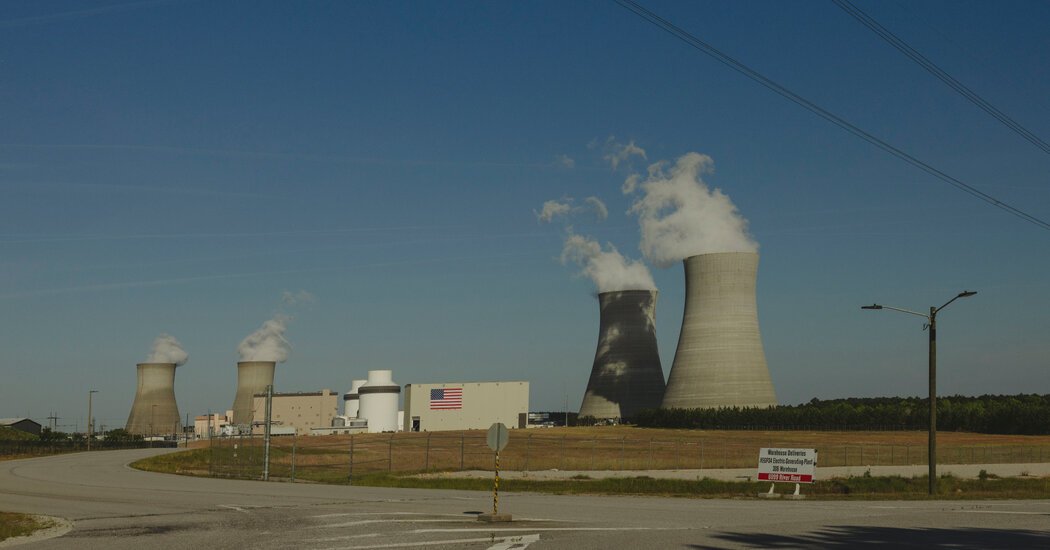
The Nuclear Regulatory Commission on Wednesday proposed overhauling its safety rules for radiation exposure from nuclear power plants, saying that the current regulations are too costly and go beyond what is needed to protect human health.
The N.R.C. would keep its existing limits on the maximum amount of radiation that workers and the public can receive each year. But it is proposing to eliminate a principle in place for decades that said nuclear-plant operators should keep radiation exposure “as low as reasonably achievable.” In some cases, that meant regulators could order plants to install additional equipment to drive radiation exposure far below the legal limits.
The agency said that this often led to additional costs “without a measurable safety benefit.” It added that the maximum dose limits were already set “well below levels associated with known health effects.”
The N.R.C. also proposed on Wednesday a sweeping package of changes aimed at simplifying the process for choosing locations for and licensing new nuclear reactors.
Taken together, the rule changes could make it cheaper and easier to build and operate new nuclear power plants in the United States. The Trump administration has urged the Nuclear Regulatory Commission, the nation’s safety regulator, to streamline its rules in order to greatly expand the use of nuclear power.
“N.R.C.’s regulations have not kept pace with new technologies and our energy needs,” said Ho Nieh, the chairman of the commission. The proposed rules, he said, would “strip out rigid frameworks and unnecessary conservatism to accelerate the safe deployment of new reactors and expand existing capacity across America.”
The new rules wade into a longstanding and often fierce debate over how much protection against low levels of radiation is worthwhile.
Experts agree that high doses of radiation are dangerous and can cause various types of cancer. But there’s much more disagreement about the effects of lower doses of radiation, such as the amounts that workers at nuclear power plants might receive in the course of their jobs.
Different studies have found that low doses can be harmful, neutral or even beneficial. Many researchers say the science is inconclusive, particularly since people are naturally exposed to varying amounts of background radiation in day-to-day life.
For decades, many researchers and regulators have tried to simplify things by adopting what’s known as the “linear no-threshold model,” which says that the effects of radiation scale down linearly with the dose, and that even tiny amounts of radiation can have small negative effects. While researchers say it’s extremely difficult to prove or disprove this model, some say it’s a reasonable precaution.
Since the 1970s, regulators have in turn adopted the principle that radiation exposure from nuclear power plants should be kept “as low as reasonably achievable.” That might mean installing additional shielding and equipment at plants or hiring more workers so that they could be rotated more often in order to keep radiation exposure to each individual as low as possible. And it means operators should always be looking for ways to limit exposure further.
Yet supporters of nuclear power have argued that shifting targets for safety make it more difficult and expensive to build and operate nuclear plants — which produce far less air pollution than coal- or gas-burning power plants — with little detectable safety benefit.
In its proposed rule, the N.R.C. said that instead of requiring radiation exposure be “as low as reasonably achievable,” it would allow more flexibility for plant operators to manage exposure and adopt new methods for evaluating radiation doses. The agency is also proposing to allow certain medical workers who work with radioactive materials to voluntarily receive higher doses.
“Our radiation dose limits remain unchanged. What we’re eliminating is unnecessary ambiguity,” Mr. Nieh said.
Some experts said the new rules were unlikely to cause major changes at existing plants, since many plant operators already keep radiation exposure far below the maximum legal limits.
Current U.S. nuclear plants “already operate far below what the regulatory limits are because they recognize it’s the best practice for the operations of the plant and the workers,” said Patrick White, an expert on nuclear power at the Clean Air Task Force, an environmental group. “It’s hard to imagine operators changing that just because the regulations are changing.”
Others have suggested that the new rules could make it easier for companies to develop new plants. The Breakthrough Institute, a pronuclear group, published research suggesting that moving away from the “as low as reasonably achievable” standard could cut the cost of building reactors by as much as 20 percent because developers might need to use less steel, concrete, shielding and labor.
Opponents of nuclear power criticized the new rules. The changes “would allow nuclear facility workers and the general public to be exposed to higher levels of cancer-causing radiation just to save the nuclear industry money,” said Edwin Lyman, the director of nuclear power safety at the Union of Concerned Scientists and a frequent critic of the industry.
Separately, the agency said it was streamlining an array of rules that developers of nuclear power plants have to follow for siting, building and licensing plants. Traditionally, for instance, companies have to receive an N.R.C. license before they can begin construction. The new rules could allow companies to conduct more types of early site work while they wait for N.R.C. approval, allowing them to speed up project timelines.
The agency will solicit public comment on both proposed rules for 45 days and is expected to finalize them later this year.
The Nuclear Regulatory Commission was established by Congress as an independent agency responsible for overseeing the safety of the nation’s nuclear power plants and approving plans for new reactors. The agency’s safety rules, which have become more stringent since the 1970s, have sometimes been blamed for the slowdown in construction of U.S. nuclear plants. Only three new reactors have come online since 1996.
Since taking office, President Trump has sought to exert greater authority over the agency, including breaking precedent by firing one of its Democratic commissioners last year. (The five-member board traditionally has commissioners appointed by both parties who serve for fixed terms. It currently has three Republican appointees and two Democratic appointees.)
Last May, Mr. Trump issued a series of executive orders telling the N.R.C. to overhaul its rules and take no more than 18 months to approve new reactors. Mr. Trump has also ordered the agency to clear all major regulatory decisions with the White House’s Office of Information and Regulatory Affairs, creating a new level of political oversight.
Mr. Nieh, who was appointed by Mr. Trump, has said that the agency will continue to make its own decisions. “There’s no political pressure on our safety decisions,” he said on Wednesday.
Nuclear power has attracted bipartisan interest in the United States in recent years, particularly as demand for electricity rises. Nuclear reactors don’t emit planet-warming greenhouse gases, unlike coal and gas plants, and they can produce electricity around the clock, unlike wind turbines and solar panels. While some Democrats remain opposed because of concerns over safety and the disposal of nuclear waste, others have come to see it as a tool to fight climate change.
In 2024, Congress overwhelmingly passed a bill aimed at speeding up the development of a new generation of nuclear plants. Since then, the N.R.C. has taken several steps to streamline its regulatory processes, including issuing permits for new reactors in Wyoming and Tennessee within 18 months, a quick pace for the agency.
Still, some Democrats who support nuclear energy are concerned that the Trump administration may be moving too fast.
The Energy Department, for instance, is encouraging start-ups to build a new generation of small demonstration reactors on federal land under an accelerated approval process that does not involve the Nuclear Regulatory Commission. Those reactors could then apply for N.R.C. approval under a new streamlined pathway, a process that some Democrats have criticized as lacking transparency.

