
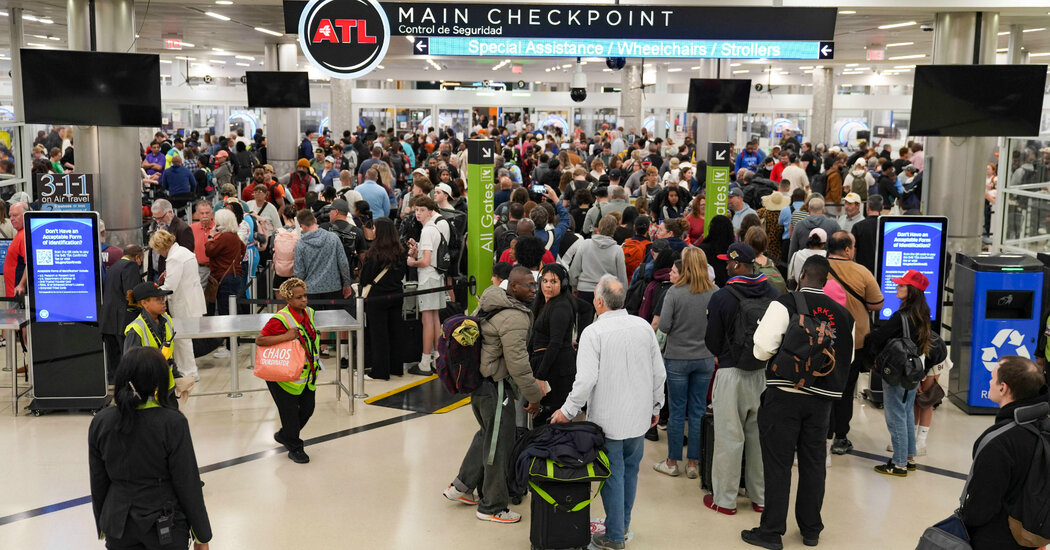
In what industry experts call an about-face for the Transportation Security Administration, the agency is ramping up efforts to privatize security at U.S. airports.
The recent government shutdowns, which left T.S.A. agents unpaid for months and led to long lines, have fueled a push to expand the Screening Partnership Program, which uses private contractors to staff security checkpoints, and to roll out a new voluntary public-private screening initiative called Gold+.
Twenty airports, including San Francisco International, currently participate in the Screening Partnership Program. While lines at airports like Houston’s Hobby, which uses T.S.A., extended outside terminals during the last shutdown, passengers often waited 10 minutes or less at the non-T.S.A. airports.
The T.S.A. seeks to spend an extra $477 million to allow smaller airports to join the Screening Partnership Program, according to its proposed budget, which also calls for eliminating more than 4,300 of its roughly 50,000 agents. Separately, the T.S.A. also recently introduced an expansion of this program to allow private contractors to deploy and manage screening equipment at checkpoints.
Details are scant about Gold+, which the agency announced to staff last week in a mass email that was first reported by the Gate Access newsletter. The email, obtained by The New York Times, states that the program would “enable closer collaboration with the private sector” and would be put in place “thoughtfully and in phases.” Another document, sent to top T.S.A. leaders at airports, estimates the transition to Gold+ could take seven to 11 months.
Neither the emails nor the Gold+ website provided specific information about airports, vendors or funding, but a T.S.A. spokesperson said Gold+ would be an “evolution of the Screening Partnership Program” tailored to airports and regulated by the T.S.A. Participating airports would get staffing, technology and maintenance at no additional cost to them, the website said.
For passengers, this could mean faster trips through checkpoints and fewer headaches during funding disruptions. The moves accompany recent efforts to speed up screening using biometrics and the planned opening of a remote screening center in the Boston suburbs for Delta and JetBlue passengers heading to Boston Logan International Airport.
Privatization emerged on Wednesday as a central focus of a House Homeland Security Committee hearing on T.S.A. modernization.
“We want airports to choose,” Chris Sununu, the chief executive of the industry trade group Airlines for America, told lawmakers. “But understand, during the shutdown, know where morale was highest? At the airports where they were privatized.” The security personnel at those airports were being paid.
Chris McLaughlin, the chief executive of Dallas Fort Worth International Airport, which uses T.S.A., echoed that what works for one airport may not for another.
Aviation industry leaders also complained to lawmakers that the T.S.A.’s financial and bureaucratic limits kept them from being able to quickly deploy new security technology.
Everett Kelley, the national president of the American Federation of Government Employees, the union representing T.S.A. agents, said the group opposed privatization, telling lawmakers that the federal model that Congress built after 9/11 was “a lesson learned in blood.”
“We cannot go back to contracted-out aviation security and expect the lessons to hold,” Mr. Kelley said.
The T.S.A. replaced a patchwork of private security at U.S. airport checkpoints after the terrorist attacks of Sept. 11, 2001. Unlike the firms that participate in the Screening Partnership Program, those pre-9/11 firms were not directly overseen by the federal government.
The T.S.A.’s pivot to a public-private security model like Gold+ is a “massive mind-set shift,” said Ajay Amlani, the chief executive of Aware, a biometric technology company that is eyeing Gold+.
“This is like the biggest opportunity for innovation that can improve the traveler experience and save taxpayer money at the same time,” Mr. Amlani said, pointing out a growing chasm between available technology and aging T.S.A. equipment.
Privatization is a “common model internationally,” said Jeff Price, a professor of aviation security at Metropolitan State University of Denver, but in the United States, it’s been a “third rail people wouldn’t touch.” But now, he added, there’s a greater appetite in Washington for a more hands-off approach.
“It’s a significant change that has risks,” said John Pistole, a former T.S.A. administrator who is advising on Gold+.
Critics point out that relatively few airports have signed up for the current private screening option, which has existed since 2004, and warn that travelers could see a lack of consistency.
But the T.S.A., in its email to employees, said that a “handful of airports” had already expressed interest in Gold+.
Hartsfield-Jackson Atlanta International, the world’s busiest airport, may be on that list. This week, the Atlanta City Council moved to study a private screening model at the airport, where, during the last shutdown, some travelers spent four hours in line.
Follow New York Times Travel on Instagram and sign up for our Travel Dispatch newsletter to get expert tips on traveling smarter and inspiration for your next vacation. Dreaming up a future getaway or just armchair traveling? Check out our 52 Places to Go in 2026.

