
The proliferation of documentaries on streaming services makes it difficult to choose what to watch. Each month, we select three nonfiction films — classics, overlooked recent docs and more — that will reward your time.
‘12 Days’ (2018)
Stream it on Ovid. Rent it on Amazon and Apple TV.
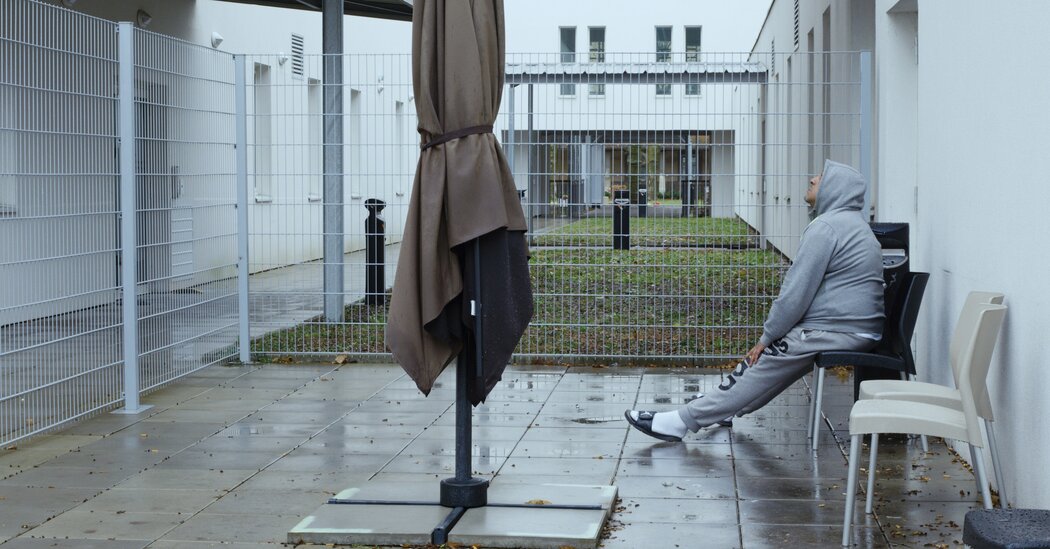
Earlier this year, Film at Lincoln Center held a retrospective on the great French documentarian Raymond Depardon. The remastered versions shown there aren’t streaming yet, but until then, the representative “12 Days” will do. Like Depardon’s “Caught in the Acts” (which observes accused criminals meeting with prosecutors) and “The 10th District Court — Moments of Trials” (which shows defendants interacting with judges), “12 Days” concerns an aspect of the French legal system. By law, patients who are involuntarily placed in psychiatric hospitals must meet with a specialist judge within 12 days; the judge will then determine whether the hospitalization should continue. The judges emphasize that they are viewing the cases strictly from a legal perspective, not a medical one.
Depardon’s camera bears witness to these encounters (a lawyer is present as well), as patients with varying degrees of lucidity answer questions about how their hospitalizations are going. There are moments of heartbreak, horror and even bleak humor. (“Are you looking for work now?” one man is asked. “No, I’m in the psych hospital,” he replies.) One patient believes he’s going to start a political party with Bernie Sanders. The subjects occasionally acknowledge that they are being filmed; one asks Depardon to zoom in, while another, who gives a harrowing account of having been raped multiple times (but also says a girl “attacked me by telepathy,” so may not be entirely reliable), repeatedly locks eyes with the camera.
These interview sessions are interspersed with eerily serene footage of the hospital environs, a device that gives “12 Days,” like several Depardon works, a kinship with Frederick Wiseman’s films. One striking aspect of the process is that (from what we see) the judges almost invariably continue the hospitalizations — which may only speak to the fact that the confinements were carried out legally, but also makes one wonder whether these interrogations are effectively over before they start.
Geeta Gandbhir’s Oscar-nominated documentary contains relatively little material that the director filmed herself. Instead, its spine consists of the body camera footage recorded by police officers who were repeatedly called to a residential block in Marion County, Florida — a block that eventually became the scene of a crime. The documentary implies that the tragedy was inevitable, yet in watching these events unfold, a viewer might well wonder what, from a legal perspective, the police could have done to prevent it.
For nearly its first hour, the movie illustrates the growing tension between a group of children who play on the block and Susan Lorincz, a professed “perfect neighbor” who repeatedly calls the cops to complain about them. The police seem to recognize that the calls are a case of crying wolf (“You explain to her that there doesn’t need to be a call every time a kid’s playing in the road or in the yard?” one officer asks another), but they also have to respect both sides of a story, and probably the best advice they could give the children and their parents is to keep a wide berth from Lorincz, even though, as far as we can tell, they are never on her property or doing anything wrong. It’s worth adding that several of the children are Black and the neighbor, whom the kids refer to as “the Karen,” is white; at various points, as when the film shows Lorincz being questioned about whether she used a slur, Gandbhir suggests that racial bias may have played a role in what unfolded.
Later on, Gandbhir switches from the body cam footage to the material recorded during police interrogations, at which point Lorincz’s particular brand of reality distortion comes into full focus: “I’m sorry. I can’t do this,” she says to officers who are about to handcuff her, as if she could somehow will away what is happening before our eyes.
Missed out on this month’s Cannes Film Festival and the exuberant screening introductions by its head programmer, Thierry Frémaux? You can catch Frémaux in his other job, as the director of the Institut Lumière in Lyon, through this documentary, on which he’s credited as the author. Most of the imagery, though, was shot more than a century ago.
The institute celebrates the legacy of the brothers Louis and Auguste Lumière. Famously, on Dec. 28, 1895, a public, paid screening of films they had shot with their cinematograph (a combination of camera and projector) inaugurated moviegoing as we know it. Part of the joy of “Lumière, le Cinéma!” is seeing their shorts — widely available in degraded versions — restored to such superb visual condition. But “Lumière, le Cinéma!,” narrated by Frémaux and set to music by the contemporaneous composer Gabriel Fauré, goes well beyond the obvious choices. Its overarching argument is that the Lumières seeded the medium not just technically but also artistically — that their images laid the groundwork for masterpieces by John Ford and many others.
Frémaux poses historical questions (we have three versions of “Workers Leaving a Factory,” for instance, and there’s some ambiguity about which one was shown at a demonstration for scientists in March 1895) and debunks myths. He says that an ostensible, frequently parroted Lumière remark — “cinema is an invention without a future,” quoted in no less a source than Jean-Luc Godard’s “Contempt” — is a fabrication. (“The Lumières produced more than 2,000 films,” he says. “That’s how much of a future they saw for it.”)
Frémaux looks at how Louis Lumière’s filmmaking evolved into a sort of precursor to studio thinking: In one short from 1896, Lumière combined the comic setups of two previous films, “L’Arroseur Arrosé” and “Partie de Cartes.” (Frémaux calls it “efficiency multiplied by crossing scenarios,” comparing it to a later matchup of Godzilla and King Kong.) The negotiation between the camera subject and the lens comes under scrutiny: Frémaux analyzes a composition from “The Tedders” in which a family of raking farmers is visibly trying to hit precise marks. Above all, the shorts offer a panorama of life at the fin de siècle: performances, military pageantry, travelogues. There are more than 100 shorts featured in “Lumière, le Cinéma!,” and every one feels vital and timeless.

