
Emma Willard was a feminist pioneer who pushed early for equality in education for white women and established herself as a reputable artist who combined her love of illustration with her love of pedagogy. She created inventive visualizations of historic events, which she described as “memory palaces.” In 1845, later in her life, Willard turned a drawing of a sprawling tree into a wall map depicting American history. It is perhaps her best-known illustration, which still appears as the cover of textbooks and is available, as a print.
Almost 200 years later, that map serves as a canvas for the artist Firelei Báez (pronounced FEER-eh-lay), who used the source material as inspiration for her own cosmology. Willard’s rambling tree reminded Báez of an underwater creature, so, for her solo show at Hauser & Wirth in Chelsea, she painted a large, milky white jellyfish whose lanky tentacles flop onto the tree’s bark, which is inscribed with the dates of “Columbus’ Discovery 1492,” “Pilgrims landing” and “Confederacy begins.”
In her own work, which Báez named “Not even unalterable limitations (or a transformational topology for remembering Willard’s Chronographer of American History),” a chaos of color erupts below the gelatinous creature, with protrusions of legs and feet, some comfortably blotting out the colonial past. Others use the base of the map for leverage, as if to flee the violence implicit in the timeline. The figure represents someone — or something — “coming into being, unruly, mid-formation,” Báez said.
Maps function as place makers and stand-ins for collective memory. But they have been manipulated endlessly to perpetuate notions and policies, often harmful, about global hierarchies and supremacies. Even today, on contemporary maps, Greenland often appears to be about the same size as Africa, even though Africa is roughly 14 times larger.
Báez, 45, has long collaborated with archives to unsettle the idea of a singular past, or a linear history — especially considering that Columbus’s “discovery” in 1492 was technically not what is currently called the United States. It was modern-day Dominican Republic, where she was born. Báez’s work remaps the stories of the world, creating possibilities to understand history anew, and by extension, humanity.
In the case of the American tree, it is perpetuating the idea of America as organic and autonomous as nature itself, and Báez replaces that myth with one of the artist’s own, reminding viewers that despite how it may feel at times, the future of the world, and humanity, is still in motion.
“Every painting is over a document that purports to contain the world or reality, all in one two-dimensional image,” she said. It documents “the hubris of the 19th century,” as both archive and warning. Her work, she said, is trying to bring forth the “idea of the actual complexity of being, of navigating, of knowing more, and the possibility of knowing more.”
During an early spring visit to her studio in the Red Hook section of Brooklyn, Báez showed me several works in progress that appear in her current show at Hauser & Wirth, titled “feet squelching on wet grass, nourished by uncertainty.”
There was a painting layered on top of an 1860 infographic by a German cartographer named Paul Ahrens depicting a 360-degree view from a peak in a German forest. In Báez’s studiousness lives some trickster energy. The original topography seemed phallic to the artist, so her modification also features a cheeky close-up of a painting of a single breast, complete with areola, stretch marks, pores and hair follicles. She named it simply: “View From the Tower.”
Another work on display uses a set of French playing cards developed by a prolific geographer named Pierre Du Val for the young Louis XIV, to teach him about other countries that he needed to maintain relations with, to negotiate — or invade. “It was also a game of colonization,” Báez said. “I’ll take your kingdom or I’ll take your land in a game.” She painted a stampede of horses over that one.
Báez’s work is deeply rooted in intense scholarship. It is also wedded to the spiritual world. She may have a proposition for a new work, but it always starts with the pour — the moment paint hits the canvas. “It is an index of my body and the architecture of the space that I’m in,” she told me. The figures in the work emerge from that crucial moment. Consider it a divination.
“I hate the word ‘woo-woo,’” she said. But anyone involved in the miracle of creation — whether painting, the birth of a child — understands this feeling.
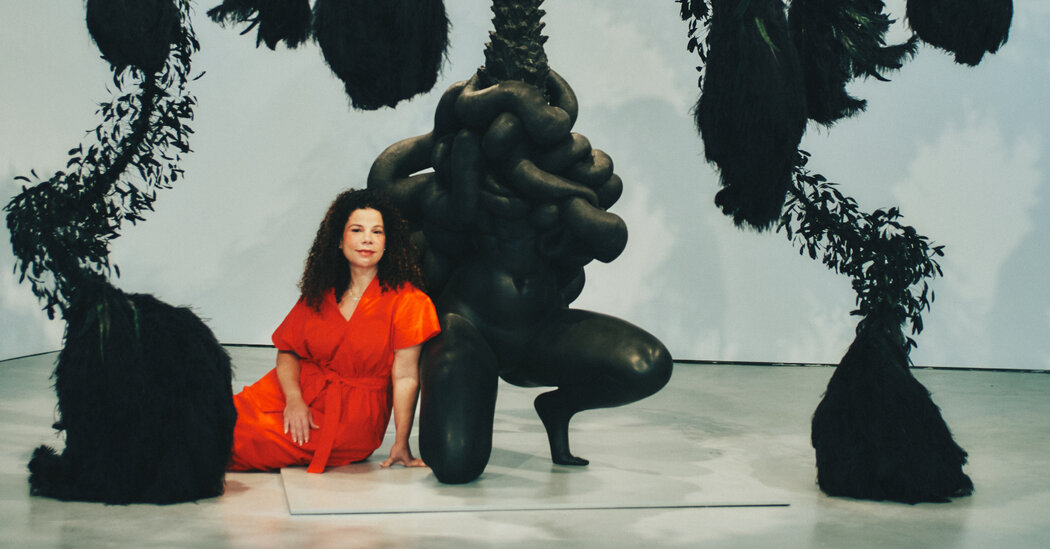
She is also showing two bronzes of feminine figures who appear half-human and half mystical being, their bodies subsumed by twisting, winding organic matter, as if they have morphed into folkloric creatures.
“Nothing brings more fear to human civilization than the idea of nature being unkempt,” she said. Additionally, there is a series of figurative drawings resplendent with color, each of them exploring possibilities for human transcendence into a new, fluid flesh state. . If the maps are a repatriation of timelines, these works offer a glimpse of futurity.
During my visit, we sat on an ornate couch by a table full of herbal teas, nuts and dried fruit. Her studio doubles as a lush greenhouse full of more than 100 plants, including monsteras, rubber trees and ferns. The centerpiece of the Hauser & Wirth show leaned on the opposite wall, a 50-foot-long panel of sprawling and lush flora and foliage over a document called “View of Nature in All Climates, from the Equator to the Arctic Circle,” a pictorial diagram drawn by John Emslie in the mid-1800s.
Báez worked on her version (called “View of Nature”) upstate, near the Catskills, where she often rents a studio. Her painted vegetation almost chokes the document out of being. Figures seem to move throughout the greenery. It calls to the mind the postapocalyptic landscapes of “The Last of Us,” or “28 Years Later,” when the horrors of reality are tempered by the beauty of nature reclaiming itself as rightful heir to the land.
They resemble the Dominican and Floridian landscapes of her childhood, and of her dreams. Here, Báez has rendered the modern dilemma all too neatly: Horror is mundane. The apocalypse is not a singularity. It undulates eternally, populated by aftershocks and fresh new events that rival the previous. A similar work — an 85-foot-wide mural — is currently being installed in the new Terminal One, at John F. Kennedy Airport, and will open in October.
She prints the documents directly from various online archives, so that they contain all their original marks, like scrapes, tears, fingerprints. And then she paints over them, “rewilding” them, as she described it to me.
Báez grew up in Miami, and whenever there was strife in the city, her mother sent her and her siblings back home to spend time with their grandmother. “I remember that being such a creative space,” she said. “There was no television. We made whole new worlds in our heads, and it was formative. It made enough of an impact as a 4-year-old that I still remember that freedom.”
Báez’s work is prescient, grappling with the production of knowledge in the modern world and the havoc wreaked when one group of people decided to establish a hierarchy with themselves at the top, and bend the universe to their will. She is in great company — including Wangechi Mutu and Toyin Ojih Odutola — working to rewild the imagination. Their joint efforts are declarative acts of refusal against the ending of a story. Their work acknowledges that it may only be beginning.
Firelei Báez: “feet squelching on wet grass, nourished by uncertainty”
Through July 31, Hauser & Wirth, 542 West 22nd Street, Chelsea; 212-790-3900, hauserwirth.com.

