
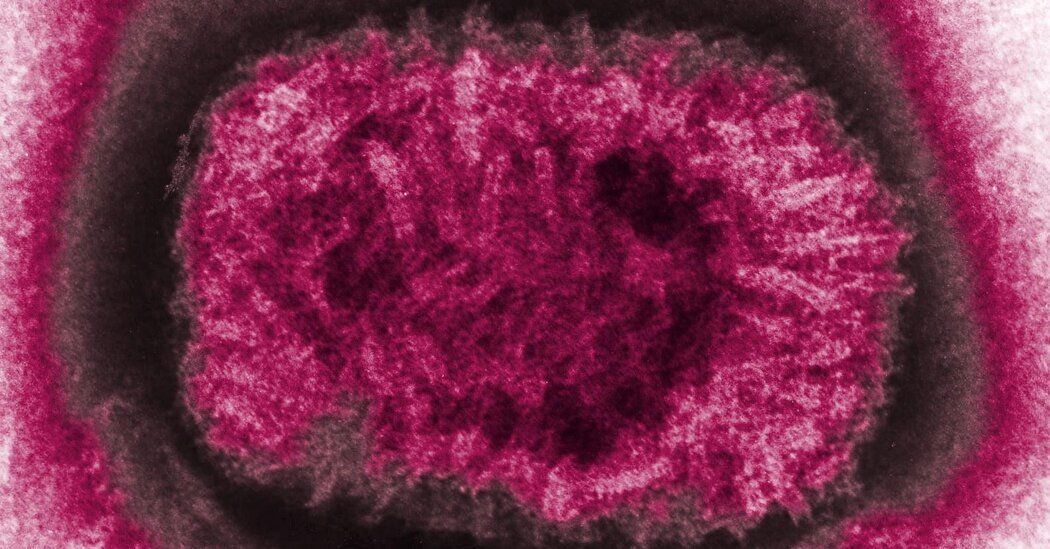
Perhaps no disease has inspired more terror than smallpox. Edward Jenner, who invented the smallpox vaccine in 1796, called it “the most dreadful scourge of the human species.” In the 20th century alone, smallpox is estimated to have killed 300 million people. The eradication of the virus in the 1970s stands as one of the great triumphs of medicine. And yet, five decades later, smallpox still haunts us, as the world worries about its resurrection as a biological weapon.
For all the anxiety that smallpox inspires, its history remains remarkably mysterious. Researchers don’t know how smallpox first evolved or how long it has plagued humanity. But over the past decade geneticists have offered a new line of evidence, as they find smallpox DNA still lurking in the bodies of people who died centuries ago.
On Thursday, researchers revealed the latest genetic trace in a paper published in Science. For the first time, they have found ancient smallpox genomes from the Americas, hiding in skeletons in Chile that date back about 500 years.
These DNA fragments have prompted scientists to think about smallpox in a new light. It may not have begun as the dreaded killer we think of it as today. It’s possible that it was a relatively mild infection for centuries, taking many generations to evolve into Jenner’s dreadful scourge.
Hendrik Poinar, an expert on ancient smallpox at McMaster University in Ontario, Canada, who was not involved in the new study, said he was not aware of any other disease that had taken such a course. “This is very strange,” he said.
Scientists generally agree that the smallpox virus jumped into humans from another species. Other animals carry a variety of related viruses, but scientists have yet to find a virus that could have been the forerunner.
“We’re not any closer to knowing the actual reservoir species from which smallpox came, which to me is kind of amazing,” Dr. Poinar said.
To understand when smallpox first started killing humans, researchers have looked at mummified remains, searching for the sores and scars the virus creates. The mummy of Pharaoh Ramses V, which dates back 3,000 years, has pockmarks on its cheeks; many experts have suggested it’s the oldest trace of smallpox in human history.
But Dr. Poinar no longer shares that view. “I don’t buy Ramses,” he said.
Dr. Poinar changed his opinion after he discovered how well other pathogens can mimic smallpox. He and his colleagues examined the body of a child who had died in Italy nearly 500 years ago, considered the oldest physical evidence of smallpox there.
But Dr. Poinar and his colleagues found no smallpox DNA. Instead, they found genes from hepatitis B, which can cause a facial rash that resembles smallpox sores.
In 2016, Dr. Poinar and his colleagues offered up far more compelling proof of ancient smallpox: its DNA. They found genetic fragments of the virus in the body of child who lived in Lithuania in the 1600s.
Four years later, another team of researchers discovered smallpox DNA, in the leg of an 18th century infant preserved in a London museum. Even more surprising was the discovery by other researchers of four smallpox genomes from the Viking Age, in the bones of northern Europeans who had lived between 1,000 and 1,400 years ago.
The newest discovery of ancient smallpox was made 4,000 miles to the east, on a cliff-edged stretch of coastline in northern Chile, at a site called Camarones 9. It was there, in the 1950s, that archaeologists discovered an Incan cemetery.
Recently, researchers at the University of Chile took a fresh look at the cemetery remains, using new techniques to search for DNA, including for genes of viruses and bacteria. The scientists sifted through vast amounts of DNA left behind by soil microbes that had fed on the bones.
Constanza de la Fuente Castro, a biological anthropologist at the University of Chile and an author of the new study, said she had hoped they might find DNA from tuberculosis, which was present in South America long before the arrival of Europeans.
“Smallpox was definitely not in our picture,” she said.
But when she and her colleagues had finished searching through their data, they came up with genetically identical smallpox viruses, infecting a man and a woman who lived some time between the late 1400s and early 1600s.
Dr. Castro and her colleagues then compared the genetic sequence of the Camarones 9 viruses to older and younger smallpox samples. Based on the similarities and differences in the viral DNA, the researchers drew a family tree.
All known smallpox viruses appear to share a common viral ancestor that existed about 1500 years ago. As the smallpox virus found new people to infect, its descendants split into distinct branches of the family tree.
The Viking viruses belong to branches that are not closely related to any modern smallpox strains. It appears that they became extinct centuries ago.
The Camarones 9 viruses from Chile occupy an intermediate spot on the smallpox family tree. They’re more closely related to modern smallpox than the Viking viruses. But they split off on a distinct branch of their own, which also appears to have disappeared. The viruses from Lithuania in the 1600s and England in the 1700s, in contrast, are very closely related to modern strains of the virus.
Over the centuries, Dr. Castro and her colleagues found, smallpox had undergone a striking transformation. Mutations arose that completely disabled some of its genes.
By the time the Viking smallpox viruses evolved, over two dozen genes had been shut down. Even more were lost in the Camarones 9 viruses. And by the 1600s and 1700s, the viruses from Lithuania and England had lost even more.
“By our rough calculation, it looks like one or two genes per century,” said Shigeki Nakagome, a geneticist at Trinity College Dublin and an author of the Camarones 9 study.
Losing genes may have actually made smallpox better at infecting humans. The virus may have abandoned ones that had helped it infect other species. Over centuries, it became more efficient at multiplying inside human cells. And as it churned out more new viruses, smallpox may have grown deadlier.
In other words, early smallpox viruses might have been relatively mild. Dr. Poinar noted that there are no written records of smallpox outbreaks in northern Europe during the period of the Viking viruses. It’s possible that most people regularly survived smallpox and gained immunity to it.
The Camarones 9 study suggests that when the Spanish came to the Americas, they brought with them smallpox viruses that had been circulating in Europe in the 1400s; ultimately the viruses reached Indigenous people living in remote communities.
Historians have long suspected that Europeans brought smallpox to the New World, and that it then helped drive down the populations of Indigenous people there. But many historical records of outbreaks are ambiguous.
Sébastien Calvignac-Spencer, an evolutionary biologist at the Helmholtz Institute for One Health in Germany, said the new study dispels any doubt that smallpox played a role in the devastation of the Americas.
“It confirms that the virus was already spreading in the Americas at this time,” said Dr. Calvignac-Spencer, who was not involved in the new study.
Several factors could have made it deadlier in the Americas. For starters, people there had no immunity to the new virus. And the famine, slavery, and poverty ushered in under colonial rule could have weakened their defenses even further.
“Because the Native Americans had zero exposure to the virus, it caused a lot of problems in their societies, even if it was milder to Europeans,” Dr. Nakagome said.
But smallpox was still not done evolving, the new study suggests. It’s possible that the disease reached its modern levels of lethality in the 1700s. Dr. Poinar speculated that the growing population in Europe might have allowed smallpox to become even deadlier. Even if it was more likely to kill off a host in an epidemic, it was also more likely to find a new host to infect.
This scenario may fit the evidence that scientists have found so far, but there are huge swaths of history they don’t yet understand. Most of the research on ancient DNA has traditionally focused on Europe, but historical records suggest that smallpox also circulated in parts of Africa and Asia for centuries.
“All of these are total black boxes,” said Dr. Calvignac-Spencer. “Until we fill in these gaps, it would be difficult to create a global history of such an important disease.”

