
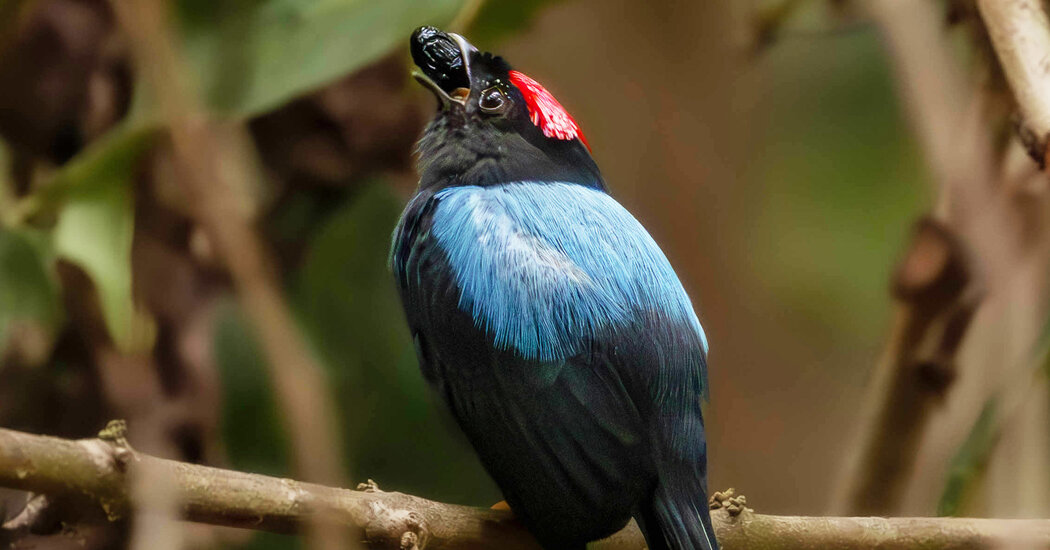
Manakins can move so quickly that they often appear only as blurs of blue or red as they flit along the rainforest floors of South and Central America. The males, known for their elaborate courtship rituals, snap their wings, spin around their rivals and even do backflips to woo potential partners.
Where do they get the energy? Previous studies have shown manakins possess fast-moving muscles and hearts that can manage short bursts of intense activity. Now, genetic research suggests that these evolutionary adaptations were made possible by an important dietary change: Before they could dance, manakins had to be able to detect and digest sugary fruits.
“This is such a wonderful aspect of the study,” said Maude Baldwin, an evolutionary biologist at the Max Planck Institute for Biological Intelligence in Germany and an author of the study, which appeared on June 10 in Current Biology. “We were able to dig into the evolutionary history of their relationship with fruit.”
The first bird genome was sequenced more than 20 years ago, gathered from a wild species of chicken known as red junglefowl. The breakthrough gave researchers their first glimpse of avian genes and what they reveal about how birds experience the world. Notably, red junglefowl lacked a taste-receptor gene that had allowed birds earlier in evolutionary history to detect sweet flavors. (The gene is still present in mammals.)
Subsequent genetic research in other species confirmed that birds lost the taste receptor for sweetness back in the days of dinosaurs and were “ancestrally sweet-blind,” Dr. Baldwin said. But some fruit and nectar eaters found their way to sweetness anyway: They gained the ability to taste plant sugars using the receptor that mammals use for savory, umami flavors.
The new study sequenced the genomes of five manakin species, and it confirmed that manakins can taste and easily digest sugar from the fruits they eat. This adaptation gave them access to the energy they need for their spectacular shows.
“This led me to appreciate that feeding is not merely about obtaining nutrients, but may also be a driving force behind the generation of biodiversity,” said Yasuka Toda, a food scientist at Meiji University in Japan and an author of the study.
To draw this link between diet and behavior, the researchers compared the genomes of species that split off from the common ancestor of manakins at different moments in time. This enabled the scientists to reconstruct the order in which the manakin’s physiological and behavioral traits evolved.
As it turned out, even before manakins gained the ability to taste sugar using the umami receptor, they acquired a change to the gene that, in humans, helps to digest lactose. Scientists think that, in birds, this gene might help mitigate harms from natural toxins or fruit compounds that are difficult to digest. Only later did manakins gain the genes behind their energetic dance routines and colorful ornamentation — made possible, researchers believe, by the birds’ calorie-dense diet.
“We’ve been in this age of genomics for a while, but it’s still hard to get really high-quality genomic data,” said Sushma Reddy, an evolutionary biologist and ornithologist at the University of Minnesota, who was not involved in the new study. “So this is a really great study, because we can actually make those connections to actual traits.”
The study’s authors hope that their interdisciplinary approach will inspire other scientists to uncover new information about manakins and other birds.
“There are so many sort of hidden surprises and hidden insights that you can get from studying the genomes of diverse organisms,” Dr. Baldwin said. “Evolution has come up with a million different ways to solve problems and different mechanisms, and we’re only aware of a small number of them.”

