
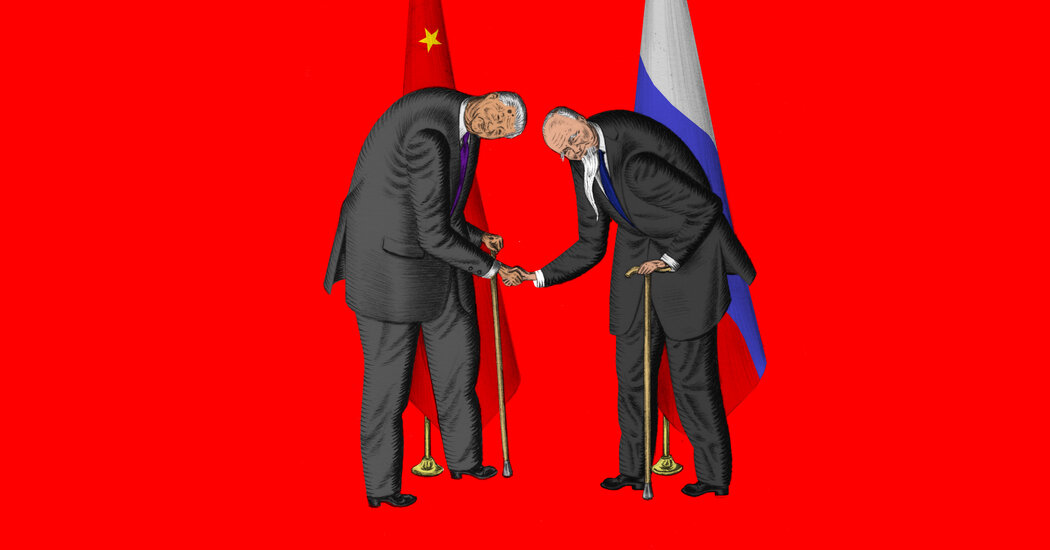
Xi, it seems, is less concerned with personal immortality than Putin. Watching that hot-mic clip, it’s easy to imagine that he was really just indulging the eccentric preoccupations of his Russian counterpart, if for no other reason than it was something to talk about while they walked to the podium. But in 2018, Xi rescinded a two-term limit on the presidency that had been in place for decades, removing any legal barrier to his serving as leader for life.
And like Putin, he is driven by a desire to restore his country to a former imperial grandeur; “the great rejuvenation of the Chinese nation,” and the redressing of humiliations imposed on the country during the 19th and early 20th centuries by Western imperial powers, have been presiding goals of his premiership. China’s seemingly inexorable rise, under Xi’s leadership, to global hegemony secures him a kind of figurative deathlessness. It’s not quite immortality, but it’s not nothing either.
The obsession with bodily immortality has a long pedigree in Chinese history. Chinese alchemists believed that they could synthesize gold through compounds of arsenic and lead and mercury, and that drinking such compounds in a liquid form might impart the metal’s incorruptible essence to the human body. (“The 24 Histories,” a collection of the official chronicles of the Chinese dynasties, records that drinking the golden elixir caused the deaths of no fewer than six emperors of the Tang dynasty alone.)
The symbolic connection between gold and immortality transcends cultures and historical periods. For the ancient Egyptians, gold was associated with the life-giving power of the eternal sun, and for the alchemists of medieval and early modern Europe it was both a symbol and a potential source of eternal life. Because of its comparative rarity, and because it is a metal that does not tarnish or corrode with time, gold became the universal substance of wealth, something that could be passed on to descendants, as kings handed on power to their heirs. A person could live on in his money, as he lived on in the structures it built: the temples, the cathedrals, the libraries and galleries and opera houses, the technologies and the social orders.
These lines of magical thinking have now been rewoven in a more technologically sophisticated form. In his 2023 “Techno-Optimist Manifesto,” the billionaire venture-capitalist Marc Andreessen made the following assertion: “We believe artificial intelligence is our alchemy, our Philosophers’ Stone — we are literally making sand think.” This was something of a tell, this invocation of the Philosophers’ Stone: a mythical material that the alchemists of antiquity and the Middle Ages believed could transmute base metals into gold, and could be used to produce a potion that granted its drinker eternal youth. This is the promise of technology, that it will intercede between us and our deaths. This is the promise of money itself.

