
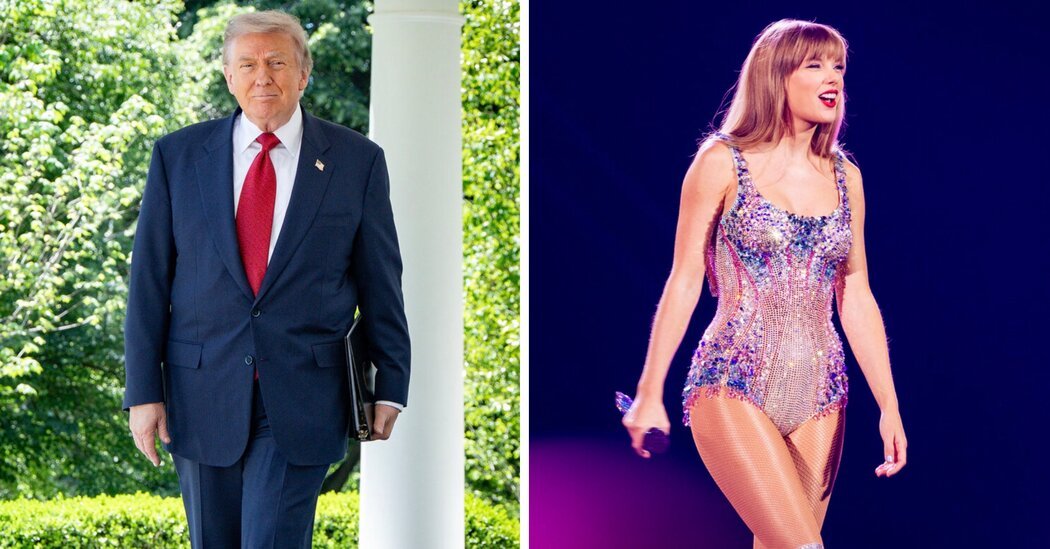
Call it a quirk of wedding planning or the battle for the Fourth of July, but the coming weekend is shaping up to be a culmination of a decade-long cultural Cold War between two of the world’s most famous people: Taylor Swift and Donald Trump.
Over the years, the two have traded quips and barbs about everything from political endorsements and social movements to football games and personal appearance, with the president usually the instigator of such beefs.
Swift, 36, is expected to celebrate her wedding to Travis Kelce, the Kansas City Chiefs star tight end, in a multiday affair at Madison Square Garden, though details about the event have been state-level secrets.
Considering the anticipation surrounding the Swift-Kelce nuptials, the celebration is shaping up to feel like an American royal wedding, expected to draw celebrities from around the world — and potentially a horde of fans and onlookers.
Fans were already making pilgrimages to the streets around the arena as setup was underway. On Thursday evening, there is expected to be a rehearsal dinner of about 100 people in the Infosys Theater, not the main arena, a person familiar with the plans told The New York Times.
On Friday, about 1,000 guests will convene for a cocktail hour, kicking off a larger event. The dress code is black tie. The two events will have no-phone policies for all guests, vendors and security, the same person said. Security will be high.
Meanwhile, in Washington, Trump, 80, is planning a celebration on the National Mall on Saturday to celebrate the nation’s 250th birthday, a self-described “TRUMP RALLY” that promises flyovers, military bands and the “LARGEST FIREWORKS SHOW IN HISTORY,” including hundreds of thousands of explosives.
Taken together, the two events represent a nearly simultaneous flex by two supersize constants in American culture, both at world-famous venues, M.S.G. and the White House, with nothing more at stake than the attention — and potential adoration — of a nation celebrating its 250th birthday.
The president and the pop star have seemingly circled each other in the public sphere for years, including at the Super Bowl in 2025, which they both attended (though not together). The president later ribbed the singer while greeting the Philadelphia Eagles, which beat Kelce’s Chiefs, at the White House.
“I was there along with Taylor Swift,” Trump said to the Eagles. “How did that work out?”
Last August, the president posted a lengthy Truth Social, accusing Swift of being “woke” and adding that the singer was “NO LONGER HOT.”
The two also nearly collided during the New York Knicks recent championship run. The president attended Game 3 at the Garden and the team lost, while in Game 4, which Swift attended, the team won (mounting the largest comeback in N.B.A. Finals history).
In many ways, the dynamic has been that of a conversation carried out by the most powerful man in the nation with its biggest pop star; a president who has had to publicly address performers dropping out of his event, while Swift’s guest list is bound to include a roster of stars.
Indeed, his frustration at Swift was never more evident than in his four-word post in September 2024, just after she endorsed his political opponent, Kamala Harris: “I HATE TAYLOR SWIFT!”
For her part, Swift has not directly responded to the president’s remarks — including his comments last year about her looks and popularity. And while it is unlikely that Swift was intending for her wedding to compete with the president, comparisons are inevitable, perhaps even in the Oval Office.
“Do I think that she did this to upstage Donald Trump? Absolutely not,” said Susan Del Percio, a Republican political consultant who has been critical of the president. “Do I think Donald Trump thinks that she did this to upstage him? Absolutely. Because that’s the way he thinks.”
A representative for Swift did not comment. The White House did not respond to requests for comment.
For all the seeming antipathy, there are similarities between Trump and Swift: both are masters of commanding attention, and neither has shied from attacking those they feel have wronged them — Swift in songs about disappointing romantic partners, the president with political opponents.
Both are savvy social media operators with rapturous fan bases, cultivating and capitalizing on their own brand of authenticity to create a sometimes intense parasocial relationship between themselves and tens of millions of their followers.
Stephanie Burt, a professor of English at Harvard University who has taught classes on the songwriter, said that both Trump and Swift could also be seen as having a gift for coining memorable phrases, and for delivering them, calling the president “some combination of a playground bully and a talented insult comic.”
Swift has sometimes also shown a sharp tongue, and pen, when it comes to perceived slights, including in her recent song “Actually Romantic,” which many interpreted as a response to the track “Sympathy Is a Knife,” by the pop star Charli XCX, which tracked the inner life of an insecure woman. Other Swift songs have also led some critics to accuse her of being petty, or worse, uninspired. Ex-boyfriends like Jake Gyllenhaal have been rumored to be referenced in songs like “All Too Well,” and — as is their way — piled on by her army of Swifties.
At the same time, Swift’s last album also included a song, “Wish Li$t,” which was interpreted by some right-wing commentators as an endorsement of traditional marriage and tradwife culture.
E. Michele Ramsey, a professor of communication arts and science at Penn State Berks who has taught classes on Swift, said such a prism of opinions was common when it came to the singer.
“Pretty much anything Taylor Swift does becomes this cultural conversation,” Ramsey said. “She’s one of those people who becomes the vehicle through which we talk about a lot of this stuff.”
Swift’s broad appeal also extends to conservatives like Jenna Piwowarczyk, a senior at Concordia University in Mequon, Wis., who found internet fame in 2024 after she wore a homemade “Swifties for Trump” shirt while meeting Trump. (The president later posted a photo of Piwowarczyk, along with several A.I.-generated images, suggesting a false endorsement from Swift.)
Piwowarczyk, 21, said she felt Swift’s wedding and Trump’s celebrations in Washington had some values in common.
“It’s really about going back to core roots of American traditionalism,” she said. “This weekend isn’t actually about politics at all. It’s more about the concept of inalienable rights and liberties that only God can give us.”
Alexis Coe, a presidential historian and author of the George Washington biography “You Never Forget Your First,” noted that the Fourth of July weekend has been linked to Swift, due to her well-documented celebrity-filled parties for the patriotic holiday, which some fans called “Taymerica.”
“Taylor Swift has long associated herself with Americana, literally, as a brand,” Coe said.
Some of the comparisons between Swift and Trump may stem from the president’s pursuit of celebrity approval and cultural cachet that has appeared to animate his second term. That includes his takeover of the Kennedy Center and his attempt to stage a series of concerts for the Great American State Fair event on the mall, an effort hindered by artists dropping out, leading Trump to disavow the planned shows.
Swift, a teen country phenom who grew into a global superstar, was long hesitant to weigh in on politics, something she reflected on in the 2020 documentary “Miss Americana,” mentioning what happened to the Chicks, the country band that was blacklisted after criticizing President George W. Bush in 2003.
But in 2018, she endorsed two Democratic candidates in Tennessee’s midterm elections and decried the positions of Representative Marsha Blackburn, a hard-right Republican running for Senate.
Running in a deep-red state, Blackburn won anyway.
In 2020, Swift grew more direct in her criticism, tagging the president in a post on X and accusing him of “stoking the fires of white supremacy” in the wake of the killing of George Floyd. “We will vote you out in November,” the singer wrote. She endorsed Joe Biden that year, and Vice President Harris four years later, signing her post as a “childless cat lady,” a reference to JD Vance’s disparaging remarks about Democratic women.
Swift’s songs have spoken to issues like double standards related to women in “The Man” and support for gay and transgender rights in “You Need to Calm Down,” that included lyrics some believed were a reference to Trump’s online posting. (“Say it in the street, that’s a knockout/But you say it in a tweet, that’s a cop-out.”)
One of her most overtly political songs, “Only The Young,” a tune about challenging young people to make change, is a favorite of New York’s Mayor Zohran Mamdani, a democratic socialist.
Kevin Evers, the author of “There’s Nothing Like This: The Strategic Genius of Taylor Swift,” said that Swift had been “very selective” as to when and where to dip into politics.
“I think speaking out does come at somewhat of a risk for her,” Evers said. “And I think she’s smart enough not to get into a back and forth with President Trump.”

