
In 1976, Manhattan’s great art museums went big for the Bicentennial: American masterpieces at the Metropolitan Museum of Art; the nation’s Romantics at the Modern; our sculptors, then and now, at the Whitney.
Fifty years later, the semiquincentennial barely gets a nod. The Met has one little room of objects from the founders’ era. The Museum of Modern Art has folk art displayed “on the occasion of the country’s 250th anniversary,” but with no obvious link to that birthday. At the Whitney Museum of American Art, the 250th doesn’t rate a mention.
But over at the New York Public Library, a truly ambitious mix of nationhood and art is on display.
Spread across the top floor of the library’s grand Fifth Avenue flagship is “Art as Declaration,” an exciting spread of photos, drawings, videos and objects that aims to consider how American artists of the past few decades “have reframed and reimagined the promises of the country’s founding documents.” (Some of those documents, including one of Thomas Jefferson’s handwritten copies of the Declaration of Independence, sit in a pair of historical displays on a floor below.)
The walls in “Art as Declaration,” which runs through Jan. 10, come topped with texts from America’s origins as a nation. One quotes our constitution’s prohibition of laws promoting “an establishment of religion, or prohibiting the free exercise thereof; or abridging the freedom of speech.” Another cites the same document on “the right of the people to be secure in their persons.” A quote from the Declaration of Independence chides George III for having “endeavoured to prevent the population of these States” by throttling immigration.
Below those ancient words comes the recent art. It spoke to me not so much for how it addresses the quotes, but for how well it captures their four-square, declarative spirit. That’s the brilliance of the show: Although a lot of its artworks could easily be read as critique, they almost always come closer to demonstration than polemic, to showing than telling — the way the Declaration of Independence asserts that we are all “created equal,” instead of setting out to argue the point.
The Declaration’s quote on migration has a counterpoint in photographs, captured in 1995, from the “Migrantes” series by Joseph Rodriguez. They have a down-home directness worthy of Ben Franklin. They simply document Mexicans — soon, maybe, to be Mexican Americans — as they flow into and then across the United States, encountering such sites as Eero Saarinen’s St. Louis arch, the so-called gateway to the West.
The Constitution’s effort to keep Americans “secure in their persons” comes paired with portraits of how that might not be so easy to guarantee in a world of digital intrusions.
In “A New American Picture,” a 2007 project from the early days of Google’s Street View, Doug Rickard captured frames from Google’s record of America’s less prosperous streets, and fed them back to us as an image of the fractured country we live in. Not all of our streets are so painful to see, but in our digital age almost all of them are now there for the seeing.
In a similar vein, for a 2012 series called “Photographs in 3 Acts” Ethan Levitas identified the surveillance cameras that now intrude on our “persons” almost anywhere we go. He then used his cumbersome sheet-film camera to record the same image the CCTV might have captured, but in glorious color, at the highest analog resolution. His glowing photos put our world’s lurking surveillance on view.
The N.Y.P.L. has not included a quote about the Constitution’s “right to bear arms”; its meaning might be too contested, these days, to bear such brief examination. But a photograph that speaks to the free exercise of our worship also talks about how we arm ourselves. From a series that documents Americans “who have made the decision to live well outside of normative lifestyles,” says a wall text, Lucas Foglia presents an image of a modestly dressed Christian girl whose community believes in a return to holier, unmodern ways — except maybe for the looming shotgun she’s pointing straight at Foglia’s lens. W.W.J.D., I wonder, if offered such a weapon?
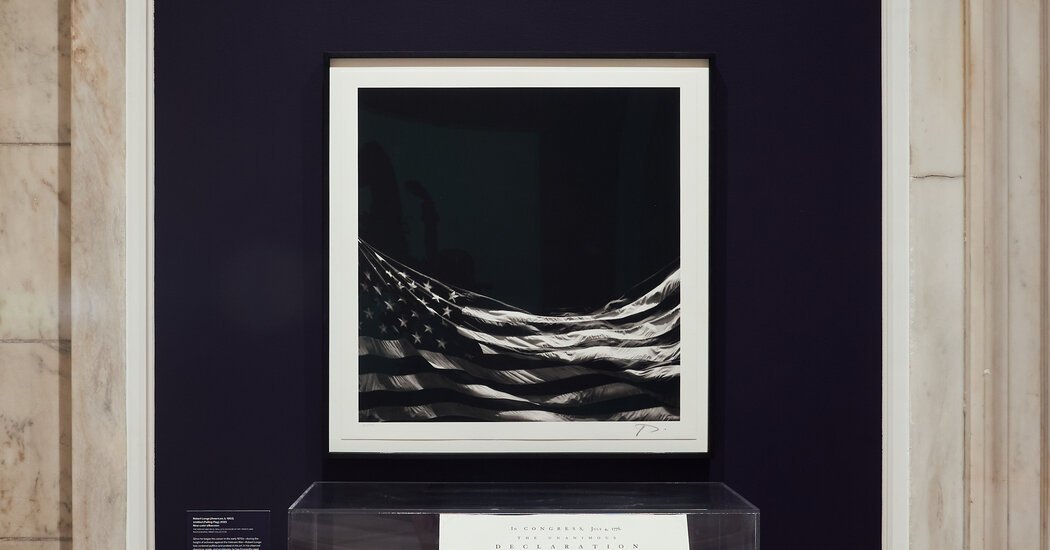
Not all 39 works in the show are as strictly documentary as the photos I’ve cited. The art stars Kara Walker and Glenn Ligon give us handcrafted pictures that riff on American history and its imagery; the show’s four videos are all of dance. But a sense of documentation, of a national accounting, lurks throughout. Even Robert Longo’s silkscreen of the American flag doesn’t seem to take a position on that symbol: Although it’s subtitled “Falling Flag,” the Stars and Stripes might just as well be rising.
I’ll close this review on an artwork that’s an actual document — just a single typewritten sheet — whose aspirational flavor echoes documents from the nation’s founding. Zoe Leonard’s “I Want a President” presents a list of the kinds of Americans she’d like to see have a chance at the White House: poor people, sick people, gay people. “I want a Black woman for president,” she writes. “I want someone with bad teeth, someone who has eaten hospital food, someone who cross dresses and has done drugs and been in therapy. I want someone who has committed civil disobedience. And I want to know why this isn’t possible.”
Don’t most Americans have a list of their own, and don’t they ask a similar question — even on the Fourth of July?

