
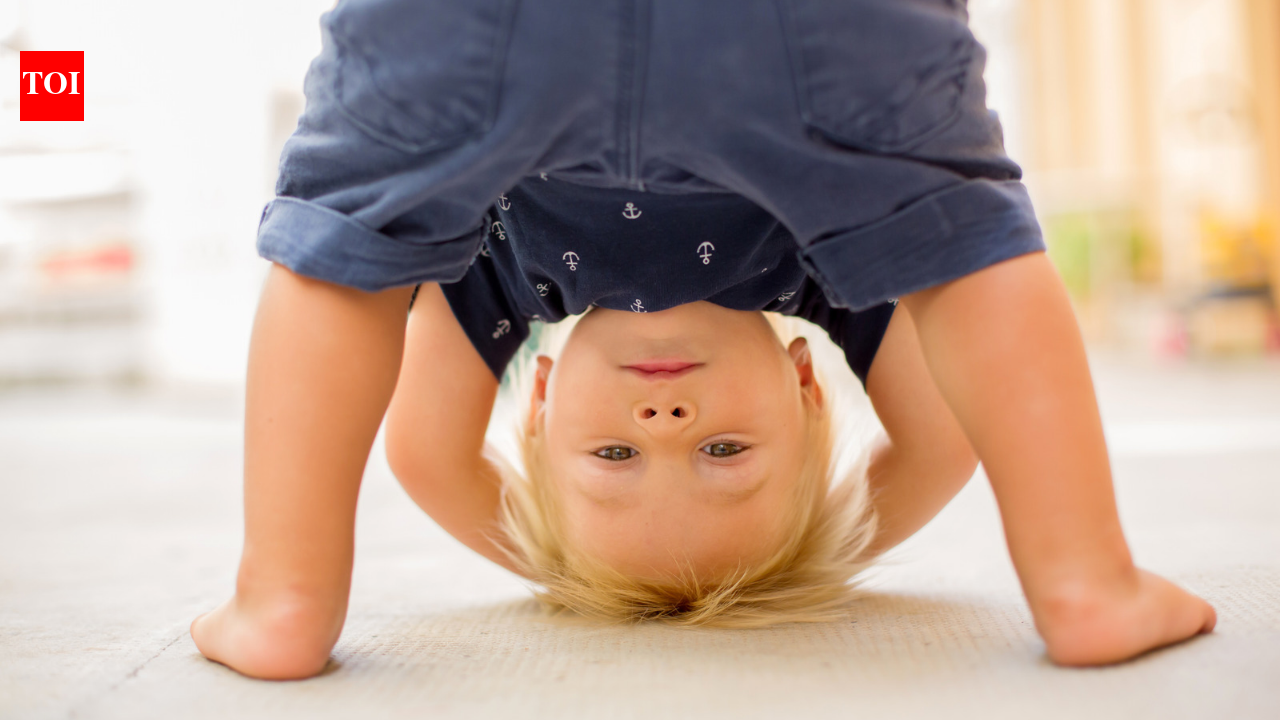
You may have seen your child bend forward, tuck their head between their legs and look at the room upside down. A familiar face, the living room sofa or a parent standing nearby suddenly becomes something to look at from an entirely different angle. The child may giggle, move around to get another view or repeat the action without any apparent reason.For adults, it can look like an amusing little habit. But this unusual way of looking at familiar surroundings raises an interesting question: what happens when children change their viewpoint and see something they already know in an unfamiliar way?
8 Oct 2026 | 14:25
What is the hardest part of raising a toddler that nobody prepared you for?
Developmental psychology offers some clues through research on visual perception, object exploration and how children learn to interpret the world around them. However, there is an important distinction: scientists have studied how children explore objects and process unusual visual information, but this does not mean that every child who looks through their legs is consciously trying to learn something.
Children learn by changing how they see things
Much of what children learn about their surroundings comes through active exploration. They do not simply receive information through their eyes; they move, reach, turn objects and change their position to discover what things look like from different viewpoints.A study published in the journal Infant Behavior and Development examined how children between 12 and 36 months explored objects visually and manually. Researchers recorded the viewing patterns of 54 children and compared them with those of 17 adults.The findings revealed that children developed preferences for looking at objects from particular angles, especially views that showed their surfaces clearly and kept objects upright. These preferences became more pronounced during the first three years of life and were also evident in adults.The research suggests that the way children look at objects is not entirely random. Their movements influence the visual information they receive, and the views they select are relevant to how they recognise objects.When a child bends down to look at a familiar room from between their legs, the unusual position changes the visual information available to them. The room has not changed, but its orientation and appearance have.That does not prove the child is deliberately experimenting with perception. It does, however, offer a useful way to understand why changing viewpoints can be part of early exploration.
Why does the familiar world look different upside down?
Try looking at your own room while bending forward. The furniture, doors and people are still recognisable, but their positions appear reversed. The experience can feel surprisingly different despite the surroundings remaining unchanged.Research has examined some of these perceptual changes. In a 2011 study published in Attention, Perception, & Psychophysics, researchers Atsuki Higashiyama and Miyuki Toga investigated why pictures viewed from between the legs can appear brighter and more distinct. Their study, titled Brightness and image definition of pictures viewed from between the legs, examined the factors contributing to this change in visual experience.An earlier study, The moon illusion: a different view through the legs, published in 1992, explored how viewing a scene upside down affected the familiar illusion in which the moon near the horizon appears larger than when it is high in the sky. In an experiment involving 70 participants, the illusion was reduced when people viewed inverted scenes.These studies were conducted with people viewing scenes under specific conditions; they did not establish why young children spontaneously bend down to look between their legs. Nevertheless, they demonstrate that changing the orientation of a visual scene can alter how it is perceived.For a child, this creates an opportunity to encounter familiar surroundings in a different visual arrangement. Whether the child is consciously curious about the effect or simply enjoying the unusual sensation cannot be determined from the action alone.
Children are still learning how to interpret what they see
Seeing something from a different angle is one part of a broader developmental process: learning to understand visual information and how viewpoints relate to one another.A 2014 study published in Frontiers in Psychology examined visual perspective-taking in 80 children aged four to eight. The researchers asked children to identify which pictures represented scenes viewed from different positions.The findings showed that performance improved with age. Four-year-olds found the tasks difficult, while children’s ability to identify another viewpoint improved notably around ages six to eight. There were also considerable differences between individual children.The study was about identifying other viewpoints in pictures, not bending down to look at the world upside down. Its findings nevertheless illustrate that understanding how a scene looks from a particular position involves skills that continue to develop throughout childhood.This is an important distinction for parents. A child looking at a room upside down is not necessarily demonstrating advanced perspective-taking. Rather, the behaviour offers an everyday example of how children encounter the world from different physical positions while their visual and spatial understanding develops.

Photo: Canva
Why children may repeat this unusual action
If your child repeatedly bends forward to look through their legs, you may wonder why they keep doing it when the room looks the same each time.There may be several explanations. The unusual view might simply be entertaining. The child may enjoy the physical movement, find the altered appearance interesting or discover that the action reliably gets a reaction from family members. Different children may repeat it for different reasons.Research published in 2026 in The Quarterly Journal of Experimental Psychology examined how children attend to objects that appear upside down within otherwise ordinary scenes. Researchers Elizabeth A. G. Watson, Louise Ewing and George L. Malcolm studied children aged five to six, children aged nine to ten, and adults using eye-tracking methods.The younger children were quick to notice inverted objects but spent more time examining them than older children and adults. The researchers suggested that younger children may devote additional attention to unusual objects as they process inconsistencies in a scene.Again, this was not a study of children bending between their legs. It examined inverted objects in pictures, so its findings cannot establish the motivation behind the behaviour in question. However, it offers an interesting insight into how children of different ages respond to visual information that does not match the expected arrangement of a scene.A child who changes their viewing position may simply be enjoying a different experience of the same surroundings. The action alone cannot tell us whether the child is exploring, playing or responding to something else.
Should parents encourage it or stop it?
In most cases, there is no need to attach a special developmental meaning to this behaviour. If a child occasionally bends forward to look at the world upside down, appears comfortable and returns to other activities normally, parents can treat it as ordinary exploration.Rather than immediately correcting the child or insisting that they explain why they are doing it, parents can observe what happens next. Does the child laugh and move on? Do they try looking at different objects? Are they playing a game with someone else?These observations provide more context than the posture alone. Parents can also ask a simple, open-ended question, such as, “What does the room look like from there?” This gives the child an opportunity to describe the experience, if they want to.Safety matters, particularly if the child is bending near furniture, stairs or hard surfaces. Parents should ensure there is enough space to move without falling or hitting their head.There is no reason to assume that the behaviour indicates unusual intelligence, exceptional creativity or a particular personality trait. Nor should parents treat it as a developmental concern simply because it looks unusual.The takeaway: A child looking at the world between their legs may be playing, enjoying a different visual experience or exploring their surroundings. Research on visual perception and children’s exploration helps explain why changing viewpoints can be interesting, but it does not establish one universal psychological reason for this specific action. The most useful response is to remain curious about the child without reading more into the behaviour than the evidence supports.


