
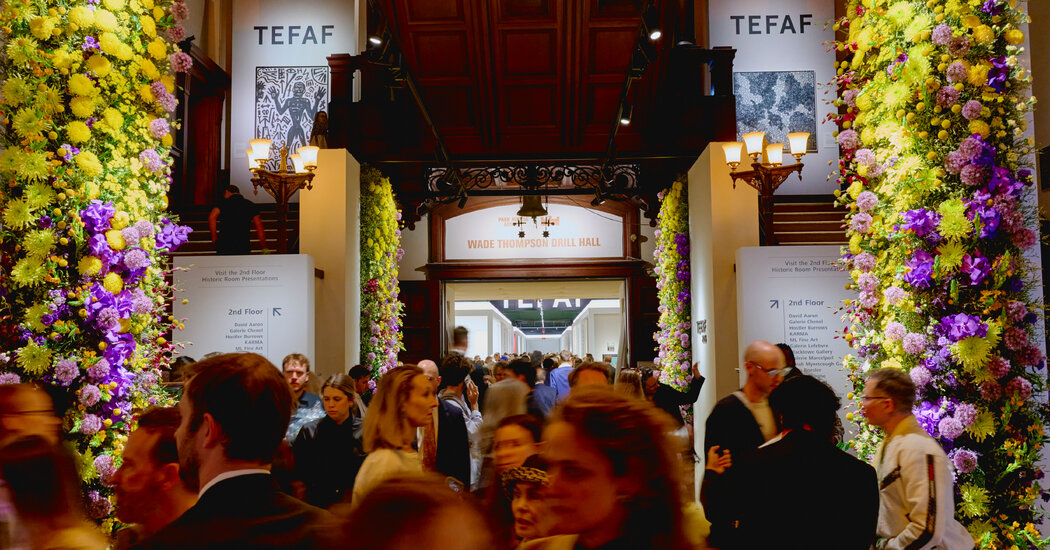
“Two days in London, two days in Paris, two days in Brussels, two days in Venice,” a jet-setting patron at the V.I.P. preview of TEFAF, the premier art and antiques fair, said on Thursday — adding a lament: “It just puts me in a bad mood.”
The woman and a companion had joined hundreds of other well-heeled patrons standing in line at the Park Avenue Armory, as if waiting for an imaginary start gun to sound, to frantically funnel, braced behind their Birkins, through security and race through flower-bedecked portals and into carpeted halls filled with the material wonders of the ages.
This has happened semi-regularly for the past decade, when the European Fine Art Foundation alights in Manhattan from its home in Maastricht, the Netherlands, to stage this billionaire version of the classic television game show “Supermarket Sweep.” And if the atmosphere this time was unusually buzzy, perhaps it was in response to a resurgent stock market or else to the servers circulating with trays of free rosé Champagne.
During several tours of the fair on a fine spring afternoon, it appeared — superficially, at least — to this observer as if wars, inflation, oil blockades and government stagnation had negligible impact on that group most likely to be affected by the proposed pied-à-terre tax. That is, the billionaire class.
“Money, money, money, money, money,” Wendy Goodman, the design editor of New York magazine, said as she surveyed the Armory’s vast interior, which echoed that day with lively conversations in German, French, Italian and Spanish and both American and British English.
Among them, the Christie’s, Sotheby’s and Phillips auction houses aim to sell more than $2.6 billion in art over the next week. Much of it is work of impeccable provenance and matchless quality. Artworks from the estates of the publishing magnate S.I. Newhouse, the philanthropist Agnes Gund and the dealers Marian Goodman and Robert Mnuchin will all come on the block, and this rare confluence of collections has had a bracing effect on a market that, not long ago, was retrenched. Eleven of those lots are conservatively estimated to realize more than $50 million each.
“Our entire system of status has moved toward money,” said the art dealer Jeanne Greenberg Rohatyn. “I’ll probably be killed for saying this,” she added as she stood at the entry to a plush booth operated by her Salon 94 gallery. “But we used to privilege culture, and that system is disappearing, and we need to talk about that.”
In the meantime, why not stop for an oyster? Circulating through the 55,000-square-foot drill hall — where, this year, 88 galleries from around the world exhibited their wares beneath a vast barrel roof — were men and women wearing leather aprons, chain-mail gloves and murderous-looking shuckers. From aluminum buckets slung at their waists they plucked and deftly cleaved the briny mollusks. “It’s called Oystertainment,” said one waiter, Haydn Harvey. And, indeed, Oystertainment is a trademarked term registered to the New York-based catering company Red Oyster.
As it happened, Harvey was shucking just outside a booth operated by Galerie Chastel-Maréchal, Paris-based antiquarians specializing in apex 20th-century French decorative arts. Near the entry stood Alexandre Maréchal, a scion of the family that owns the gallery. Asked to identify noteworthy distinctions between connoisseur collectors of the past and those from among the growing ranks of modern billionaires, he had a one-word reply: advisers.
“The new rich have one, two, three advisers,” he said. “And they think more about the investment quality of what they are acquiring, what it will be worth at resale in three years.”
And what about the aesthetic value? “They still love the work,” he said.
For Simona Fantinelli, a private art adviser based in Zurich, the appeal of fairs like TEFAF for those at the upper end of the market goes well beyond the transactional. “The pursuit of beautiful things is still a magical aspect of our world,” she said. “It is much more than finding the right art for your mantelpiece.”
She herself was pitching a rare pierced aluminum work by the Italian-Argentine artist Lucio Fontana to a client. It was being offered by the ML Fine Art gallery of Milan at a little over $1 million. “People are wary, of course, and risk averse, and I understand that,” Fantinelli said. “But you should not forget how much walking into a room and being surrounded by beautiful objects can change your life.”

