
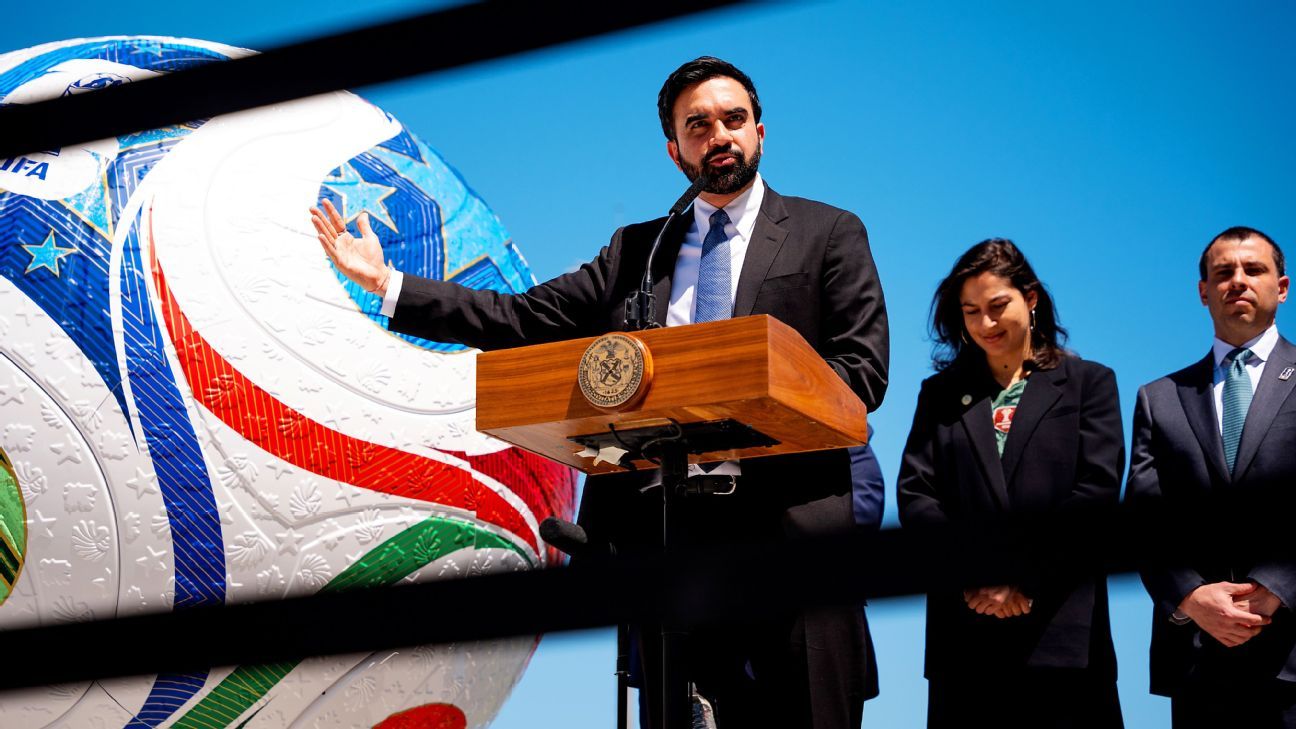
A few weeks after New York City Mayor Zohran Mamdani won election, the noted soccer fan said he was excited that New York would be hosting eight World Cup games.
Across the Hudson River in New Jersey, then-Governor-elect Mikie Sherrill shot back, “With all due respect to Mayor-elect Mamdani, maybe he doesn’t know where the games are going to be played, because that’s going to be in New Jersey.”
The two states have been rivals longer than the United States has been a country, but what has long been a clash of pride has turned into a more direct economic tussle as the World Cup approaches.
When Sherrill took office in January, her administration began a series of moves intended to shift the costs of hosting the games from state taxpayers to visitors, whether they’re coming from around the globe or across the river to watch games in what will be called New York-New Jersey Stadium.
“New Jersey-New York is how I would have done it,” said U.S. Rep. Nellie Pou, whose New Jersey district includes the stadium. “During the tournament they can call it what they want. But we know where the games are being played, and it isn’t the Empire State, it’s in the Garden State.”
In New York, numerous officials say no one can deny New York City is the attraction and the venue — normally known as MetLife Stadium — just happens to be in a swamp a few miles past the state line. FIFA required stadiums to remove sponsor branding and adopt geographical names during the World Cup.
“New York isn’t just hosting the World Cup, New York is the World Cup,” New York Gov. Kathy Hochul said in late April, while announcing a series of fan fests around her state.
She posted the same message on the social media platform X, earning a community note that pointed out no games will be played in New York. The stadium of 82,500, serving a metropolitan area of about 20 million, is in the borough of East Rutherford, N.J., population 10,000.
New Jersey officials say the moves to shift costs aren’t a matter of pride but rather a reflection that nearly the entire burden of hosting the games falls on their state.
“It hasn’t been in the context of New York versus New Jersey, it’s more about: How do we take something that we inherited that was not set up particularly well for New Jersey and make it better in terms of bringing in economic benefits more broadly around the state?” said one New Jersey official familiar with the governor’s thinking.
When Sherrill came into office, officials in her administration made it clear they were not happy with the agreement they inherited from fellow Democrat Phil Murphy — primarily, that New York hadn’t been contributing to the considerable transportation costs.
Earlier this week, Hochul announced it was allocating $6 million to increase bus service — including classic yellow school buses — and dropping the cost of a round trip by bus to $20 from the previously announced $80. Hochul said 20% of seats would be reserved for New Yorkers.
Also not long after taking office, Sherrill canceled the planned fan fest, which was to be held in Liberty State Park in Jersey City. Tourists typically come to take ferries to the Statue of Liberty and Ellis Island — both in New Jersey. The views (of Manhattan) are stunning. The traffic in and out, however, can be calamitous. Sherrill chose instead to spread the love around the state with a series of smaller fests in New Jersey towns.
“I don’t think she was very pleased with the planning before she got into office, to say the least,” another New Jersey official said. “It was going to be a bunch of people coming from New York across the Hudson and rich people coming across in their boats and then going back to New York, and I think she felt there wasn’t going to be a ton of access for the community.”
New Jersey estimates that the additional NJ Transit train and bus service needed for the games will cost $48 million.
To that end, Sherrill’s government announced:
-
A 3% sales tax increase in the Meadowlands district, where the stadium is, for the five weeks of the World Cup, along with a 2.5% hotel surcharge and a fee of 50 cents per ride on ride-share services. The tax hike applies to any beer, food or merchandise sold inside the stadium. A number of Jersey residents howled on social media and in local news reports that it will affect them, too.
-
NJ Transit trains from New York’s Penn Station will be limited to World Cup ticket holders for four hours before kickoff on game days in order to avoid overcrowding.
-
After initially announcing that a round trip on NJ Transit from Manhattan would cost $150, New Jersey officials recently said sponsor donations will allow them to cut the trips to $98. The normal fare is $12.90.
The cost of transit particularly rankles New Yorkers and potential international visitors, as reflected by their own social media rants. Several have called the rate increase outrageous, among other choice terms.
“Foreign fans are probably really upset, and I understand that, but I think it’s playing very differently locally. I think locally, everyone gets it,” said a member of the New York/New Jersey Host Committee, speaking on condition of anonymity.
Bickering about costs is hardly new. New Jerseyans have long complained about the heavy tolls to cross bridges and tunnels into New York City. (There is no charge to go to New Jersey.)
Passenger cars crossing from New Jersey into Manhattan via any bridge or tunnel pay $14.79 to $23.30 in tolls. When New York announced it would introduce congestion pricing in 2023, charging an extra $9 for cars traveling below 60th Street in Manhattan, New Jersey sued in federal court. The case appears to be headed for mediation.
“Governor Sherrill is fighting to ensure the World Cup agreement we inherited brings real economic benefit and revenue to the entire state while not putting costs on the backs of New Jerseyans,” said Stephen Sigmund, Sherrill’s senior communications adviser.
Officials in both states appear to share a general distaste for FIFA and its onerous demands, such as removing stadium branding by sponsors.
The host committee member said the fact that New Jersey shares the name at all is a sign of how far the state has come as an economic and social force.
“Fifteen years ago, this would have been the ‘New York Host Committee,’ with games in New Jersey,” the committee member said. “Jersey has kind of been able to get itself out of New York’s shadow a bit.”
The last time the stadium hosted a major sports event was the 2014 Super Bowl. New Jersey officials say they don’t want to repeat what they feel was an overly New York-focused celebration.
“New York is New York. I get it,” said Antonio Segalini, the president of the East Rutherford Council. “I mean, I know we get a lot of flak, but New Jersey is kind of the heartbeat of our country. You’re an hour from the mountains, an hour from the beach, less than an hour from New York City. You don’t need to leave to get any of those experiences. You can get all of America in one trip in New Jersey.”
The Mamdani administration has largely withheld comment on New Jersey’s plan for $98 NJ Transit round trips. One New Jersey official said of the silence: “They’re not contributing right now towards the cost of the transportation — they’re not going to pipe up.”
Asked about the plan in April, Mamdani said, “It’s a decision that they’re making because of the cost that comes with the host duties, and I empathize with the fact that what we see oftentimes is municipalities being left with a cost of a tournament that will generate $11 billion in revenue” for FIFA, he said.
The burdens on local communities, as is the case around the country, are significant.
“We have had to make hard budget decisions due to not being guaranteed FEMA money from the host committee,” Segalini said. “We’re a small borough and have a budget a fraction of a fraction the size of the city’s. So each dollar we spend has a large opportunity cost and really impacts residents.”
The rules about visiting the stadium have created a number of potential headaches for East Rutherford’s police and fire personnel. FIFA will not allow fans to drive, which means no tailgating, and fans aren’t allowed to approach the stadium on foot. Borough officials have asked hotels to tell visitors that they may not walk to the stadium, and the East Rutherford police will have to patrol local roads to make sure visitors comply.
To handle the load, the borough has ordered all East Rutherford police personnel to be on duty for game days. The state issued a grant of $100,000 to help cover the additional cost, but borough officials say the extra pay will cost them at least three times that much.
“Also, these [officers] aren’t chess pieces; they’re human beings,” Segalini says. “Our police officers and firefighters are people who have families they want to get home to and lives that are getting disrupted. And we have a responsibility to do right by them and get them home safe.”
As for New York’s complaints about the extra taxes and fees, Segalini said he has limited sympathy.
“Yeah, you want to have all your parties, you want to have all your events in New York? O.K., fine, but then we’re going to toll you to come hang out,” he said. “Don’t worry, we repay it back every time we take the tunnel.”
There’s one area of strong agreement, though. ESPN asked officials on both sides if they plan to attend games.
A New Jersey official: “No, no, God no. I’m still on a government salary.”
A New York City senior official: “Ha. I can’t afford that.”
Rep. Pou: “I certainly can’t afford the tickets.”
Segalini: “Yes, in Philadelphia. Because tickets were cheaper. They’re the only ones I could afford.”

