
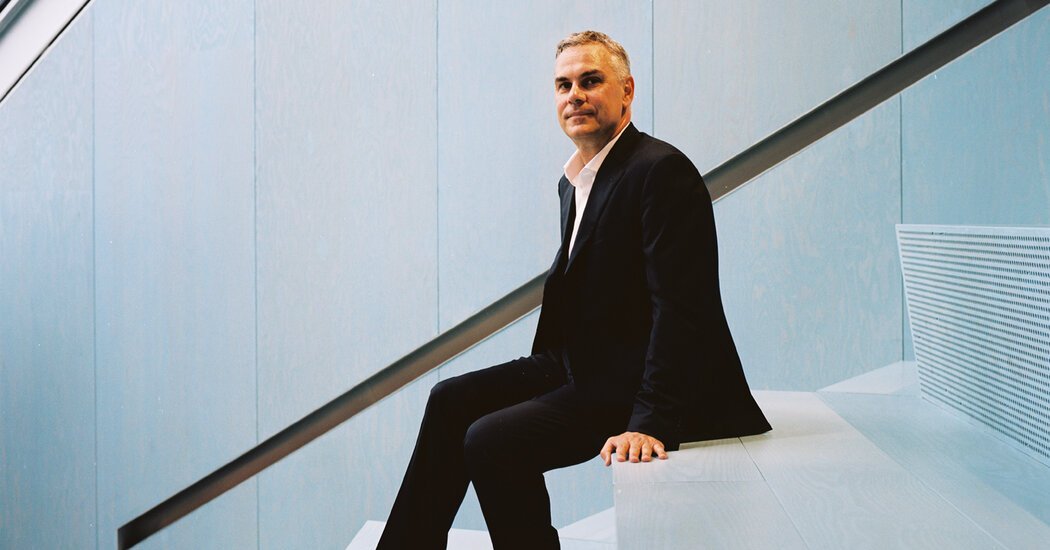
The New Museum reopened earlier this year in an expanded facility in Lower Manhattan, with twice the gallery space and views all around downtown. Now the contemporary art center has a new leader: Massimiliano Gioni, the museum’s longtime artistic director, will take over the top job on Aug. 1, the museum announced Tuesday.
Gioni, 52, joined the New Museum as a curator in 2006 and has overseen its exhibitions program since 2014. He has also remained an active curator abroad, organizing an acclaimed edition of the Venice Biennale and shows in Mexico, Greece, Lebanon and China. Art world prognosticators considered Gioni the most likely successor of Lisa Phillips, who directed the New Museum from 1999 until this spring. But the board undertook a full-scale search, interviewing international applicants over eight months — with an acting director, Regan Grusy, in place — before concluding that its next leader was already in the building.
“When we thought about who’s the best person to lead the organization, we wanted somebody who thinks globally,” James-Keith Brown, the museum’s president, said in an interview. The search committee also sought a director with experience producing temporary exhibitions and new commissions, rather than a leader at a collection-centered museum. “We don’t have a collection,” Brown explained. “It allows us to be more nimble, more experimental and a little more curious.”
“After 27 years, we needed to do a full, proper search, and Mas was incredibly supportive of that — he encouraged it,” Brown added. “We went through the whole process. But at the end of the day, our conclusion was that our best person was right in front of us.”
The New Museum of Contemporary Art, as it was then known, was founded in 1977, and over nearly 50 years it has had two leaders. Marcia Tucker, who staged its first exhibitions in rented spaces downtown, ran it as “a somewhat chaotic, idealistic place where the nature of art was always in question, exhibitions were a form of consciousness raising and mistakes were inevitable,” as Roberta Smith wrote in The New York Times. Phillips, her successor, transformed the New Museum into an international institution, overseeing the museum’s construction of a permanent home on the Bowery in 2007 as well as the just-completed expansion.
In an interview, Gioni said those women cast a long shadow on his new role. “It comes, obviously, with a big responsibility and illustrious legacy at this point, which seems crazy for a young institution that’s had only two directors,” he said. “But it also comes in the wake of a great reopening, where there’s lots of momentum and good energy and good will. Which was not necessarily a given.”
The Museums Special Section
While the New Museum’s expansion, designed by the firm OMA/Shohei Shigematsu and Rem Koolhaas, drew a mix of praise for its improved circulation and tutting about less-than-pristine finishes, critics have given strong notices to its first show, “New Humans: Memories of the Future,” staged by Gioni and his curatorial team. “New Humans,” covering more than a century of art history, examines how successive waves of technological and economic change redefined our notions of humanity.
With as much art by long-dead artists like Marcel Duchamp and Francis Picabia as by young painters, Gioni’s reopening show came across as an ironic riposte to expectations that a contemporary art museum would point the way to tomorrow. “I always joke, even as I’m doing tours, that in 2007 there was no doubt that there would be such a thing as ‘the future,’” the curator said. “In 2026: not so sure!”
Gioni was born near Milan and began his career as a critic and editor for the Italian magazine Flash Art. While there he became friendly with the Padua-born artist Maurizio Cattelan, who would later gain notoriety for crafting an 18-karat gold toilet and taping a banana to a wall. The day after they met, Cattelan was scheduled to give an interview on Italian radio. Ever the jokester, Cattelan sent the young Gioni in his stead — the first of hundreds of interviews, TV appearances and public lectures in which Gioni masqueraded as the artist.
A certain deadpan humor has percolated through Gioni’s career ever since. From 2002 to 2005, the two Italians and the curator Ali Subotnick ran The Wrong Gallery, a Chelsea art space that was nothing more than a doorway. Leading artists showed a single work that could only be seen through the glass door. The trio called it “the back door to contemporary art, and it’s always locked.”
Many of Gioni’s most acclaimed exhibitions have been large-scale biennials and group shows, often blending new art with historical documents or scientific materials, as well as outsider art and imagery of the occult. In addition to the 2013 Venice Biennale — he remains the youngest curator in 130 years to lead it — he also organized editions of the Berlin Biennale (with Cattelan and Subotnick) and of the Gwangju Biennale in South Korea.
His major exhibitions at the New Museum, which he has organized with a rotating team of co-curators, include “After Nature,” an apocalyptic show of environmental alienation; “NYC 1993,” a time capsule of art in New York in the last year before the Giuliani era; “Here and Elsewhere,” a rambling survey of contemporary art from the Middle East after the Arab Spring; and “The Keeper,” which brought together artists who collect, archive or just plain hoard. He also organized solo shows by the painters Albert Oehlen and Nicole Eisenman, the filmmakers Tacita Dean and Apichatpong Weerasethakul, and the installation artists Pipilotti Rist and Nari Ward.
In his new job, Gioni will retain ultimate oversight over programming, although he will be “less in the weeds of each show.” He will continue to organize occasional shows outside New York in partnership with the New Museum, and he has no immediate plans to appoint a chief curator. “We now have the new building; in a way, we expanded the hardware. And now it’s all the excitement of working on the software, which I always think is actually the engine of museums.”
The museum’s relocation to the Bowery helped boost attendance to more than 400,000 by 2019 — the last year it reported attendance. Though it has to rebuild its audience after two years’ closure for renovation, Gioni said he would not measure success on attendance alone. “I think we remain an avant-garde museum, I hope, an edgy museum,” he said. “So while we want to be open and welcoming to everybody, I don’t think we have the pressure of crazy numbers that others have.”
He added: “The challenge for museums today is how you don’t succumb to a certain idea of entertainment that is complicit with a kind of spectacle machine — that transforms the viewer into a zombie, frankly speaking. And instead, how do you imagine your audience as intelligent, as committed, as capable also of leaps of imagination and faith? I think that’s one of the biggest pressures, even more than the second pressure, which is obviously: Where do you get the money to do all this?”
Money matters have troubled the New Museum in the past. In 2019, employees formed a union — one that sparked a wave of labor organization at other American museums — and nearly went on strike amid tense negotiations. “I think we have witnessed a change between when the union was created and now,” Gioni said. “Maybe the most immediate response was a bit rigid.” (The museum has 118 core staff members; a contract later established minimum salaries ranging from $46,000 to $68,500 alongside increased paid time off and reduced employee contributions to health care costs.)
Gioni added: “The museum kept everybody during the closure, and made a strong commitment to the staff in that sense.”
The question remains as to the role of a museum of contemporary art when contemporary art is losing its market luster, and viewers’ phones are flooded with artificially “intelligent” slop. Gioni credited the German artist Hito Steyerl, who has a major work in “New Humans,” for helping him think through how a museum must change as A.I. dissolves notions of truth in representation.
“She says, ‘From now on, we will look at images as illustrations,’” Gioni said. “You look at the image fully knowing that it’s fake. But you also know that the image is ideologically constructed. And I think that, paradoxically, makes the museum more valuable. Because it is a space where you deconstruct the image, or you learn how images are fabricated.
“And secondly — this is maybe political — the museum is a place where you come to terms with complexity and difference. I often steal this from Umberto Eco,” Gioni went on, referring to the Italian philosopher and semiotician. “The museum is a kind of gym for coming to terms with what you don’t understand. And God knows,” he said with a laugh, “we need a lot of that.”

