
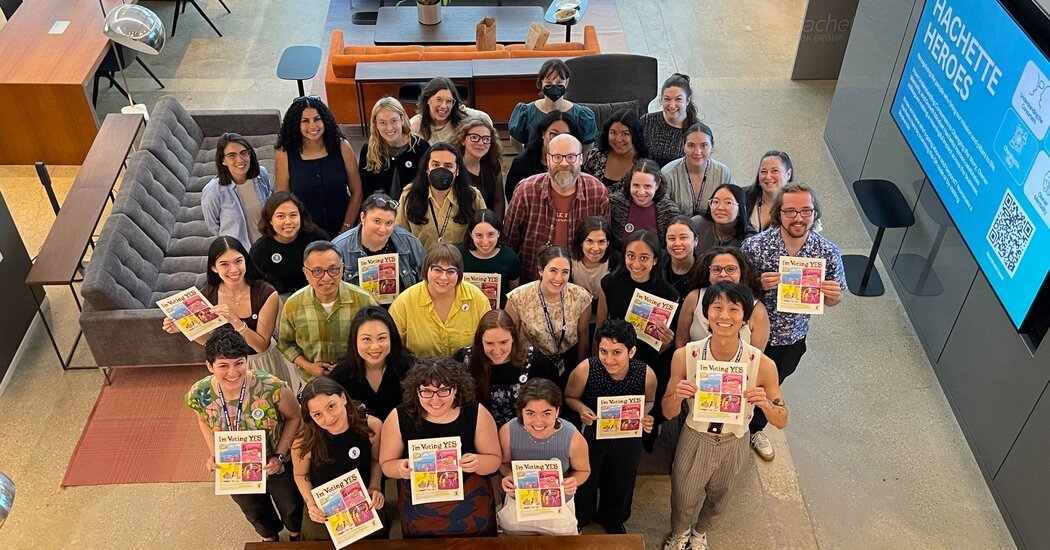
Hundreds of staff members at Hachette Book Group voted to unionize on Tuesday, forming the largest union in American trade book publishing at one of the biggest publishers in the United States.
Employees at Hachette imprints across the United States and Canada, including Little, Brown and Workman, voted 388 to 130 to join the Washington-Baltimore News Guild, under the name Hachette Workers Coalition. Representatives of the group said they established a union to secure salary increases and better benefits and protections, including a cap on working hours.
A spokeswoman for the News Guild, Kathleen Floyd, said that the Hachette union comprises around 600 workers, and added that Hachette employees “have built the largest union in trade publishing history, standing together to demand better benefits, transparency, and equity.”
The union’s formation reflects a broader push for workers’ rights in the publishing industry. Publishing unions have historically been rare, and salaries for entry and midlevel employees typically fall short of the high cost of living in New York City, where most sizable book publishers in the United States are based.
The Hachette employees who led the unionization effort hope to negotiate a contract that secures pay raises at all levels. Currently, the minimum starting salary for Hachette employees in New York City is $52,500. A livable salary for a single adult in and around New York City is around $65,500, according to estimates from the Massachusetts Institute of Technology’s Living Wage Calculator.
“There’s a big trap in publishing where folks can spend years in the same position without a raise or a promotion,” said Andy Wang, a member of the coalition who is a designer at Workman, a division of Hachette.
In addition to the ongoing concerns over pay and benefits, a growing number of publishing industry professionals worry about losing their jobs to A.I., as publishers adopt the technology in areas like marketing and promotion. Many fear that A.I. could soon be used more widely for jobs like editing, proofreading and cover design, threatening the livelihoods of people in creative roles.
“It’s very important to us as workers that our work doesn’t get replaced by A.I., and that we can create protections to make sure that doesn’t happen,” said Julia DeVarti, an associate editor at Little, Brown.
After Hachette employees first announced their plans to unionize, in late April, Hachette declined to recognize the union. The company distributed fliers with information about the collective bargaining process noting that unionizing might jeopardize current benefits like discretionary bonuses and work flexibility, which could be revisited as part of future contract negotiations.
In a statement shared with The Times, a spokeswoman for Hachette said the company recognizes the results of Tuesday’s union election, and that respects its employees’ decision to unionize.
The recent flurry of labor organizing efforts follows decades where only one major publishing house, HarperCollins, had a union. In the 1940s, employees at what was then called Harper & Row formed a workers’ collective, at a time when union drives were surging across the United States in the years after the passage of the National Labor Relations Act.
Hachette is the latest company to see its workers successfully unionize, following Verso, which won union recognition in 2020, and Abrams, whose employees voted to form a union last year. An overwhelming majority of employees at Catapult, Counterpoint, Soft Skull, and Hawthorne Books organized in June through the Catapult Workers Collective. They joined U.A.W. Local 2110, the same union that represents employees at HarperCollins and Abrams.
Catapult employees said they wanted to unionize to secure better pay and job security. Miriam Vance, a contracts and rights associate at Catapult who is part of the union organizing committee, said she and other employees felt that forming a union aligned with the values of the press, which is left leaning and often publishes books that promote racial, social and economic justice.
“It’s kind of like, put your money where your mouth is,” she said.
Several factors are driving the push to unionize among publishing employees, which is part of a broader movement to organize among college-educated white collar workers in fields like museum work, the nonprofit sector and journalism.
A younger generation of college graduates is hard-pressed economically in an uncertain job market. Many are struggling to pay down student loan debt while making wages that haven’t kept up with inflation. Some entered the work force during the pandemic and became accustomed to flexible, remote work hours and the ability to live in places with lower costs of living — benefits that many companies have rolled back in recent years.
“It is a distinctly generational phenomenon,” said Ruth Milkman, a professor of sociology at the City University of New York, who studies labor movements. “It’s not the 60-year-olds in publishing leading this, it’s coming from these younger people who are under all this economic pressure.”
Shea Dunlop, a sales representative at Abrams, said attitudes have shifted among younger employees, who no longer accept the old argument that publishing is a labor of love.
“The idea that publishing is a creative career that you are lucky to land a job in has allowed the general public and people who are making the rules around here to keep wages low,” Dunlop said. “The idea is, ‘Oh, you’re lucky to have this job.’ I’d love to buy into that mind set if I could, but I have rent to pay.”
Dunlop and union members at several other publishing houses trace the current push for better wages and benefits to 2022, when members of the HarperCollins Union went on strike multiple times over demands that included higher wages and union protections. The union reached an agreement with the company in 2023 that included raising annual starting pay from $45,000 upon ratification to $50,000 in 2025; its most recent contract, signed in March, established a new starting salary of $52,500, which will rise to $55,200, plus eligibility for overtime, as of Jan. 1, 2028.
“Everyone’s having problems making rent, paying their bills and getting by,” said Caitlin Stamper, a children’s book designer at HarperCollins and a HarperCollins Union chairperson and bargaining committee member. “It’s important that we not necessarily frame our jobs as something we should have to sacrifice for, because it makes it that much easier for us to be exploited.”

