
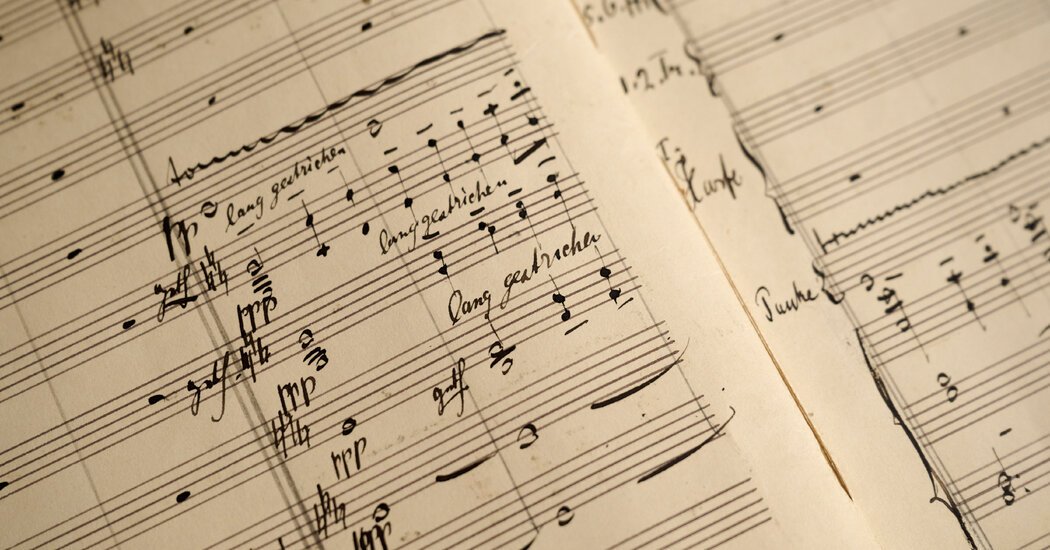
Franz Welser-Möst was having coffee at Café Imperial in Vienna when he was given a musical score under the table.
He was with the media mogul Herbert G. Kloiber, who nudged a black briefcase toward him with his foot. Kloiber didn’t say what was inside. He just told Welser-Möst, the music director of the Cleveland Orchestra and a conducting eminence in Austria, to hold on to it for a few days.
The conductor had an idea what was inside the briefcase, but he waited until he got back to his apartment to open it up. He unlatched the lid and saw the autograph manuscript of Mahler’s “Resurrection” Symphony, a cornerstone of the orchestral repertoire. It was, he said in a recent interview, “a really sacred moment.”
Why? Scores are more available than ever: in multiple published editions, online in public domain collections, in libraries and elsewhere. But a manuscript, music written in a composer’s hand, has the almost magical power to make even the most distant giants feel near and alive. You can learn about the personalities of, say, Beethoven or Brahms through their penmanship. You can track their doubts and changes of heart. You can argue, with yourself and others, about what was meant by something as small as a dot.
When Welser-Möst read the manuscript, he was struck by the handwriting. (And there’s a lot of it; Mahler’s score directions are famously verbose.) Most of the “Resurrection” was composed at Mahler’s lakeside retreat in Upper Austria, between his seasons of conducting at what is now the Vienna State Opera, and Welser-Möst believes that backdrop shows in the manuscript.
“We know how neurotic Mahler was, and contemporaries described him as this nervous little man,” Welser-Möst said. “But maybe because he did this on vacation, basically, he was more relaxed. So his handwriting is actually very calm and clear.”
The manuscript was long held at a museum in the Netherlands. (Alma Mahler, the composer’s widow, had given the score to the Dutch conductor Willem Mengelberg.) Later it was purchased by Gilbert Kaplan, a businessman and Mahler fanatic, and when he died Sotheby’s sold it in 2016 for a record-breaking $5.6 million.
The buyer was Kloiber, who maintained public anonymity while privately telling Welser-Möst about his precious purchase. As a treat, he lent his friend the score at Café Imperial. Later, in 2019, Kloiber attended a dinner to celebrate the Cleveland Orchestra Youth Orchestra’s performance in Austria and made a surprise announcement: He wanted to donate it to the Cleveland Orchestra.
Welser-Möst was in tears when he heard the news that night. Kloiber gave him the score in a plastic bag, which Welser-Möst brought back to the United States in a backpack. (He had a plan for security, to say it was “an old book, nothing interesting.”) To protect the manuscript as much as possible, the orchestra arranged to have it kept at the Cleveland Museum of Art. Recently, it was brought across the street to Severance Music Center, the ensemble’s home, where Welser-Möst laid it out on a large table and flipped through its pages during an interview.
“It makes you feel so much closer to the composer when you actually see, that’s the piece of paper he wrote something on and with his handwriting,” Welser-Möst said. “That is a really special feeling.”
The manuscript, with detailed scoring and occasional corrections in blue, may inspire new angles of interpretation, or help musicians better understand Mahler’s intentions in specific moments. Welser-Möst shared three pages that he found particularly fascinating. Here they are.
An Uncomfortable Bowing
The second movement of the “Resurrection” opens with the strings playing a ländler, a kind of rustic dance. It sways lightly because entire measures are slurred, with the notes connected by a single bow stroke.
Welser-Möst, who grew up studying violin, remembered that when he performed this movement, a concertmaster told him the opening phrase would be much more comfortable with two notes slurred in one bow stroke, followed by another bow stroke with three portato notes: slurred but gently separated.
In the score, though, Mahler puts the slur of the first two notes inside a broader slur of all five notes. That doesn’t feel natural for string players, but you have to imagine, Welser-Möst said, that as a composer whose idea of instruments was formed by being one of the greatest conductors of his day, Mahler knew exactly what he was doing.
“It’s a little uncomfortable, but at the same time, it gives you a different swing if you do it all in one bow,” Welser-Möst said. The ländler melody, he added, “becomes less earthbound and more floating, sort of airy.”
On this page of the score Mahler corrects himself in a couple of spots, lowering an E flat by an octave in the cellos and changing a dynamic to make it quieter. Because of this, Welser-Möst said, you can feel even more confident in the violin bowings: “The handwriting tells me he had a very clear plan.”
A Mysterious Blue Line
Mahler is less clear in the third movement. On its last page, before the last measure, he draws a blue line down all the orchestra parts and writes the word “Coda” at the top, underlined twice. Was there supposed to be more music before the ending?
Welser-Möst has no idea. “That’s an enigma for me,” he said.
The movement closes with the gloomy gong sound of a tam-tam. “That is used by a lot of composers as a symbol for death,” he said. “Sort of the final sound. So, the way it ends, the music sort of disintegrates into nothing. But did he think he should write something else after that?”
It could be that Mahler considered writing a coda but abandoned the idea and forgot to cross out the note. Maybe the coda would have been just a reprise of the ending, but he didn’t add repeat signs to indicate which measures to include. Welser-Möst said with a shrug, “That’s something we cannot ask him anymore.” Certain enigmas, he added, are meant to be enigmas.
Asking the Impossible: ‘ppp’
The fourth movement is a song: “Urlicht,” or “Primeval Light.” An alto soloist, who has been waiting onstage for the symphony’s first 45 minutes, enters alone with the word “O.” It is meant to be sung very softly. Mahler marks it as “pianississimo,” an impossible extreme of quiet.
“Was that practical?” Welser-Möst said. “It’s an idea, let’s say.”
Universal’s published edition has the vocal line marked with a more realistic “piano.” But Welser-Möst believes this moment, which emerges from the dying resonance of the tam-tam in the third movement, was informed by Mahler’s experience as director of the Vienna State Opera.
“In his first season, he conducted 41 different operas,” he said. “So, beyond his knowledge of repertoire, he actually knew what singers could do.”
Welser-Möst pointed at the direction “choralmässig,” or chorale-like, in the score. “The way I look at it,” he said, “this shouldn’t just be very soft but should actually sound like an idea, not realistic.”
Mahler gives enough clues, he said, for how to think about the beginning of “Urlicht” in context of everything that comes before and after it. This a composer who made practical changes to his scores, depending on the acoustics of a hall or the speed of a performance. But through it all, Welser-Möst said, “he was clearly a perfectionist.”
Audio credits: Cleveland Orchestra; Marie-Nicole Lemieux, alto; Franz Welser-Möst, conductor; Mahler’s Symphony No. 2, “Resurrection”

