
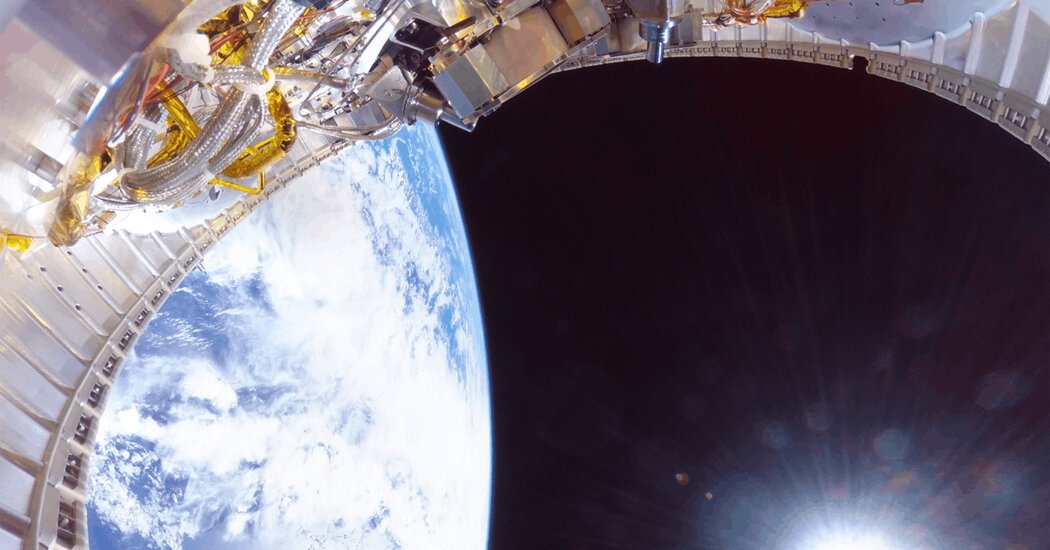
A spacecraft that is rushing to save a falling NASA space telescope now also needs to be saved.
On Saturday afternoon, the rescue spacecraft, which was within a few miles of NASA’s Neil Gehrels Swift Observatory, unexpectedly started tumbling, putting the mission in jeopardy.
“This was a very serious situation,” said Ghonhee Lee, chief executive of Katalyst Space Technologies, the small company in Flagstaff, Ariz., that built the refrigerator-size spacecraft called Link.
Engineers are working to slow down the spinning of Link, which was making a full rotation every 40 seconds. Despite its diminished state, the spacecraft should still be able to accomplish its goal of pushing Swift into a higher orbit, Mr. Lee said.
The Swift Observatory, launched in 2004, observes gamma-ray bursts — bright flashes of high-energy light from some of the most violent explosions in the universe. Swift has far outlived its planned lifetime, and the observatory’s designers never anticipated the need for a boost.
The peak of the sun’s 11-year sunspot cycle at the end of 2024 turned out to be stronger than expected. A more active sun shoots out more solar flares that warm the Earth’s upper atmosphere, causing it to puff outward and increase the drag on satellites.
Suddenly, NASA realized it might soon lose Swift. The space agency quickly sought proposals from companies it thought could come up with quick, inexpensive solutions. Katalyst won the contract and built Link in nine months.
NASA officials had warned that the Swift rescue was a high-risk, high-reward effort. Because of the hurried schedule, it did not go through the years of testing and scrutiny that NASA missions typically receive.
“There are still potential paths forward for a boost, and we’re working very closely with Katalyst to consider revised approaches,” Shawn Domagal-Goldman, director of NASA’s astrophysics division, said on Wednesday in a statement provided by NASA. “We knew attempting this boost mission on such an unprecedented short timeline would be very challenging. But we also knew it was worthwhile to try.”
Mr. Lee said Link’s rendezvous with Swift was now probably delayed by a couple of weeks, to the end of August. Link will first make careful observations of Swift before attempting to grab it.
Despite the setback on Saturday, there should still be enough time to save Swift before the friction of air drags the 1.6-ton observatory down to its destruction. Swift is currently a bit more than 200 miles above the Earth’s surface and dropping about 1.5 miles a week, Mr. Lee said, although the pace of falling will speed up as the observatory encounters thicker parts of the atmosphere.
If Swift’s orbit decays to about 185 miles, a rescue would become more difficult to pull off.
The Link mission had been progressing well since its launch on July 3. On Saturday, Katalyst’s mission operations center in Broomfield, Colo., lost contact with the spacecraft. That was expected. As a low-cost mission — at $30 million — Katalyst did not have the resources for round-the-clock communications with its spacecraft.
But such blackouts typically last 30 to 60 minutes, although gaps of three to four hours are not uncommon, Mr. Lee said. This time, the silence stretched for a day. A few snippets of data that dribbled in showed that Link was spinning. “That was a little bit of a whiplash for the team,” Mr. Lee said.
Troubleshooting revealed that Link’s problems extended beyond the spinning. Two of the spacecraft’s three reaction wheels — spinning disks used to point the spacecraft — were not working, and the reaction control thrusters, which shoot out jets of gas, were performing inconsistently.
During the blackout, the spacecraft rebooted its electrical system, probably causing at least some of the problems. “Shutting down the reaction wheels in an uncontrolled manner — you’re essentially pulling the plug out from them,” Mr. Lee said. “That’s not how they’re designed to operate.”
Other news was more reassuring. The main propulsion system, which uses electric fields to accelerate charged xenon atoms, is working without issue. Those electric thrusters can be swiveled around and are now pointed in a direction to slow Link’s spin.
Other systems, including the communication radios and the three robotic arms that are to grab Swift, also appear to be undamaged.
Katalyst and NASA engineers still do not know what went wrong during the communications blackout. Within a couple of days, as the spin slows, a high-speed communications channel will send data from Link detailing what happened on the spacecraft during the blackout hours.
“I don’t have a root cause on the initial spin,” Mr. Lee said. “And, to be honest, I don’t have a great hypothesis at this point without really looking at the data.”
Katalyst engineers hope they can revive the nonspinning reaction wheels and the gas thrusters, but if not, the electric propulsion system can serve as a substitute, Mr. Lee said. “Which is why we’re so confident that this is not over and that we’re not giving up.”

