
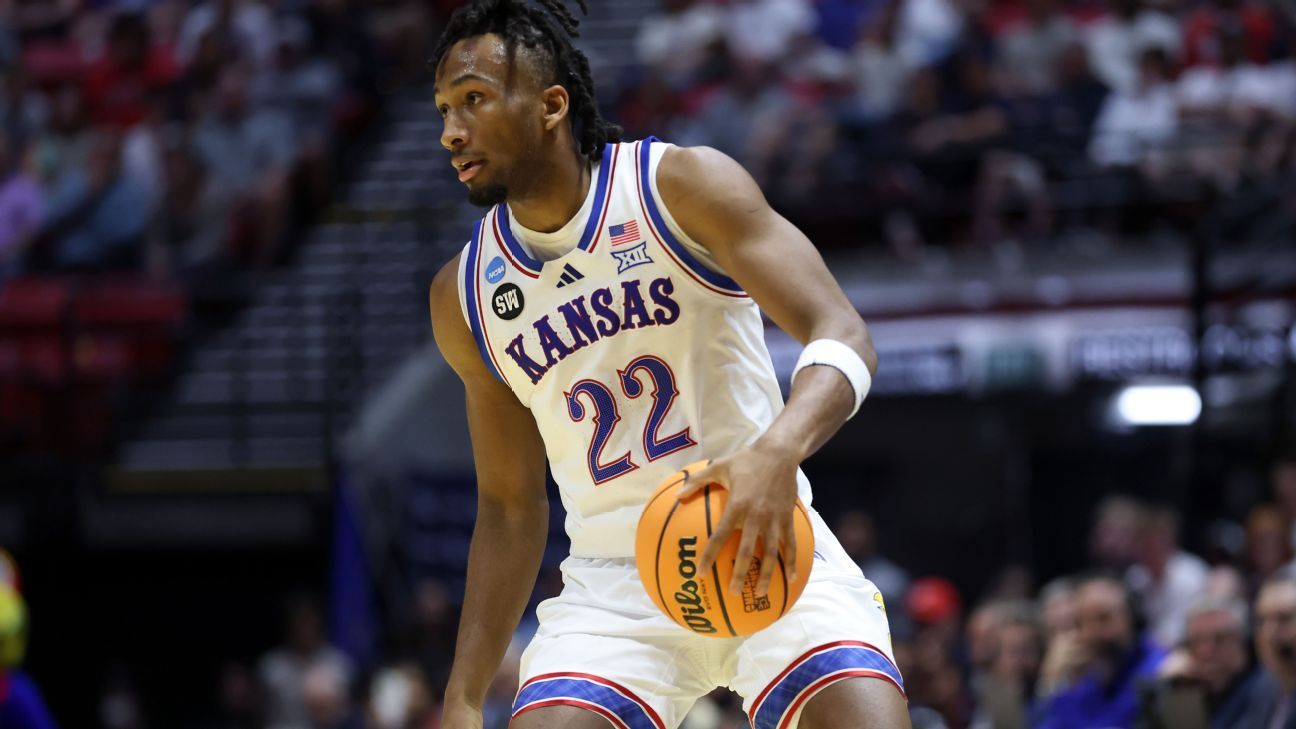
Darryn Peterson finally has an answer.
One of the top prospects in this year’s NBA draft spent much of his freshman season at Kansas trying to solve mysterious and sometimes debilitating cramping. But in an extended interview with ESPN this week, Peterson said that a new round of bloodwork and other tests after the college basketball season led his doctors to conclude that his use of high doses of creatine created the condition.
“I’d never taken it before [going to college],” Peterson said of the popular supplement which helps to increase muscle strength, power and growth. “But after the season I took two weeks off and they did tests which showed my baseline level was already high. So, they said when I dosed [a process of increasing a dose over time to create maximum benefit at the beginning of taking a supplement], it must’ve made the levels unsafe.”
Peterson, who is ranked as the No. 2 prospect available in next month’s draft by ESPN’s Jeremy Woo, said his issues started last year with a scary episode after Kansas coach Bill Self’s annual weeklong boot camp in September that sent him to the hospital in an ambulance.
First his legs started cramping. Then his stomach, back, arms and hands. Eventually his whole body was cramping.
“I made it to the training room and just started begging them to call 911,” he said. “They were trying to get a vein to get me the IV, get me back hydrated. But I was cramping so hard they couldn’t get a vein.
“I thought I was going to die on the training table that day.”
Finally at the hospital the emergency room doctors were able to get a vein and give him several bags of fluids intravenously. Peterson stayed there for several hours being treated for what doctors thought was severe dehydration.
He said he was sore for days afterward but pushed to return to play. The experience was far from over, however. The full-body cramp was so intense, Peterson said, that he struggled to shake the fear that it could happen again.
“Whenever I felt anything like that come on, my initial thought was that it might get to that again,” Peterson said. “And I can’t let that happen and be embarrassed and have that on TV and all that.
“It kind of put me in a tizzy because I didn’t know what was causing it. Nothing has ever been wrong with me before. Basketball is my life. What I love to do. But something was going on and I couldn’t figure it out.
“My biggest thing was I’m going to keep trying because we don’t know what’s wrong and we can’t say something’s wrong. So, I’m going to go out there and when it happens, I’m going to ask to come out. I don’t know if that was a right or wrong move.
“But when I committed to Kansas, I told Coach [Self], ‘I’m going to do whatever I can. I’m going to try to help you get a championship. I’m going to be out there for my teammates and for you guys.’ So, I tried to hold up my end of the deal, trying to be out there.”
In all, Peterson missed 11 games and asked to come out of several more throughout the season. By the end of the season, Peterson had figured out how to stay in the game, and he played more than 30 minutes in eight of the Jayhawks final nine regular-season games. But by that point, the scrutiny and criticism of the former Naismith High School Player of the Year had grown loud and uncomfortable.
Peterson rarely spoke to the media about his issue, he said, because he didn’t have an explanation for what was causing the issues and hadn’t publicly revealed the scary, full-body cramp that sent him to the hospital. Finally at the Big 12 tournament in the middle of March, he told the story of that incident to the assembled media. At that point, however, he didn’t have an explanation for what caused it.
All season HIPAA rules had prohibited Self from discussing the cramping incident or giving further details on Peterson’s health.
After that interview, Self told The Athletic that “the stops and starts definitely affected him. Conditioning, rhythm, team rhythm, a lot of things. I think it did impact him differently. If you can imagine him going into every game believing that this is going to be the game in which your body feels right, and it just didn’t happen.”
Many of his teammates had seen Peterson be taken by ambulance to the hospital after the full-body cramp. They’d kept it private all season long, out of respect for Peterson. But it had informed their view of his seasonlong struggle to understand what was wrong with him.
His teammates were also aware that Peterson frequently received preventative IV bags, electrolyte supplements, massages and other physical therapies to try to stay on the court.
“My roommate Bryson Tiller had my back, Melvin Council Jr. did as well. They would say certain stuff about it, but even they didn’t know what it was. They’re trying to defend you, but they don’t know what to say except, ‘If he could have been out there, he would be. He’s trying, he’s working.’
“They saw I was in rehab every day before practice, after practice. Get massages. Trying all types of stuff. Carb loading because they thought I didn’t have glucose or something. Electrolytes. Liquid IV, LMNT. I changed my diet. I meal-prepped. Everything I could think of.”
As the criticism grew, Peterson said he leaned in harder to his support system.
His father, Darryl Peterson, who played collegiately at the University of Akron and was Peterson’s coach for much of his life, kept telling him that “we are going to get to the last laugh whenever it is. We know what kind of kid you are. This is not going to be your life. Don’t get too high or too low about this. We’re going to get through it. We’re going to figure it out.”
It was harder on his mother, Natatia, though. Peterson recalled a time when his mom called him crying because she couldn’t do anything to help him.
“She was like, ‘I always had an angel for you your whole life, but right now I just don’t know what to do,'” Peterson said. “There were definitely times I wanted to quit and when the world was against me, but they had my back and it was just great to have somebody to lean on.”
Peterson’s former AAU coach, Sam Mitchell, checked on him throughout the year as well. The former NBA coach of the year with the Toronto Raptors said he was bothered by the criticism that was being leveled at his former protégé because it didn’t match up with the player he’d grown close to as the head coach of Phenom United, which is operated by Peterson’s father, Darryl.
“That hurt me and upset me because I know this kid,” Mitchell told ESPN. “This young man, I don’t even call him a kid. Because I treated him like a young man from day one.”
“Excuse my language, but that motherf—er worked his ass off. He loved this s—. Even to the point where I’d have to say, you got to get some rest. … I got on in one game because he was trying to block every shot and the motherf—er had eight blocks. You can do that here, but when you get to the league your team needs you to save your energy to make everyone else better. Not be jumping all over trying to block every shot.”
Peterson says he’s starting to feel like himself again now that he has an explanation for what caused his issues with cramping. He has been training for the NBA combine and draft in Los Angeles and hasn’t had any issues since he stopped taking a creatine supplement.
His focus during this period is on honing his shooting and point guard skills. At Kansas, he often played off the ball, but he believes point guard is his best position.
“I was off [the ball] most of the year, but some of that was me not really being myself,” Peterson said. “So, Coach was trying to figure out ways to help me still be effective without exerting too much. As the point guard, you got to bring it up, you got to do everything.
“I’ve been thinking about how differently things could have been [at Kansas] if I didn’t get hurt or have all this stuff going on. When I was out there, I felt like I still did all right. But there was another level of me that people didn’t get to see.”

