
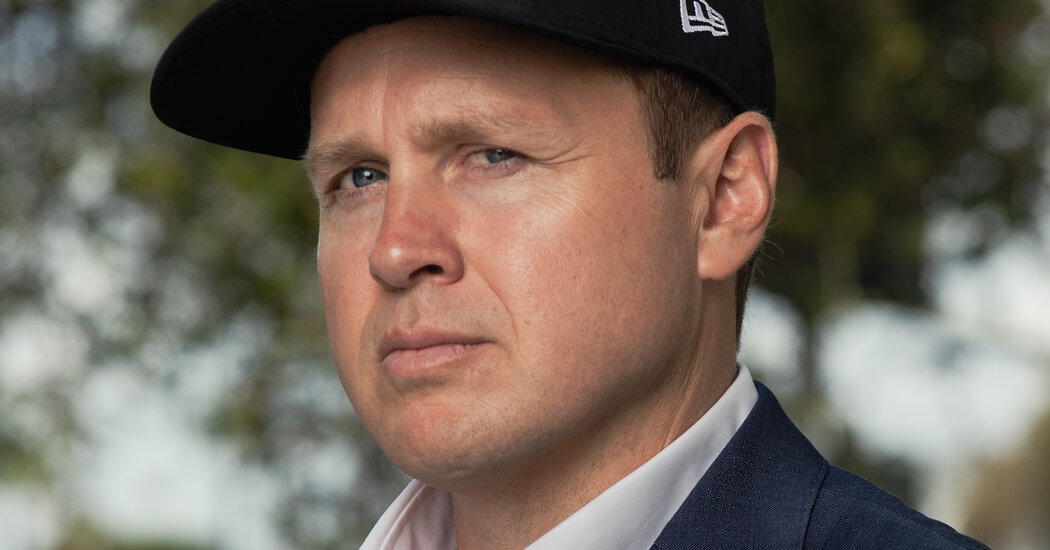
Ask Spencer Pratt how he imagined his life would pan out and he’ll tell you he wanted to be Tom Cruise famous. Red carpets and premieres famous. Fame beyond the villainous notoriety he attained as a reality star in the 2000s that played out in tabloids and on MTV’s “The Hills.”
But what about the celebrity that comes with pledging to fix one of the most complex, most populous municipalities in the country?
“It’s not a kind of fame that is fun,” said Pratt, 42. “I don’t know why a politician would want this. If they’re doing it for the attention, they’re crazy.”
Yet he’s become a national fixation as he competes in California’s open primary race to become the next mayor of Los Angeles. And despite Pratt’s self-proclaimed reluctance, he’s also become a political headache for the city’s political establishment. Recent polling shows Pratt in a tight three-way battle ahead of the June 2 primary, and last month alone his campaign reported $2.7 million in donations, or nearly 10 times the amount the incumbent, Karen Bass, raised in that same period.
On a recent morning, Pratt was walking down a Venice Beach alleyway, where an episode of Fox’s “Baywatch” reboot was taping. Wearing a suit and high-top Vans rounded out with a black baseball cap bearing his own name, he had been invited to the set by a longhaired location manager named Jennifer Smith, a 20-year veteran of the TV business.
“I’m not here to bash people, but the mayor hates entertainment,” Smith said to Pratt, alluding to the city’s slowed production, which has became a central issue in the race.
He nodded, hands folded at his waist, as a campaign camera man — one of two dedicated staffers employed by Pratt’s campaign — filmed him just feet away. As Smith led Pratt down the tree-lined street, members of the crew came to greet him.
“You don’t have to be a miracle worker, brother,” a bearded production assistant in his 20s told Pratt, promising to vote for him.
“I’m just trying to represent you properly,” Pratt said to a small circle that had gathered. “You all are my Rebel Alliance fighters.”
It was moment of restraint, at odds with the bombast of the online tactics that have so far fueled Pratt’s momentum. Search for his name and a bottomless pit of fan-generated A.I. slop appears, portraying his liberal opponents as sinister authoritarians (and Pratt as a Batman-esque superhero). An army of paid clippers — hired hands who edit video into snippets — have helped spread his message, which paints Los Angeles as a hive of crime, corruption and rampant drug addiction.
As a candidate, he frequently veers into exaggeration and outright vitriol. Pratt has claimed, without evidence, that “90 percent” of the city’s homeless population is addicted to drugs. He regularly accuses Bass, as well the race’s other contender, Nithya Raman, a progressive City Council member, of corruption and fraud. (“We’re talking billions of dollars,” he said.)
It’s a law-and-order campaign that sounds plucked from yesteryear. Pratt’s most in-depth proposal, a “five-step plan” to end homelessness that he posted on Instagram, includes a promise to hold these residents in what amounts to a mandatory conservatorship. (Pratt has also suggested that he would bus the homeless to liberal cities, such as Seattle.) But he is light on specifics.
The one-word message Pratt drills is simple. “Safety,” he said. “Everything is about not feeling safe.”
The open-endedness of his platform has made Pratt’s campaign a vessel for a motley crowd with diverse political views: disgruntled liberals upset with the current mayor; homeowners paranoid about crime; burn-it-all-down Gen X-ers agitating for change; Hollywood executives exasperated by the state of the industry; and a raft of MAGA-aligned supporters hungry for a brash outsider to take charge.
Pratt’s message is resonating in an era of perceived crisis that has gripped Los Angeles and the country beyond it. In a bizarre twist, the traits that might usually disqualify a political hopeful, such as lack of experience, have endeared Pratt to his supporters.
At a block party held for Pratt last week in South Central Los Angeles, white Silver Lake moms with strollers and older Black residents mingled with peppy Pratt volunteers in trucker hats. Some posed for selfies beneath an A.I.-generated campaign poster, replete with scenes of fire and disorder, that read: “END THE CHAOS. CHOOSE SAFETY.”
Nearby, Jerome McAlpin, a real estate broker and lifelong Angeleno, introduced himself to Pratt. “L.A.’s become a hard place to do business,” he told him.
Pratt listened, a concerned squint drawn on his face. After a beat, he gave McAlpin his phone number and told him to give him a call sometime.
“He was approachable, at least,” McAlpin told me later. “But in politics, you never know if that’s genuine or a part of the job.”
Feeling Like a Victim
It’s one of the biggest questions surrounding Pratt’s campaign: Are his mayoral ambitions genuine, or is his campaign pure political opportunism?
Pratt likes to say he had no choice but to run after his home burned down in last year’s Palisades wildfires — or as he puts it, after Bass, Pratt’s chief political adversary, let his house burn down.
Of course, Bass didn’t personally set fire to Pratt’s $2.5 million property, once filled with his collection of magic crystals and surrounded by hummingbirds at dusk. But he takes issue with her response to the crisis. At the start of the fires, Bass was out of the country, a move that has been widely criticized.
“I started this because I felt like a victim,” Pratt said, “and I didn’t want to be a victim.”
This January, at a rally in the Pacific Palisades called “They Let Us Burn,” Pratt announced his mayoral bid. “Business as usual is a death sentence for Los Angeles, and I am done waiting for someone to take real action,” he said, reading from an iPhone.
For some voters, this back story has added an aura of authenticity to his crusade.
“He never wanted to be mayor, but once he uncovered all of the negligence in our city, he stepped in,” said Marisela Mardesich, 47, the organizer of an event in San Pedro for Pratt that took place after his drop-in at the “Baywatch” set.
The afternoon gathering, held in a former immigration building turned Italian restaurant, brought together a group of concerned mothers.
Denise Louro, 70, a San Pedro resident who had come with her husband, was one of them. She said she was upset that drug users in the city had become a “protected class.”
A longtime Trump supporter, Louro felt a connection to Pratt repeated by several supporters that day. “He’s just a normal person,” she said. “And he doesn’t have political ties.”
‘Too Many Words’
The next morning, Pratt sat in a booth at the back of Langer’s Delicatessen, on the edge of MacArthur Park, where homelessness and drug and gang activity have converged in recent years. A noisy weekend brunch crowd hunched over omelets and corned beef.
Pratt had been invited by the restaurant’s owner, Norm Langer, a vocal opponent of the city’s harm-reduction approach to drug treatment. Langer, 79, offered him some management advice.
“The most important thing in any profession is that the person at the top has to ask the right questions,” Langer told Pratt.
While Pratt’s appearances are typically invitation-only and filled with supporters, there were some critics in the room that morning, like Scott Jacobs, 46, a Los Angeles native in pharmaceutical sales eating at an adjacent booth.
“This race has been leaking into my daily life for sure,” Jacobs said. “But I honestly didn’t expect it to leak into my brunch.”
Jacobs described his opinion of Pratt as “vehement dislike,” noting what he sees as Pratt’s “arrogance” and thin policy proposals. “I think he’s a complete opportunist using the fires as a platform to have some type of career,” he said.
After his sit-down with Langer, Pratt plopped down across from me. The night before, his wife, Heidi Montag, had insisted he turn his phone off and be in bed by 9 p.m. “I woke up feeling like a different human being,” he said.
This was the version of Pratt more often seen on TV than on the campaign trail. The bombastic personality, who, on the phone days earlier, had greeted me with a drawled out “Sup, player.”
He reminisced about the tranquillity of pre-Covid Los Angeles, a time before politics had entered his mind. “Nightclubs were popping — you could go out seven nights a week,” he said. “Now, it’s scary out at night. You never know what could happen to you.”
He was energetic until our conversation veered toward the thornier questions nagging his campaign. Pratt grew exasperated when asked if he had ever directly engaged with a homeless person in Los Angeles. (While campaigning, he often calls them “zombies.”)
“You can’t not interface with homeless people living here — that’s the point,” he responded, without offering specifics. “There’s more homeless people on the streets than there are taxpaying citizens.”
Then there was the question of the overwhelming Republican support directed his way. President Trump had recently given him a tepid endorsement, telling reporters, “I’d like to see him do well.” The West Coast arm of The New York Post chimed in, praising his “strong grasp” of the issues facing the city. Other conservative-friendly figures had backed Pratt, too, like the manosphere superstar Joe Rogan, tech executives, Hollywood moguls and entertainment industry titans.
Add to that: Pratt’s revelation in a recent CNN interview that he was “aligned” with Republicans for their Second-Amendment views.
This chain of events, combined with his draconian proposals, has led many to view Pratt as a Trump-lite candidate running in an open race. (According to his campaign finance report, Pratt has also paid G.O.P.-affiliated consulting firms and fund-raising platforms nearly $100,000 to date.)
A spokesman for the Bass campaign described Pratt as a “MAGA candidate who is running a campaign based on A.I. slop.”
Pratt, for his part, insists he is his own man.
“I have no loyalty to any party,” he said. Both , in his view, were “failing because they don’t work together to make sure cities don’t fail.”
The solutions, for Pratt, are teasingly straightforward. In an earlier conversation, he described his campaign approach as having “no strategy.” Asked how he planned to lead the city, to rid the streets of homelessness and crime and corruption, he made only vague references to his “team” or pointed to his phone. There were “guys” on Twitter, he said. He promised to text me their names.
Any politician can say things, Pratt seemed to be suggesting. But can they make you feel things?
“There are too many words in this race,” he said. “Nobody wants 20,000 words about policy. They want to hear the word ‘safety.’ They want to hear ‘no more corruption.’ They want accountability,” he said in rapid succession before getting up from the table.
Nearby, two busboys in their early 20s approached the candidate for a quick picture on his way out.
“I’m succeeding,” Pratt said, “because I’m taking all the words away.”

