
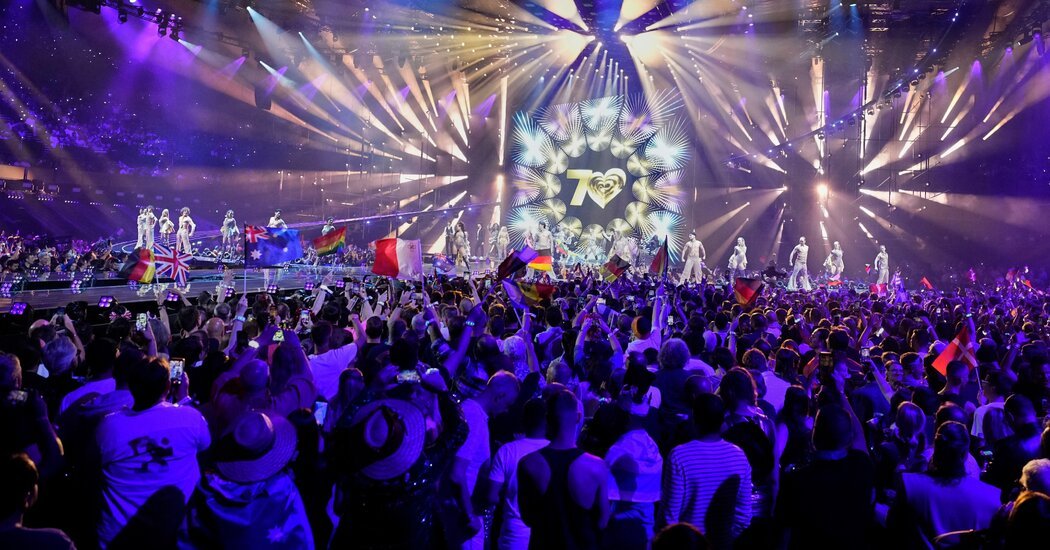
Canada may be several thousand miles from Europe, but it could soon take part in the Eurovision Song Contest, the high-camp singing competition that is watched by tens of millions of music fans in Europe every year but is hardly a fixture of the cultural calender in Ottawa or Vancouver.
On Thursday, the Canadian Broadcasting Corporation said in a news release that it had become a full member of the European Broadcasting Union, the body that runs Eurovision — a move that allows it to enter the singing competition.
The news release did not mention Eurovision, and Leon Mar, a spokesman for the Canadian broadcaster, declined to comment on whether Canada would now take part. “We’ll have more to say about the Eurovision Song Contest later,” he said.
But if Canada does join the competition, the next edition of which is scheduled to take place in Bulgaria in May, it would be seen as both a sign of Eurovision’s increasing global ambitions and Canada’s desire to align itself more with Europe as its relations with the United States are strained under the Trump administration.
The announcement of the corporation gaining membership came during a two-day meeting of the European Broadcasting Union in Prague.
Despite its name, Eurovision has long included countries outside the continent. Israel debuted in 1973 and has won four times, and Australia has competed since 2015. This year, the Australian singer Delta Goodrem was one of the most talked-about acts.
Although Canada has never competed, a handful of Canadian singers have represented other countries — most notably Celine Dion, who won the 1988 contest for Switzerland with the song “Ne partez pas sans moi” (“Don’t Leave Without Me”).
Eurovision has also recently expanded its reach on another continent: In March, its organizers announced that an Asian edition would take place in Bangkok this fall.
Despite growing chatter among Eurovision fans about Canada’s potential involvement, the CBC’s participation would be a surprise, given that only a few years ago it showed little interest in taking part. In 2022, Insight Productions, a Canadian TV company, tried to persuade the broadcaster to set up a nationwide singing contest in which singers from Canada’s regions would compete to represent the country at Eurovision, but a CBC spokesman told reporters that the idea was “prohibitively expensive.”
That situation changed last year when Canada released a federal budget that included a sentence saying that Prime Minister Mark Carney’s government was “working with” the CBC “to explore participation in Eurovision.”
Shortly after the budget announcement, Canada’s finance minister, François-Philippe Champagne, told the TV network Global News that Eurovision was “a platform for Canada to shine.”
The CBC distanced itself from such comments at the time, saying that it is independent from the government. “There is no budget allocation for the E.S.C. and to date we have not had discussions with government on this matter,” Mar, the spokesman, said of the song contest.
Still, the government’s interest in bringing Eurovision to Canadians appears to be part of efforts by Carney, a former Bank of England governor, to strengthen Canada’s relations with Europe and other allies as a response to President Trump’s musings about annexing the country as the 51st state and the president’s tariffs on key Canadian exports.
When signing a security and defense agreement a year ago in Brussels, Carney called Canada “the most European of the non-European countries.”
In May, the CBC sent three staff members from both its French- and English-language services to watch this year’s Eurovision Song Contest in Vienna.
William Lee Adams, the founder of the popular Eurovision YouTube channel Wiwibloggs, said that the competition’s fans were likely to give Canada a mixed reception if it did ever join. As much as some will appreciate a growing interest in their favorite singing contest, Adams said that many, including himself, see Eurovision as “a bulwark against North American cultural hegemony” and a place where European nations get a rare chance to showcase their culture on a global stage.
Australia met similar ambivalence when it joined in 2015, Adams said, and is only now shaking off questions about its participation after years of sending strong acts.
Adams added that some fans would see Eurovision’s courting of Canada as “a distraction” from demands for the event to bar Israel over its military actions in Gaza — a situation that led five countries, including Spain and Ireland, to boycott this year’s event.

