
Is there a city with more top-end hotels than London? From grandes dames like Claridge’s to newcomers like the Six Senses London, an abundance of choices awaits travelers in the category shorthanded as U.H.N.W. (that’s “ultrahigh net worth”).
Among the newest and most acclaimed, both in historic buildings: Raffles at the OWO, which opened in 2023 in the Old War Office in Whitehall, and the Chancery Rosewood, which made its debut in 2025 in the former U.S. Embassy on Grosvenor Square in Mayfair.
How do they stack up? To find out, we conducted a five-star face-off, booking an entry-level room at each hotel for two nights (I booked under my husband’s name to conceal my New York Times affiliation and paid the full rate). Ahead of our stay, we asked the concierges to assist us with dinner and bar reservations; after check-in, we took advantage of the fitness centers and pools, ate breakfast, had cocktails, wandered the halls and generally made ourselves at home.
Both hotels delivered the expected: robes, slippers, turndown service, complimentary welcome snacks (with handwritten notes from management), small-label toiletries in refillable bottles, high-thread-count sheets and blissful quiet. Both have fancy spas, signature restaurants by famous chefs and well-equipped 24-hour gyms. Our hands did not touch plastic: Water came in glass bottles and milk for coffee from diminutive jars in the fridge. The key card at the Rosewood was a slim wooden square with the hotel’s name etched into it; at the Raffles, it was a green leather rectangle.
I am not really a luxury hotel person. My attitude: I’m not traveling to spend time in the room, so why pay the money? Give me clean, nicely designed and throw in free breakfast, and I’m happy. During my last stay in London, my room was so small I couldn’t walk around the bed. That was not an issue this time.
Most striking was a level of thoughtfulness and unstuffy conviviality: Staff members greeted us by name and asked about our plans. The Rosewood not only put order to my tangle of charging cords on the bedside table, but also secured them into loops with small leather straps. At the Raffles, when my husband complained that the duvet was too hot, housekeeping replaced it with a lighter blanket.
Oh, and there was a ride in a Bentley.
The Chancery Rosewood
The details: We booked a Mayfair Junior Suite Twin (though we asked for and received a king bed), and paid 1,410 pounds a night, plus a nightly £70.50 accommodation service charge, which is distributed among the staff, or about $2,000 a night, including taxes (breakfast and incidentals were not included). That made us pikers at the Rosewood, where the grandest suites, called houses, can run over 3,500 square feet and cost well over £25,000 a night.
You enter the hotel on the ground floor, and mount a grand staircase to the first level (there are also elevators), where you’ll find a lounge area with a soaring atrium, sleek couches, tables and a two-sided fireplace, concierge and check-in desks, and restaurants tucked into the corners (there are six, including an outpost of the hot New York restaurant Carbone). The décor includes giant sprays of flowers and twinkly modern chandeliers.
Designed by the Finnish American architect Eero Saarinen, the building opened in 1960 as the U.S. Embassy, which for security reasons was moved to another location. In 2009 the building was sold to a Qatari investment group, which selected the Hong Kong-based Rosewood brand. The British architect David Chipperfield converted the 600 or so offices to 144 suites, with interiors by Joseph Dirand, a French architect and designer. The look is modern understated elegance, with lots of dark wood, and fabric-paneled walls in shades like moss and ecru.
The Chancery wears its history lightly, with few obvious nods to the building’s past other than the enormous eagle perched on the front facade, which lends its name to the rooftop Eagle Bar.
The Mayfair Junior suites clock in at roughly 600 square feet. In our room — which offered a treetop view of townhouse-lined Upper Brook Street — a dressing area led into a large space separated into living and sleeping sections. A curved couch sat against one wall of floor-to-ceiling windows. The bathroom was an expanse of deeply veined green marble, with double sinks, a deep soaking tub, a walk-in shower and a separate toilet. Shortbread cookies had been laid out for us (replenished daily) and the nonalcoholic items in the minibar were free.
The first morning we grabbed a quick breakfast at GSQ, the hotel’s ground-level cafe. The next day we ate at Serra, the Chancery’s light-filled, Mediterranean-style restaurant overlooking Grosvenor Square.
Hits: The hotel offers free pickup and drop-off at the airport or train station and has no set check-in or checkout time. When you are ready, so is your room. Coming off the red-eye at Heathrow, being driven to the hotel and taken straight to our room felt priceless.
Misses: The 25-meter pool, while gorgeous with tiles in shades of green, was at bath-water temperature (almost 89 degrees Fahrenheit, the attendant told me), too warm for serious swimming.
Before our stay, we had asked the concierge to make a dinner reservation for our first night. At the appointed time, we showed up at the popular Mayfair Chippy, sliced through the crowd outside and announced ourselves at the check-in stand. No reservation found. Back at the hotel, the concierge booked us at another restaurant. Later, when my husband reached out by email, he was told that one of the concierges, unable to get the Chippy on the phone, had walked over to secure a table, and that the restaurant had erred. Whoever was to blame, it took an edge off our pampered weekend.
At checkout, the concierge offered compensation: A ride to our next stop in the house car, a Bentley Bentayga. Feeling rather self-conscious, I gave my battered wheelie to the chauffeur who loaded it into the car for the drive to Paddington Station.
The details: We booked a Classic room, but were upgraded to a slightly larger Superior one at check-in. It cost £900 a night, plus a nightly £45 service charge (also distributed among the staff), or close to $1,280 a night, including taxes, but not breakfast or incidentals.
The OWO, completed in 1906, is a massive pile of white Portland stone with turrets and sculpted figures symbolizing Peace and War, Truth and Justice, and Fame and Victory perched along the front facade. Winston Churchill worked there during World Wars I and II; Ian Fleming spent time there during the latter. In 2016, the British government sold it to the Hinduja Group, an Indian conglomerate, which developed it into a hotel and residences under the Raffles brand. The interior design is by Thierry Despont, the French designer and architect, who died in 2023.
Unlike the Chancery, Raffles wears its history on its sleeve, with “heritage” suites named after Churchill and others (the largest of these, named for Lord Richard Haldane, a secretary of state for war, is almost 1,950 square feet and costs £18,000 a night), daily tours and a basement speakeasy called the Spy Bar that celebrates Fleming and sits behind a door numbered 007.
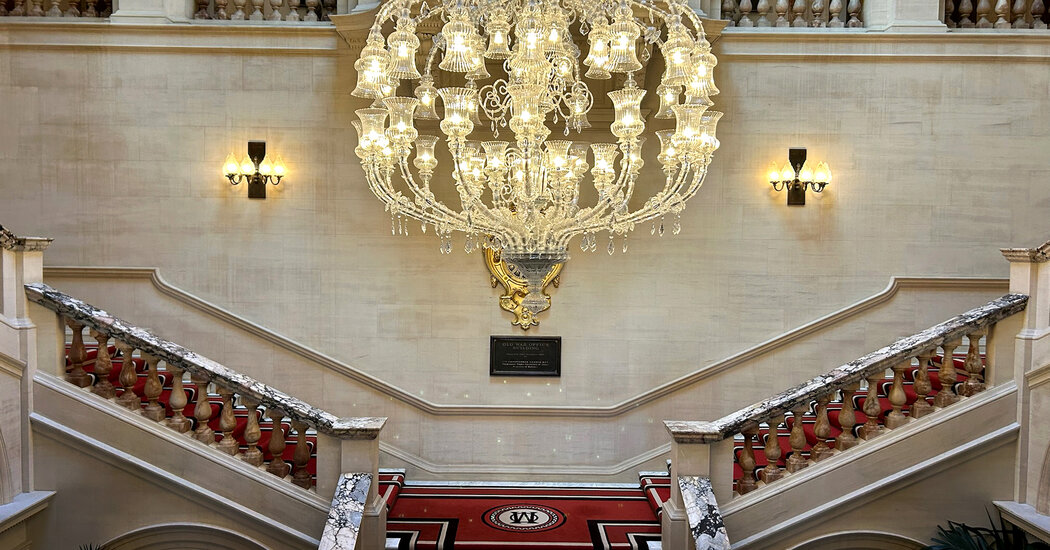
The hotel is on Whitehall, a major tourist axis. When you enter, you face a marble-and-alabaster staircase for which the word “grand” is insufficient. It’s lit by a double-globed chandelier and a domed skylight. A red carpet with black-and-cream stripes covers the stairs.
But unless you are staying in a second-floor suite, you really have no reason to climb it, as check-in, dining and some spa services are all on the ground level. So, too, is the dark-and-woody Guards Bar and Lounge with its plush seats, horse-themed art and excellent variations on classic drinks.
Hits: The pool took my breath away. From the vast, double-height entrance area, a dramatic, curving staircase led to it. While the pool was only 20 meters long, the water was cool enough for real swimming.
Glass-fronted elevators in the original wood housings offered a glimpse of each floor as we rode up and down to our room. Like Babar in the department store, I could have ridden them all day.
Misses: At about 365 square feet, our room was, well, just a hotel room (to be fair, it was about £500 a night cheaper than the Rosewood suite), with a bathroom and a dressing area that led to a king bed, a desk and various cabinets. Though we were on the fifth floor, the view was mostly of a parapet wall decorated with plants, though if I stood on tiptoe I could get a glimpse of Big Ben and the Victoria Tower.
On our final morning, we ate in the very clubby Drawing Room, where I sank down so far into one of the sofas that my chin felt as if it was at table height. I switched to a chair that was too heavy to budge closer to the table to eat. My £26 scrambled eggs came with H. Forman & Son smoked salmon, but the leisurely pace of service meant I had to bolt them down before taking my sad wheelie to catch the Lizzie Line to Heathrow.
Follow New York Times Travel on Instagram and sign up for our Travel Dispatch newsletter to get expert tips on traveling smarter and inspiration for your next vacation. Dreaming up a future getaway or just armchair traveling? Check out our 52 Places to Go in 2026.

