
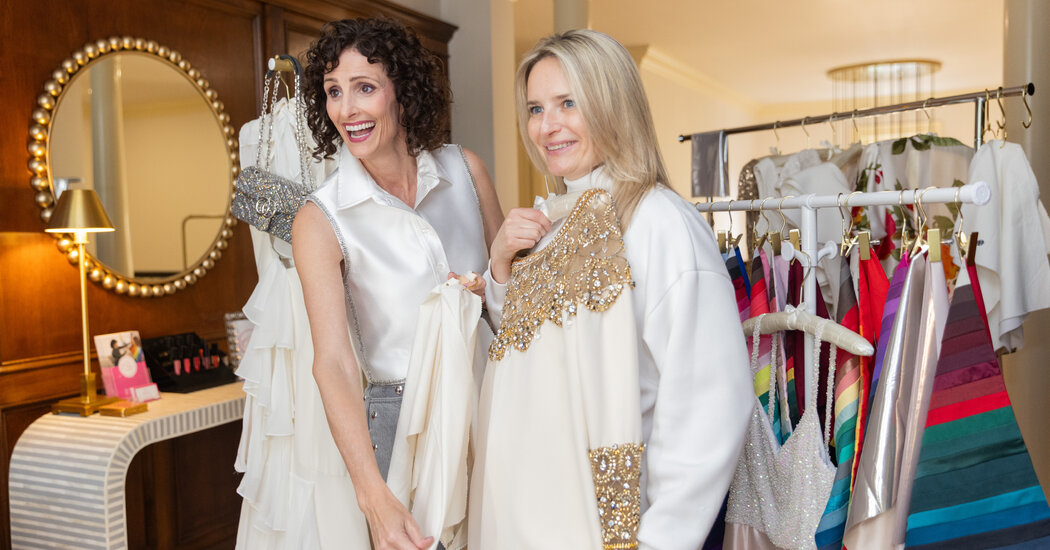
Megan Bentley, a color analyst, knows that picking a wedding dress is more than choosing a white dress you love; it’s also about the right white.
The hue you choose will either complement or work against your complexion and the silhouette of your dress, said Bentley, the founder of The Color Countess, based in Columbus, Ohio. “White is one of the most difficult colors to get right,” she said. “While it is universally bridal, you need the right hue to honor your features. The differences are subtle, but the impact is significant.”
Using color analysis, a method grounded in color theory that looks at how hues interact with people and teaches them how to identify their most flattering color palette, or season, Bentley helps brides find their ideal white for their wedding dress. And as more brides are wearing multiple looks on their wedding day, as well as for their wedding-related celebrations, Bentley is also being asked to help them build their wedding wardrobe around their color palette.
Bentley became interested in color analysis in 1992 when she was 12 years old, through her mother’s best friend, who was a certified color analyst. “I was told I was a True Spring — a palette of warm, light and bright hues including coral, lime green and aqua. I loved it,” she said. As color analysis started gaining traction again in 2024 on social media, it felt familiar to her, Bentley said, and she started formal education in the method through the Association of Image Consultants International.
Bentley began color analysis as a side business while working as a client director at Gartner, a corporate consulting firm based in Stamford, Conn., where she worked with Fortune 10 executives. In 2024, she started incorporating color analysis into her work before making The Color Countess her full-time career in 2025. “Color became a strategic tool I would use to help leaders walk into a room with more authority and confidence,” Bentley said. “Then it took off on my social media in a way I did not expect.”
She offers color analysis through in-person, 75-minute sessions, for $449, and virtual sessions, starting at $99, where she identifies her clients’ undertone (whether their skin reads warm, cool or neutral) and color season and teaches them how to dress within it. “A virtual analysis can be a great option for brides when timing matters,” Bentley said, adding that these consultations are best before trying on gowns at a bridal salon.
Here, Bentley gives a quick lesson in color analysis and how to lean into your best hues to find the right white and elevate your bridal wardrobe.
The interview was edited and condensed for clarity.
What do you think attracts brides to color analysis?
When you are preparing for one of the most photographed and important days of your life, you want to look your absolute best. Once a bride realizes there is a way to find her perfect hue of white for her dress and the right color for the groom’s suit, color analysis becomes an obvious step in their wedding planning process.
Color is one of the biggest visual decisions for a wedding. A color analysis removes the guesswork out of what hues complement you and what works together. The couple will look more refined and the photos more cohesive. It also brings confidence. When you know you are in the right colors and tones, you feel present.
What are you looking at when matching a bride or groom with their color palette?
I am always looking at the individual first. I look at their undertone, value — how light or dark their features are — and intensity — bright and reflective features versus soft and opaque. These are what determine their most harmonious colors. If the couple already has wedding colors in mind, we evaluate whether those colors are in harmony with each other. If they are not, we find the closest, most complementary versions, so that everything feels cohesive.
Time of year and décor can absolutely influence the color direction. If a wedding is in the fall or winter, we can lean into richer, deeper tones within their palettes. If the event is in the spring or summer, we may choose lighter, brighter options.
What are brides specifically asking for in a color analysis?
The number one focus is the white dress. From there, they want guidance on how everything works together — what the groom should wear, how the colors photograph and how to create a cohesive look across the entire day.
There is also a lot of interest in the full wedding wardrobe — the rehearsal dinner, welcome party, honeymoon. Once they understand their colors, they want to make confident decisions across all of their wedding-related events.
What is the science behind finding the right hue of white to complement the bride and the style of her dress?
The key is identifying your undertone, then you can determine whether you need a cooler, warmer, or more neutral white. The right hue is what makes your skin look clear and luminous, so that you stand out, rather than the dress wearing you.
It is not about matching your complexion; it is about your undertone. It can be fair, tan, rosy, golden or olive. Your undertone is the temperature beneath the skin and that is what determines which whites will be most harmonious. For example, the actress Mindy Kaling often appears very warm on the surface, but she has a cool undertone. If she leans too warm in her clothing, it can compete with her rather than support her.
On the flip side, someone like actress Emma Stone is very fair, but she has a warm undertone. Fair skin does not automatically mean cool, just like deeper or more golden skin does not automatically mean warm, such as with model Naomi Campbell, who has a cool undertone.
Does the hue of white affect the look of the silhouette and fit of a wedding dress?
Yes, color is what brings the entire look into balance first. It can completely change how a silhouette is perceived.
The right white sharpens the entire look of a gown. The right hue will enhance the structure of the garment, highlight proportions and direct where the eye goes.
When the hue is off, it creates shadows, pulls focus from your face and breaks the line of the silhouette, making the dress look heavier or less refined.
What are your tips for putting together the rest of a wedding wardrobe?
I like to anchor everything around four colors: your best white, your strongest neutral, an eye-enhancing hue that brings out your features and a pop color, which is your favorite shade within your palette. This combination gives you structure, variety and cohesion. Everything mixes and matches, everything photographs well and most importantly, everything keeps you in harmony, so that you look polished and intentional across every event leading up to and after the wedding.

