
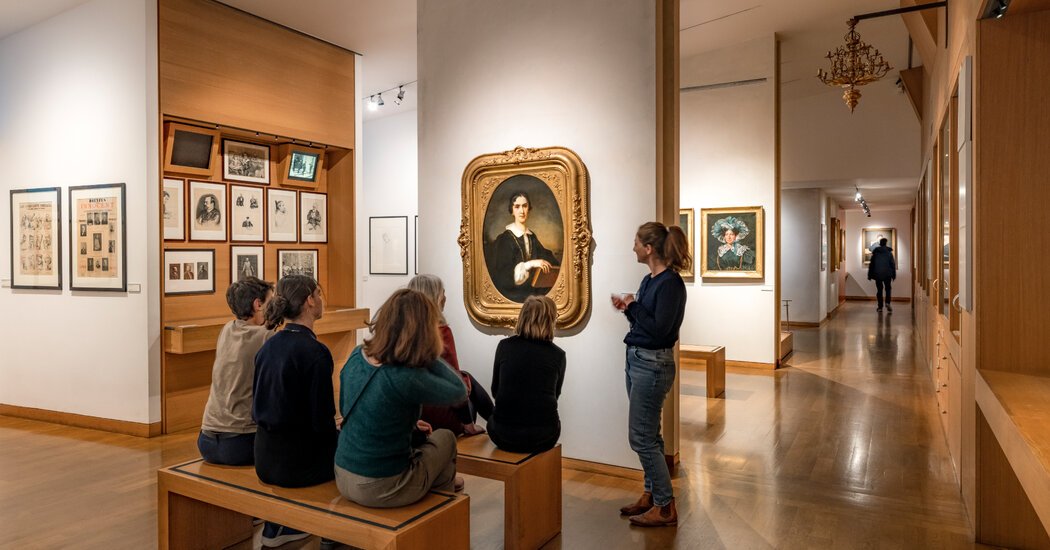
In fall 2023, the Jewish Museum of Belgium was drawing crowds to its show of photographs by the fashion portraitist Erwin Blumenfeld. Then came Oct. 7.
Attendance at the museum dropped precipitously in the days after the Hamas-led attack on Israel and Israel’s subsequent bombardment of the Gaza Strip.
Barbara Cuglietta, the museum’s director, said the building was soon as empty as it had been during the Covid-19 pandemic. School groups stopped visiting, and the public stopped showing up.
“I don’t like to use the word boycott, but it was like isolation,” she said recently by phone. The following year, attendance at the museum plunged to 9,000 visitors.
Across Europe, many Jewish museums have seen visitor numbers drop, patrons back away and security threats rise since the fall of 2023, according to a recent report by the Amsterdam-based Association of European Jewish Museums, a nonprofit network of 55 institutions. The association’s members also reported online harassment, vandalism and acts of aggression against staff members.
The root of the problems, said Mirjam Wenzel, the association’s chair, was that many people seem to perceive Europe’s Jewish museums as somehow tied to Israel, when in fact they are largely publicly funded by local governments, ticket sales and sponsorships, and typically focus on the history of Jews on the continent.
“We are being attacked as Israeli institutions and identified with the state of Israel,” Wenzel said.
In interviews, 10 directors of Jewish museums throughout Europe said that their institutions had all felt shock waves after the Oct. 7 attacks. Many agreed that a perceived association with Israel was damaging their institutions. But there were a variety of opinions about how, or whether, Jewish museums should respond. Some felt it was not their responsibility to engage with events in the Middle East, while others found that their museums could be useful forums for education and discussion about current events.
Museum directors in Amsterdam, Brussels, Copenhagen, Frankfurt and Vienna said they were struggling with lower visitor numbers. But not all museums have experienced the same drop. The directors of similar institutions in Berlin, Paris and Prague said their attendance was flat or had even increased since Oct. 7, 2023.
Paul Salmona, the director of the Museum of Art and History of Judaism, in the Marais district of Paris, said that his museum’s attendance rose slightly last year and that membership was now at the highest level since its opening in 1998. He noted that France’s Jewish population is the third largest in the world, after the United States and Israel, and said that he wanted his programming to reflect the diversity of opinions among French Jews — including about Israel.
Salmona said the museum’s 200-seat auditorium was regularly packed when it hosted panel discussions on Israel’s history and contemporary politics, which often include Israeli and Palestinian artists and thinkers who are critical of Israel or who favor a peace deal.
“Of course we are in the center of Paris in a traditionally mixed Jewish neighborhood, where Jewish people have lived since the 18th century,” he said. “It might be different in the Paris suburbs.”
It is also different in places with smaller Jewish populations. Denmark, for example, has a Jewish community of about 2,500 people, according to Janus Moller Jensen, the director of the Danish Jewish Museum in Copenhagen.
Immediately after Oct. 7, 2023, “there was a huge support for the museum,” he said, but “quite soon after the attack it turned into a very anti-Jewish sentiment, if not outright antisemitic attacks.” In 2024, museum attendance dropped 37 percent, he said, and in 2025 it was down 32 percent from 2023 levels.
“People chose to stay away because they felt that visiting would be a support for Israel, and they associated all Jewish life with Israel,” he said. “We try to explain that we are a state-funded museum of culture dealing with 400 years of Jewish life in Denmark. They make a connection between us and Israel that isn’t there.”
Wenzel, who is also the director of the Jewish Museum Frankfurt, said that this misconception was frustrating, given her institution’s specific focus on Jewish life in the city. “We are an institution that’s paid for by German taxpayers,” she said. “We are not an institution that’s taking positions on political issues.”
Like most of the museum directors interviewed, Wenzel described a sense of peril as antisemitic incidents at Jewish sites worldwide have risen. In the last year, there have been high-profile attacks against synagogues and Jewish schools in cities including Amsterdam; Liege, Belgium; London; and Manchester, England.
Her institution filed 33 criminal complaints with the police in 2025, she said. “There were swastikas on our site and on our exhibitions,” Wenzel added. “There have been several calls to us, saying things like, ‘Why haven’t you been gassed?’ and there have been letters with strange threats in them.”
Such threats have led Jewish museums to ramp up security measures and made many of them nerve-racking places to work. Most of the museum directors interviewed said their institutions had been subject to in-person and online hate attacks.
In the summer of 2024, for example, an employee at the Danish Jewish Museum forgot to change out of his work T-shirt, which had the museum logo on it; a group of teenagers verbally assaulted him on his way home, according to Jensen, the museum’s director.
“People are experiencing stress, they feel burned out, and they are looking for other jobs,” Jensen said.
Emile Schrijver, the director of the Jewish Museum in Amsterdam, said that attendance there had dropped from about 104,000 in 2023 to 86,000 in 2024 and to 65,000 in 2025. It was able to cover the ticket sales shortfall with a $1 million subsidy from the Dutch government, he said, but the loss of visitors was affecting staff morale.
“How do you keep your staff motivated if curators are making exhibitions for fewer visitors under more difficult circumstances?” Schrijver said.
At the Jewish Museum of Belgium, the Oct. 7 attack brought back painful memories of another tragedy from almost a decade earlier. In 2014, the museum was the site of a terrorist incident when a gunman opened fire inside, killing four people, including a museum volunteer.
A year after the Oct. 7 attack, the museum closed for a planned multimillion-dollar restoration and renovation, to modernize its historic building. But the construction, which is organized by the local government, has since stalled.
Then came the vandalism. One day in March 2025, Cuglietta, the director, arrived at the museum to find the words “Queers for Palestine” scrawled about 40 feet long across the building’s facade.
Cuglietta said it only made her want to reopen the museum and get back to her mission of supporting Jewish life in Belgium. She plans to do so in spring 2027.
“We feel the same level of urgency to be open again and to speak our truth,” she said. “We are not going to be shut down. We are not going to be canceled.”

