
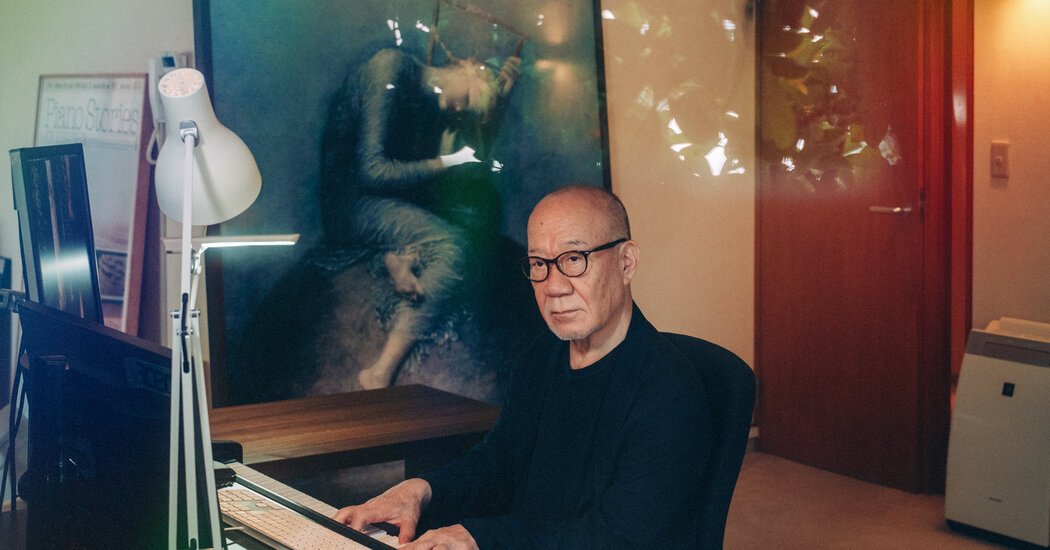
Joe Hisaishi had spent the evening leading the Chicago Symphony Orchestra from the conductor’s podium. But near the end of the concert, a grand piano was wheeled out onstage, and he took a seat on its bench. He started to play a series of rolled chords, and the auditorium rattled with cheers.
His fans immediately recognized the opening of the soundtrack for “Spirited Away” (2001), one of his many beloved collaborations with the filmmaker Hayao Miyazaki of Studio Ghibli. This excitement, the kind that makes people squeal at pop concerts when they hear the first notes of a favorite song, tends to follow Hisaishi wherever he performs.
Usually, those cheers are followed by rapt, reverential silence. At the 2,500-seat Symphony Center in Chicago, a quiet crowd is impressive; at an arena like Madison Square Garden, where he can attract thousands more to an orchestral concert of all things, it’s astounding.
That is the rare power that Hisaishi, 75, has as a composer and conductor. A celebrity because of his chameleonic and enchanting soundtracks, he has long maintained a parallel life as a classical music artist. Now, that is where he is shifting his focus. He has started writing for concerts more than film, recording for Deutsche Grammophon and appearing with some of the world’s great orchestras. And, having already filled Radio City Music Hall and Madison Square Garden, he is returning to New York this week at a hallowed venue for classical musicians: Carnegie Hall.
“I want to find new ways to draw a broader audience to classical music,” Hisaishi said in an interview. “And if, in the process, that also broadens my own horizons as a musician, then I think that would be wonderful.”
Hisaishi, born after World War II, came of age when Japanese musicians were inhaling Western culture and transforming it into new, fusion genres like city pop. His mother tongue is the Minimalism of Philip Glass and Steve Reich, but his scores are much more eclectic, even disorienting.
The soundtrack to “Kiki’s Delivery Service” (1989), for example, opens with a waltz that is later given the street sound of an accordion and mandolin, but also the lushness of a symphony orchestra. As it continues there is an effervescent tune fit for children’s television, honky-tonk piano and a melody that seems to contain elements of “Madama Butterfly,” “Snow White” and modern pop ballads all at once.
This is music with feet in many sound worlds, cohering into a disarmingly winsome and distinctive whole. Hisaishi makes it look easy, but few composers are capable of such confident freedom, and few have a cosmopolitan background so poised for it. Not just globally famous, Hisaishi is one of our most truly global composers.
AS A STUDENT, schooled in the Suzuki violin method and piano, Hisaishi had his head in the classics but also in music by living composers like Shostakovich and Pierre Boulez. He came across Terry Riley’s album “A Rainbow in Curved Air,” which inspired a transformative plunge into Minimalism. And he had a love of jazz so pronounced that he abandoned his birth name, Mamoru Fujisawa, to go by Joe Hisaishi professionally, based on the Japanese kanji and phonetic equivalents of “Quincy Jones.”
Through all this exposure and study, a personal style emerged. “Rather than simply imitating genres superficially,” Hisaishi said, “I am absorbing the philosophies, techniques and experimental spirit inherent in each form of music and aim to integrate them into my own artistic expression.”
His early album “MKWAJU,” from 1981, is Minimalism by way of pop, like Glass’s “Songs From Liquid Days” five years later. It opens with repetitive figures on a vibraphone that, joined by electronics, take on a grooving trance. It’s a sensibility he carried into the soundtrack for “Nausicaä of the Valley of the Wind” (1984), his first movie with Miyazaki.
Hisaishi had originally been brought on to compose the film’s image album, a kind of preparatory job. Miyazaki was so taken with it that he hired Hisaishi for the final soundtrack. They have stuck together ever since, though Hisaishi has said that their relationship is above all professional, likening their collaborations to elections: something that reliably happened every several years. (Miyazaki retired, not for the first time, with his most recent film, “The Boy and the Heron,” from 2023.)
In Miyazaki’s anthologies “Starting Point” and “Turning Point,” he described his work with Hisaishi as more of an exchange than a side-by-side partnership. For each film, the director would send the composer a memo or a collection of poems to give a sense of mood and character, trusting that Hisaishi would return with the right sound. For “My Neighbor Totoro” (1988), Miyazaki knew that the introduction to the title creature shouldn’t be too mystical or even endearing.
“That’s why Hisaishi-san’s Minimalist music was best,” Miyazaki wrote. “If it were more mysterious, then it would be supernatural. What I thought was perfect was that he includes sounds we’ve heard somewhere and recognize, but still gives us the feeling that something is a bit different.”
The same could be said of every Hisaishi soundtrack, though each is also a singular creation. He liberally adopts styles and forms from around the world, and from deep in music history, with references abounding: the martial symphonies of Shostakovich in “Princess Mononoke” (1997), Wagner’s “Ride of the Valkyries” in “Ponyo” (2008), John Adams’s thumping pulses in “The Wind Rises” (2013). They are a musical analogue to Miyazaki’s aesthetic in movies like “Kiki’s Delivery Service” and “Howl’s Moving Castle” (2004), whose vaguely European architecture and fashion are comfortably familiar yet unplaceable.
Hisaishi’s film music is predominantly charming and intractably memorable, in part because he approaches composition horizontally rather than vertically: through a line of melody more than stacked harmonies. This leads to soundtracks that behave almost like counterpoint, flowing alongside the film instead of strictly underscoring it with illustrative effects and emotional guideposts.
“When I create a single melody, the question becomes how it can move naturally, and how I can write it so that it truly comes alive — much like the laws of nature,” Hisaishi said. “I always try to make my music as natural as possible, allowing it to unfold naturally, creating something that anyone can embrace.”
It certainly is embraced. Esteban Batallán, the Chicago Symphony’s principal trumpet, who has played the solo in a piece adapted from the reveille in “Castle in the Sky” (1986), said that anyone who listens to a Hisaishi melody “gets touched by it immediately.” Ryan Fleur, the president and chief executive of the Philadelphia Orchestra, where Hisaishi is the composer in residence, said that when Hisaishi encored with his Studio Ghibli music, audience members “had tears running down their cheeks.”
Even Hisaishi is affected by it. “The first audience for my music is myself,” he said. “If it doesn’t move or excite me, then it simply isn’t good enough.”
HISAISHI HAS BECOME so popular, he is capable of selling out arenas, for multiple days straight, with concerts of symphonic suites adapted from his Studio Ghibli soundtracks. With a lot of merchandise for sale and a little sentimentality onstage, there is an element of classical crossover to these performances, and if they were the only thing on his calendar, he would risk becoming a Yanni or an André Rieu.
But he has always maintained a more traditional career as a classical conductor in Japan; fans looking up his soundtracks online may have also encountered his vigorous and clean interpretations of symphonies by Beethoven, Brahms and Schubert, or his compilations of contemporary, mostly Minimalist, music.
“As a composer, I chose a Minimalist approach,” Hisaishi said. “But through that experience, when I looked back at the classical repertoire, I began to think that there might be approaches no one had tried before, and that classical music might evolve in new ways. That was what led me to begin conducting.”
The challenge has been to spread Hisaishi’s classical reputation and engagements beyond Japan. He emerged from the coronavirus pandemic lockdown with a Studio Ghibli arena tour, but along the way picked up new management from the blue-chip office HarrisonParrott, which has led to appointments in Philadelphia, Paris and elsewhere. He has also been signed by the prestigious music publisher Boosey & Hawkes and is at work on an opera.
“He’d been doing these arena tours for multiple years, and it wasn’t really what he was looking for,” said Moema Parrott, the management firm’s chief executive. “He felt he was straying from his path, so this has been, ‘How do we reposition him, to pivot away from this perception of him as a film composer and get people to see what his real passion is?’ This is really his golden era.”
In his appearances as a conductor, Hisaishi often programs his music with pieces that may be less familiar to his fans, like Reich’s “Desert Music.” With the Orchestra of St. Luke’s at Carnegie Hall this week, he will pair his recent Concerto for Orchestra and Glass’s First Symphony; with the Boston Symphony Orchestra at Tanglewood the next weekend, his music will bookend Ravel’s Piano Concerto in G, with Jean-Yves Thibaudet.
Concerts like those usually sell out, with visibly younger audiences. In Philadelphia, Fleur said, 75 percent of attendees had never been to the hall or heard the orchestra before. A test comes this fall, when Hisaishi’s music will be on the program without him at the podium. Still, Fleur said, 15 percent of the new audience members he attracted returned for other concerts.
“Someone who came to one of my classical concerts once told me, ‘It felt almost like listening to rock music,’” Hisaishi said. “I think that was because my approach is very rhythm-driven, which makes the music more immediate and accessible. Perhaps that can become a point of connection, helping more people discover just how powerful an orchestra can be.”
If Hisaishi’s film scores are guided by melody, then his concert works, which sound nothing like the soundtracks, are governed by rhythm. The effect can be exhilarating, as in his recent Harp Concerto, written for Emmanuel Ceysson and out this month on Deutsche Grammophon. But it can also be difficult. Hisaishi’s Second Symphony lives or dies on rhythmic precision; it had the Philadelphia Orchestra audibly on edge last summer, and took up most of his rehearsal time with the Chicago Symphony this spring. It is, Batallán said with a sigh, “very demanding.”
In rehearsals, Hisaishi is often gentle. Stepping onto the podium in sneakers and a relaxed outfit, he greeted the Chicagoans simply: “I’m so happy to be working with you today. Please enjoy my music.” Although he could be demanding, he would often just ask the players to try a passage again, sometimes singing the correct articulation to them as guidance. Afterward, about five musicians approached him for selfies and autographs; one had even brought his family in to meet him.
Hisaishi is not done conducting his film music. That Chicago concert ended with the “Spirited Away” suite, and an encore from “My Neighbor Totoro.” (And he has expanded into Western soundtracks, such as “A Big Bold Beautiful Journey” last year.) He also has more arena concerts planned, but more selectively, at what Parrott called “iconic venues,” like Red Rocks or the Arena di Verona. The real change in his life is how those appearances live, in a more balanced way, alongside his weeks at smaller, storied halls. To him, there is no difference.
“I’ve always felt that I’m communicating directly with each person in the audience, sharing my message with them one by one,” Hisaishi said. “That’s the mind-set I always have, so whether there are 20,000 people or 2,000 doesn’t really make a difference to me. For me, it’s always one-to-one.”
Audio credits: Royal Philharmonic Orchestra and Joe Hisaishi, “One Summer’s Day (The Name of Life)” (Deutsche Grammophon); “Kiki’s Delivery Service (Original Soundtrack)” (Studio Ghibli); MKWAJU ensemble, “MKWAJU” (Nippon Columbia); “Nausicaä of the Valley of the Wind (Original Soundtrack)” (Studio Ghibli); “Princess Mononoke (Original Soundtrack)” (Studio Ghibli); “Ponyo on the Cliff by the Sea (Original Soundtrack)” (Studio Ghibli); “The Wind Rises (Original Soundtrack)” (Studio Ghibli); Royal Philharmonic Orchestra and Joe Hisaishi, “Doves and the Boy (from ‘Castle in the Sky’)” (UMG Recordings); Royal Philharmonic Orchestra, Emmanuel Ceysson and Joe Hisaishi, Harp Concerto: Movement 3 (Deutsche Grammophon); Vienna Symphony and Joe Hisaishi, Symphony No. 2, I: What the World Is Now? (Deutsche Grammophon); New Japan Symphony Orchestra and Joe Hisaishi, “My Neighbor Totoro Symphony” (Studio Ghibli)

