
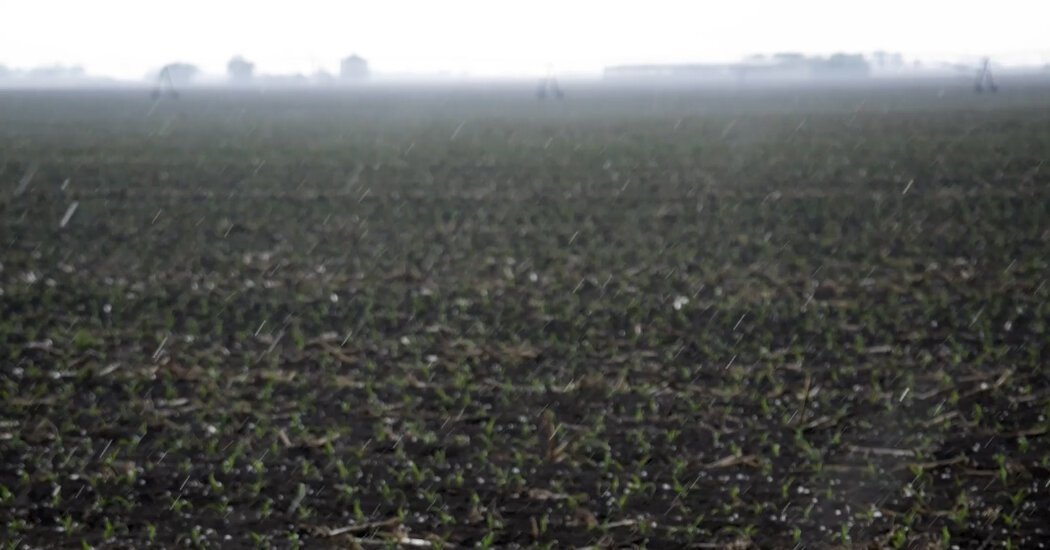
The whistling starts before the impact. It is a haunting, high-pitched keening — the sound of jagged ice stones, aerodynamically imperfect, hurtling toward the earth at terminal velocity.
“It’s fascinatingly terrifying,” Dr. Sean Waugh said. We are barreling down an Oklahoma highway, chasing a rotation that looks like a bruised thumbprint against the horizon.
We pull off where a red dirt road bisects two green fields. Above us, a dark, slate-gray cloud begins to churn. A swirling finger descends from the heavens in a jagged “S,” stretching toward the ground as a violent shroud of debris erupts at its base.
“Jesus,” Dr. Waugh said. The tornado is carving a path across the asphalt just two football fields away.
Then the ice arrives. Perfectly lit white spears are flung from the circulation of the tornado, whizzing past our heads and hitting the road with the domestic, shattering sound of ice cubes dropped on a kitchen floor. Safety helmets go on. Dr. Waugh climbs onto the bed of his truck for a better view, standing like a target on a driving range, as golf ball-size hail begins to fly diagonally, driven by 100-mile-per-hour winds.
We dive back into the cab. Thunk. The sound is percussive, vibrating through the truck, as if we’re trapped inside a bass drum during a heavy metal solo. Dr. Waugh, a research scientist at the National Oceanic and Atmospheric Administration, ignores the denting metal. He is watching the tornado, shouting at the driver to stay parallel to its vortex. He needs the data at the base.
Then, the tone shifts from clinical to urgent.
“Windows up! Right now, windows up!”
The Cost of Spherical Ice
For a century, the tornado has been the undisputed protagonist of the American storm. But while scientists have spent decades perfecting the ability to predict where a funnel will touch down, hail has remained a blind spot — one worth $1 billion a year.
This spring a handful of scientists returned to the Plains, as they have each of the last several years at the start of severe weather season. They weren’t just looking for supercells or tornadoes, the more typical storm chaser targets. They were hunting for the ice. Recent discoveries have upended decades of meteorological orthodoxy, revealing that hail the size of golf balls can be ejected from a tornado’s circulation at over 200 miles per hour.
These balls of ice aren’t just academic curiosities. They are the reason your insurance premiums keep rising.
Dr. Waugh’s primary mission at NOAA is tornado research, but his obsession is hail. Last year, he outfitted a research vehicle with a custom array of high-speed cameras and lights so bright they require eclipse glasses to approach. At the same time, researchers working as part of ICECHIP (the In-situ Collaborative Experiment for the Collection of Hail In the Plains) scoured the region with their own fleet of instruments as part of the largest hail research project in history.
An Icy Harvest
“We were probably a week from harvesting,” Kenton Gossen said.
Standing on his family’s farmhouse in western Oklahoma, Mr. Gossen recalled a night last summer that felt like the end. At midnight, the sound of the storm forced him from his bed. He opened his front door to find the world turning white.
“It wasn’t just small pieces,” he said. “There were big pieces, little pieces in between. It hailed for 30 minutes straight.”
By dawn, the drifts of ice were still piled against his barn. Mr. Gossen and his brother drove in opposite directions, surveying miles of ruined wheat. The hail hadn’t just hit the crop but had decapitated it. The stems were shattered, the grain heads lay flat on the dirt where a harvester’s header couldn’t reach them.
“It can make you feel depressed pretty fast,” Mr. Gossen said. “You know God’s in control,” but, he added, “you have to have insurance ahead of time.”
The storm destroyed 2,400 acres. Mr. Gossen had invested roughly $235 per acre into that crop. His insurance adjuster will pay about $100 per acre, he said. Still, he faced a $300,000 loss.
This is the macroeconomic reality of the American thunderstorm. Before the federal billion-dollar disaster tracking program was shuttered in 2025, it revealed a consistent grim trend: A single hour of hail over a midsize city can cause a billion dollars in damage.
“Hail is a growing driver of losses,” said Adam Smith, who ran the NOAA program for 15 years until it was dismantled by the Trump administration last year. Insurers now flag hail, not tornadoes, as the primary catalyst for the rising cost of living in the American heartland.
It takes hailstone the size of a golf ball to shatter a windshield, dent a hood, crack a shingle or pepper holes in the side of homes.
While linking climate change to a single event requires extensive analysis, the science suggests that the United States can expect more severe storms as the world heats up. In the 1980s, the country experienced, on average, one (inflation-adjusted) billion-dollar disaster every four months. Now, there is one every three weeks or so.
“From a loss perspective, we are on a pace where losses from severe storms double each decade,” said Dr. Ian Giammanco, a research scientist at the Insurance Institute for Business & Home Safety who took part in ICECHIP.
Go, Hail Cam, Go
“Whoa, jeez. Big hail. Falling now,” Dr. Waugh said.
We have pivoted the truck, pointing its reinforced rear toward the storm’s core. Dr. Waugh reaches for the ceiling and flips a red toggle switch — the kind used in movies to launch missiles.
The prairie behind us instantly lights up. The truck’s light array puts out 256,000 lumens per square meter — roughly 30 percent brighter than the surface of the sun.
Thump. Thunk. Thump. Dr. Waugh hunches over a laptop in the passenger seat, typing into a terminal prompt. “Go, hail cam, go,” he mutters.
Two high-speed 4K cameras, mounted in a custom metal housing, begin firing at 330 frames per second. They are capturing something almost no human has seen: the midflight physics of hail.
For decades, scientists’ understanding of hail has been built on the “lucky 10 percent” — the stones that survived the fall from thousands of miles up in the atmosphere, didn’t shatter on impact and happened to have been found by a researcher before melting. Dr. Waugh argues that 90 percent of the data has been literally melting away. His images capture hail before that happens.
“We’re already seeing things that are going to challenge how we forecast,” Dr. Waugh said.
The Unintended Consequence
The 2026 season has been a quieter one for scientists. ICECHIP, originally intended as a multiyear study, has largely folded because most of its funding came from the National Science Foundation, which saw significant cuts to its budget, as the Trump administration slashed federal science funding.
While Dr. Giammanco and others are sifting through the data, most of the project’s researchers did not go out into the field this year to collect more.
“As we sit today, the only solution is to raise insurance rates,” Dr. Giammanco said. “We’re racing against the clock because the dollars in damage are just piling up.”
A few researchers still were able to do work this year with leftover funds, but most of the remaining funding is coming from other sources, according to Victor Gensini of Northern Illinois University.
“Some of our biggest funders that will happen in the next five years for our program, for our research here at N.I.U., are going to be insurance and reinsurance companies,” Dr. Gensini said. “What does that say about the state of extreme weather and climate when insurance companies are willing to take shareholder profit and reinvest that into their company for research and development?”
Mr. Waugh’s work, which is funded as a division of NOAA, once again set out this season as part of a small research team called The Low-Level Internal Flows in Tornadoes experiment, or LIFT, which involves getting very, very close to tornadoes. This works well, because often getting close to a tornado means encountering the worst hail of a storm: He often flips on the hail cam, occasionally recording debris flying by his camera.
Back in western Oklahoma, Mr. Gossen is already looking toward the next generation. He wonders if his children can survive in a world where the margins are thinned by every passing cloud.
“We’ll figure out a way to get through it,” he said. “We always do.”

