
The Trump administration announced Monday that it will drop some limits on “forever chemicals” in drinking water that officials had determined can cause cancer and other serious health problems — angering some key activists who had supported President Trump’s campaign.
The Environmental Protection Agency said it would unravel the nation’s first federal drinking water limits for the compounds, perfluoroalkyl and polyfluoroalkyl substances, or PFAS. The Biden administration established the limits on six of the substances in 2024, after the agency determined that long-term exposure to PFAS was linked to kidney cancer, immune system suppression, developmental delays in infants and children and other issues.
Instead, the Trump administration will issue narrower regulations that rescind protections for four of the substances and continue to protect against two of the them.
But the move, which had been planned for more than a year, has sparked fury within the Make America Healthy Again movement, a diverse group of anti-vaccine activists, wellness influencers and others who make up a key part of Mr. Trump’s coalition.
Lee Zeldin, the E.P.A. administrator, sought to counter that anger by appearing Monday with Robert F. Kennedy Jr., the health and human services secretary who spearheaded the MAHA movement, and announcing nearly $1 billion to help states address the contaminants in drinking water.
“They persist in the environment, they build up in the human body, and addressing them is not optional. It is essential to making America healthy again,” Mr. Zeldin said at an event in the wood-paneled Map Room on the first floor of the E.P.A. headquarters.
Mr. Zeldin argued that the Biden administration made procedural errors with its drinking water standards and said his E.P.A. will regulate “the right way, following the law and following the science.” He has also raised concerns that water systems could pass costs on to consumers if the compliance deadline wasn’t pushed back. The Biden administration had estimated the rule would cost about $1.5 billion to implement each year, but Congress in 2020 provided about $9 billion to improve drinking water and address chemicals like PFAS.
The Trump administration will continue to protect communities from the chemicals present in the tap water of millions of Americans, Mr. Zeldin said. He highlighted the work of companies that create technologies to capture and destroy the substances.
Mr. Kennedy insisted that the Biden administration’s drinking water standard would not have survived a court challenge, and that the Trump administration had no choice but to start the regulatory process over. Both Mr. Kennedy and Mr. Zeldin suggested future protections might ultimately be stronger than the Biden-era standards.
“The president is completely committed to removing PFAS,” the health secretary said.
Many activists in the MAHA base have already expressed disillusionment with the Trump administration over its backing of a controversial weed killer and previous plans to delay deadlines for water utilities to limit two types of PFAS in drinking water. Some on Monday described the E.P.A.’s effort to describe their plan as positive for public health as misleading, despite more than a dozen mentions of “Make American Healthy Again” at the PFAS event.
“We have more than enough evidence to show that forever chemicals are harmful to human health,” said Kelly Ryerson, who is known as the Glyphosate Girl on social media, “I would strongly advise the E.P.A. not to move forward on deregulating PFAS if they want to win the November midterms.”
PFAS compounds are man-made and found in a wide range of consumer products including dental floss, baby bibs and fast-food wrappers. The substances help clothing and carpets resist stains and are an important ingredient in firefighting foam. But they are called forever chemicals because they also resist breaking down, lingering in the environment and accumulating in the body.
The chemicals are so ubiquitous that they can be found in the blood of almost every person in the United States. A 2023 government study of private wells and public water systems detected PFAS chemicals in nearly half the tap water in the country.
Under Mr. Zeldin’s new plan, the E.P.A. will issue two new rules. The first one will repeal limits on four types of PFAS — including what are known as GenX substances, which have contaminated a major source of drinking water in North Carolina. The E.P.A. will then restart a lengthy process to decide whether those substances should be regulated and, if so, how.
Separately, the E.P.A. will issue a new rule to retain limits on perfluoroalkyl and polyfluoroalkyl substances, commonly referred to as PFOA and PFOS. The Biden administration’s E.P.A. concluded there are no safe levels of those substances in drinking water and limited them to 4 parts per trillion, which is the lowest level at which the substances can reliably be detected. However, water utilities will be able to request two additional years to comply, until 2031 rather than the current deadline of 2029.
Chemical makers and municipal utilities had sued the E.P.A. to block all of the drinking water standards, arguing that the agency did not follow the Safe Drinking Act process or use the best data when finalizing its rule. Once the Trump administration took office, the E.P.A. asked the court to partially vacate the Biden-era regulation, but the U.S. Court of Appeals for the District of Columbia declined to do so.
A spokesman with the American Chemistry Council, a trade group that represents chemical manufacturers, declined to immediately comment and said the group is reviewing the new E.P.A. proposal.
Alexandra Muñoz, another MAHA activist and a molecular toxicologist, said she is skeptical of Mr. Zeldin’s claim that he will eventually impose protections for GenX and other compounds, given the administrator’s laser focus on eliminating regulations. The E.P.A.’s move to restart the process of considering drinking water standards for GenX and other forever chemicals effectively means the agency is agreeing with its industry critics, she said.
“What is the delay going to be now for the regulation of GenX, which is incredibly dangerous and widely used?” Dr. Muñoz asked, adding, “Why not defend this rule in court and see what the judge thinks?”
Water utility associations said the costs so far were more than double the Biden administration’s estimates, and, combined with mandates to replace lead pipes, will raise residents’ water bills even when counting the $9 billion from Congress.
Utilities also have won multimillion-dollar settlements against PFAS polluters. The $1 billion that Mr. Zeldin announced for states on Monday comes from a bipartisan infrastructure law passed under former President Joseph R. Biden Jr. in 2021.
Advocates for the environment denounced the new rule and some accused Mr. Zeldin of breaking the law. Under the Safe Drinking Water Act, passed in 1974, the E.P.A. can limit water contaminants and has what many refer to as a backsliding provision meant to prevent weakening established standards.
Melanie Benesh, vice president for government affairs at the Environmental Working Group, a nonprofit advocacy group, said the E.P.A. was poised to make drinking water less safe.
“We know that people are being harmed from drinking water that has these chemicals in them,” Ms. Benesh said. “There is no reason why the E.P.A. shouldn’t continue to fight to preserve what was a really important and consequential public health action,” she added.
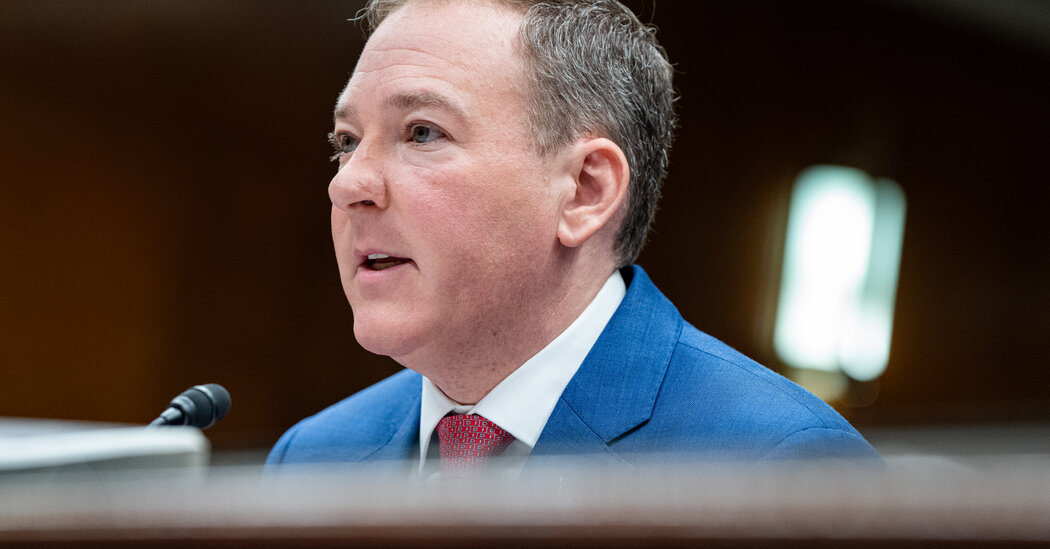
At a Senate hearing last week, Mr. Zeldin acknowledged a “health cost” of exposure to the forever chemicals. But under questioning from Senator Patty Murray, Democrat of Washington, he declined to say what analyses the agency has conducted about what the consequences to adults and children might be of repealing limits on the four chemicals.
In repealing some PFAS limits, Mr. Zeldin also is reversing positions he took as a member of Congress from Long Island, among the most polluted areas in the country.
As a Republican House member from 2019 to 2023, Mr. Zeldin was part of the PFAS congressional task force and supported legislation to regulate forever chemicals.

