
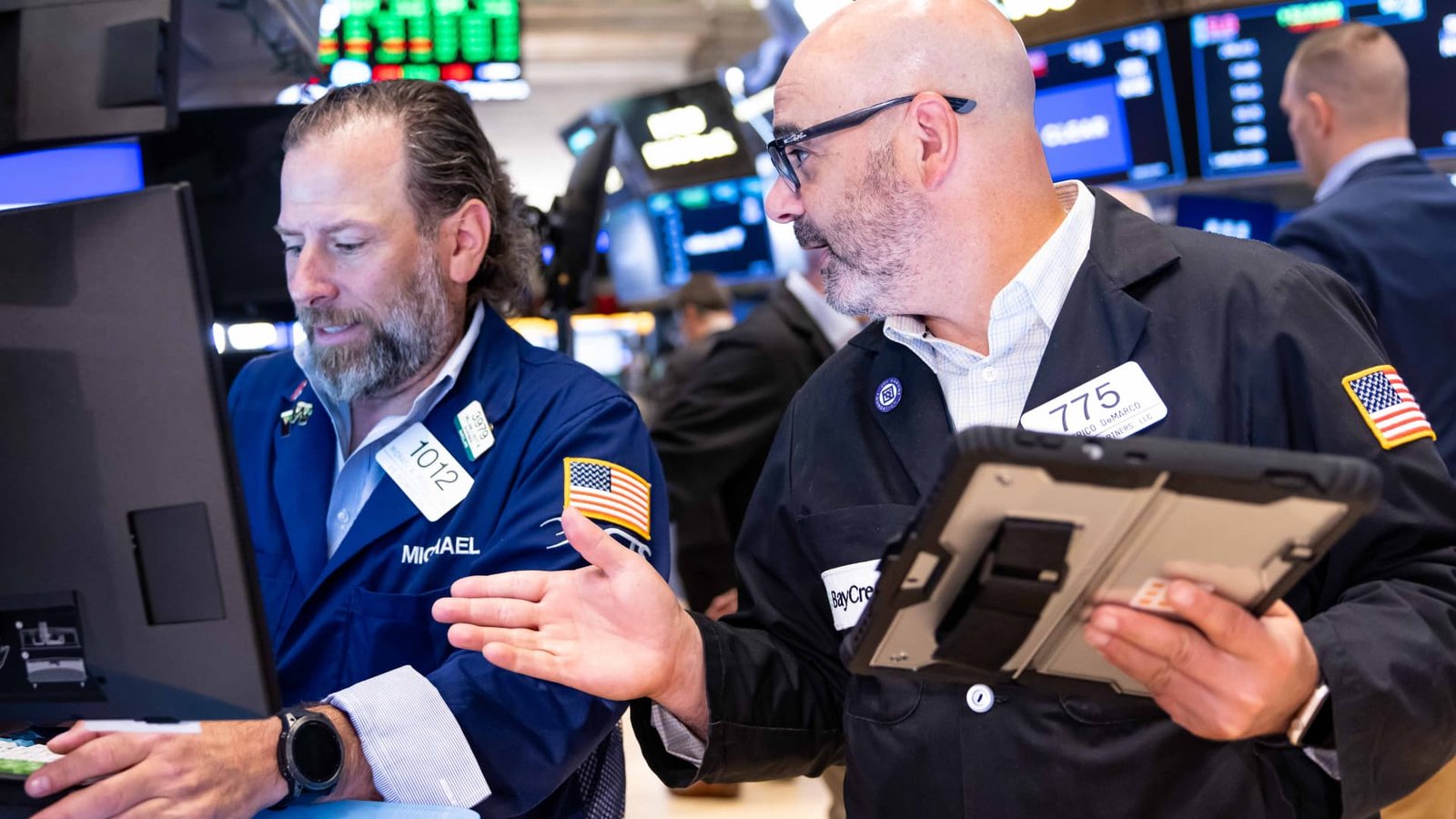
Traders work at the New York Stock Exchange on June 17, 2026.
NYSE
The Dow Jones Industrial Average was relatively unchanged on Tuesday as investors once again appeared to rotate out of names tied to artificial intelligence.
The 30-stock index traded around the flatline after earlier hitting a new all-time intraday high. The S&P 500 and Nasdaq Composite fell 0.3% and 1%, respectively.
Shares of Micron were last seen 6% lower, with KLA, Marvell Technology, Broadcom and AMD also posting declines. The VanEck Semiconductor ETF (SMH) fell more than 4%.
Investors moved into key names in other areas of the market such as healthcare, financials and Big Tech. Shares of Eli Lilly gained more than 2%, while JPMorgan Chase and Microsoft also saw gains. Walmart shares added more than 2% on the heels of the company announcing price cuts on products such as ground beef and Coca-Cola.
The downward pressure in the AI trade began in Asia-Pacific markets, after South Korea’s Kospi dropped nearly 5% following a nearly 7% drop in memory chipmaker Samsung Electronics. The company reported a big jump in second-quarter profit, though concerns about spending and demand overshadowed the increase. In Europe, the Stoxx 600 index shed 0.1%.
“The reaction to Samsung speaks to one of the biggest risks facing markets over the coming weeks: Q2 earnings results are likely to be quite robust on an absolute basis … but unlike with the Q1 season, expectations are presently very bullish (and the SPX is ~1K points higher than it was heading into the Q1 releases), which means the bar is quite elevated,” wrote Adam Crisafulli of Vital Knowledge.
Also weighing on sentiment, Reuters reported, citing sources, that DeepSeek was developing its own AI chip. The push could cut the company’s dependency on semiconductors from companies such as Nvidia and Samsung. Shares of Nvidia were more than 1% lower.
Meanwhile, SpaceX was 4% lower amid its Tuesday entrance into the Nasdaq-100. The declines also come despite a slew of bullish analyst calls from analysts. Many Wall Street shops initiated coverage of the stock with positive ratings and price targets, including Morgan Stanley and Raymond James.

