
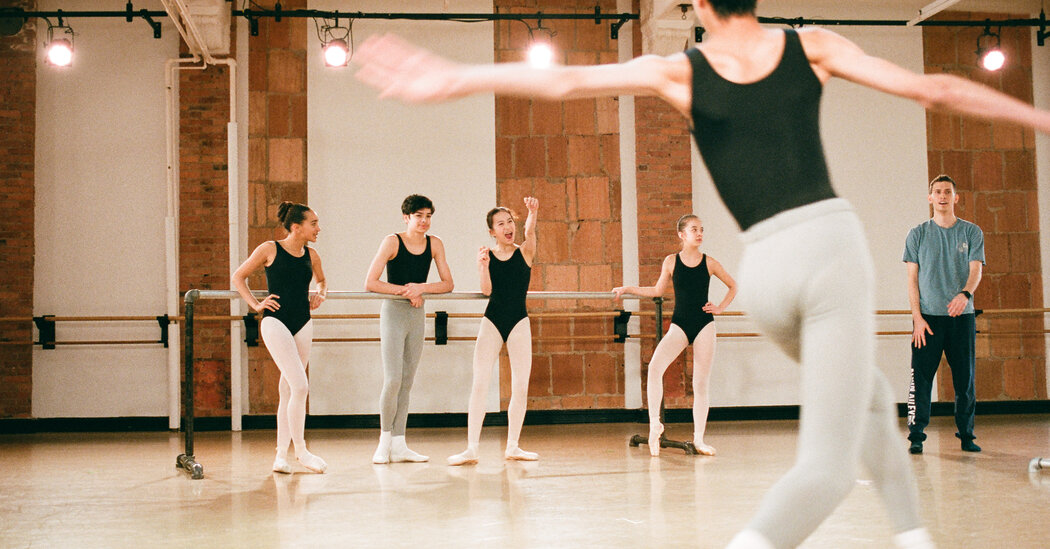
A few weeks ago at Ballet Tech, or the New York City Public School for Dance, a boy was dreaming of his future. He came up behind an adult dancer and matched his pose. He approached a woman and mimed being her partner. Then he walked to the ballet barre and got down to the hard work of achieving his dream.
This was a choreographed sequence, part of “Echoes of the Studio,” a new work by Ballet Tech’s artistic director, Dionne Figgins, that will have its premiere as part of the Ballet Tech Kids Dance program at the Joyce Theater this week.
But the choreography also enacted something that happens all the time at Ballet Tech: alumni inspiring the young.
For “Echoes of the Studio,” Figgins has cast four former students as teachers. “It’s so important for young dancers to have professionals in the space, so they can see the light at the end of the tunnel,” Figgins said after the rehearsal. “And it’s good for the adults to be reminded where they come from and be inspired by the students.”
Five years ago, Figgins became director of Ballet Tech, a school that provides both academic and dance education for fourth through eighth graders. Since then, she has made a point of bringing back former students.
“I want alumni to know that this is always going to be their home,” she said. She has offered them free classes and made studio space available at affordable rates. She has hired them as stagers and teachers.
Two of the alumni in “Echoes of the Studio,” Julienne Buenaventura and Nicholas Begun, now participate in the same outreach program that first brought them — and all other Ballet Tech students — into the program. They travel to public schools around the city, teach an introductory class and invite promising kids to audition for Ballet Tech.
“That’s the entire mission of the school,” Figgins said. “Not ‘You come to us’ but ‘We bring dance to you.’ And we want people in the room who can say, ‘I was just like you and now I’m out in the world dancing.’”
“I’m so grateful to be giving back to this place that gave me so much,” said Buenaventura, who attended Ballet Tech from 2011 to 2016 and graduated from the conservatory of dance at Purchase College in 2024.
What did Ballet Tech give her? “A strong foundation,” she said. “A lot of other studios might focus on ‘boom, pow, slay,’ but Ballet Tech starts slow, as it should.” When she was exposed to other styles later in her training, she was able to approach them with “order in my brain,” she said, “because of how I learned to learn.”
Buenaventura also stressed the importance of performing on a professional level at an early age. “My middle school recital was at the Joyce Theater,” she said. “I felt pretty cool.”
Free education in strong fundamentals with an exposure to big-time glamour: That combination has been at the heart of Ballet Tech since the school started in 1978. Eliot Feld — then one of the most prominent American ballet choreographers — looked at a raucous group of students on the subway and saw potential dancers. In partnership with the city’s education department, he began busing elementary public school students to his spacious studios at 890 Broadway (also home to American Ballet Theater).
In the years since, Ballet Tech estimates that nearly a million students have participated in its outreach program and 25,000 in its on-site classes. Since 1995, students have also attended their academic classes in that building. Now the school is in the process of doubling its student body.
From the beginning, Feld included Ballet Tech students in performances of his professional company. (“This is self-serving,” he told NBC News in 1984. “It only appears altruistic.”) In the mid 1990s, an all-student troupe called Kids Dance began taking over matinee slots in the company’s runs at the Joyce. By 1997, most dancers in the professional company, which folded in 2003, were alumni of the school. Since 2013, Kids Dance has been having its own seasons at the Joyce.
Naimah Kisoki experienced an early version of that student-to-professional pipeline. She started at Ballet Tech in 1988, when she was 8. By 12, she was performing with the company as a student. “And the next thing you know, I’m a professional dancer and still a student!” she said. “It sounds crazy.” From the Feld company, she moved to Dance Theater of Harlem, then to “The Lion King” on Broadway.
“I was a timid little kid,” she said. “But dancing on stages became second nature to me. That’s where I actually felt free and comfortable.”
Now Kisoki is a choreographer who returns to Ballet Tech to stage Feld ballets. “When I first visited the students, I thought, ‘How is this possible? These kids look just like us,’” she said. What she recognized were talented, serious students who were also “city kids, regular.” That Ballet Tech is free, she said, “makes it about the heart” and “builds a different character of performer.”
Megan Eng, who started at Ballet Tech in 2009, recalled being angry at her mom for moving her to a school without her friends. “But then I immediately started loving it,” she said. “You form a special bond with your peers.” As evidence, she cited two of her closest friends, Zuzu Park-Stettner and Asia Yiu. They all met at Ballet Tech in elementary school and now all work there as teachers and stagers.
Interviewed together, these three stressed the importance of being able to relate to the students as former students. “And sometimes a student will joke, ‘I’m gonna take your job,’” Park-Stettner said. “And I’m like, “Go ahead.’ That means we’re doing something right.”
When asked to pinpoint the most important part of a Ballet Tech education, all three had the same answer: discipline.
“But people tend to associate discipline with a negative connotation,” Park-Stettner said. “We don’t mean that.”
“It’s a form of respect,” Yiu said. “It’s starting something and seeing it through.”
Most Ballet Tech students won’t become professional dancers. While some excel in the field — like KJ Takahashi, a soloist at New York City Ballet, or the sought-after contemporary dancer Tamisha A. Guy — others will go into business or the law. Buenaventura’s best friend from Ballet Tech is now in medical school.
“Ballet builds creative, disciplined people who know how to push through a challenge,” Figgins said. “Decorum. Professionalism. Physical confidence. These are things we take for granted because it’s just part of our practice.”
In “Echoes of the Studio,” however, Figgins does not take this work for granted. Like most ballet classes, the ballet ends with a series of bows called réverénce. The students bow to the alumni. The alumni bow to the students.
“It brings tears to my eyes every time,” Buenaventura said. “I really do see myself in them, and it’s like passing the torch.”

