
During the Klondike gold rush at the turn of the 20th century, prospectors learned that there was more than just gold in the hills of Yukon, a territory in Canada. There were fossils — lots and lots of fossils. These were spectacular finds, too: mountains of woolly mammoth tusks, and the bones of saber-toothed cats and extinct giant bison.
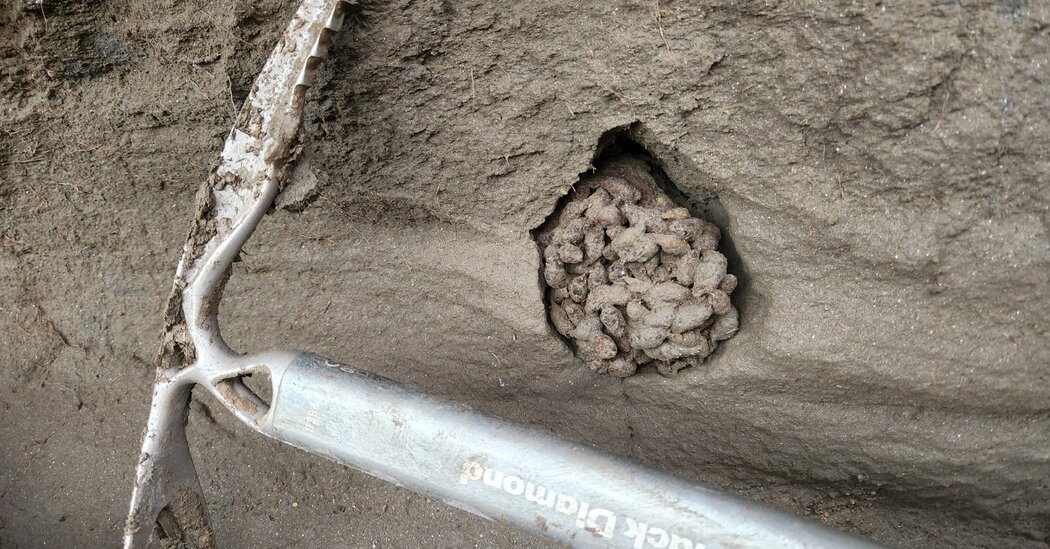
The icy rock faces also contained the tunnels and dens of prehistoric ground squirrels, which were filled with thousands of frozen pellets of ancient poop. Many of these dens remained uninterrupted, perhaps because caches of squirrel droppings are in less demand than mammoth skulls. But leaving these droppings on ice for another century meant the technology to analyze fossilized DNA had progressed. The samples were ripe for analysis.
In a new study, published in the journal Nature Communications, researchers have revealed a startling connection between the rodents and their massive neighbors. The ground squirrels’ fossilized feces contained DNA from woolly mammoths, saber-toothed cats and bison, suggesting that the squirrels were eating meat from the larger animals.
The ancient poop, and the resulting info dump it facilitated, is an example of “amazing preservation, recording these ecosystems over hundreds of thousands of years,” said Tyler Murchie, a paleogeneticist at the Hakai Institute in British Columbia and the study’s lead author.
Why is it so hard to get genetic data from fossils? DNA degrades over time, and many fossils undergo a transformation in which their original organic molecules are replaced by mineral deposits. That means that most fossil feces, or coprolites, have more in common with a rock than with a fresh pile of droppings. But because the Klondike region’s ancient squirrel dens remained frozen and sealed for around 700,000 years, the contents — including the sections used as latrines — were well preserved.
So Dr. Murchie’s colleagues, outfitted with climbing gear and pickaxes, went ahead and excavated hundreds of pellets of frozen feces from the dens and brought them back to the Ancient DNA Center at McMaster University in Ontario for analysis. There, the scientists used chemicals to break down the proteins and minerals in the coprolites to isolate any remaining DNA.
Dr. Murchie was surprised to find that even the oldest samples gave off a telltale odor during this chemical digestion. “I did not think that these would smell anymore, especially when you’re talking about 700,000-year-old poop,” he said. “It was intense.”
But the results of the genetic testing of the samples would reveal an even bigger surprise: After comparing the extracted DNA sequences with known species, the researchers found matches for plants, insects and small mammals, as well as for woolly mammoths, caribou, wolves, cougars and wild horses. It’s possible the ground squirrels ate these other animals’ droppings, but according to Dr. Murchie, it’s more likely that the squirrels were scavenging on carcasses.
The idea of a squirrel feasting on flesh might seem jarring, but most rodents, including modern Arctic ground squirrels, aren’t picky. “If there’s a lot of seeds and nuts and other plant materials around, they’ll eat that, but if there isn’t that, or if there happens to be a carcass nearby, they’ll definitely eat that carcass,” Dr. Murchie said.
Kelsey Witt, a paleogeneticist at Clemson University in South Carolina who was not involved with the study, praised the project for capturing “a snapshot in time” that could tell us more about this ancient ecosystem than only fossilized skeletons could.
But this snapshot could be fleeting. As the global temperature increases and the permafrost thaws, specimens like these coprolites and the DNA inside them are at risk. Researchers are left racing to collect and preserve as many specimens as possible before the genetic material stored in the Yukon is flushed away.

