
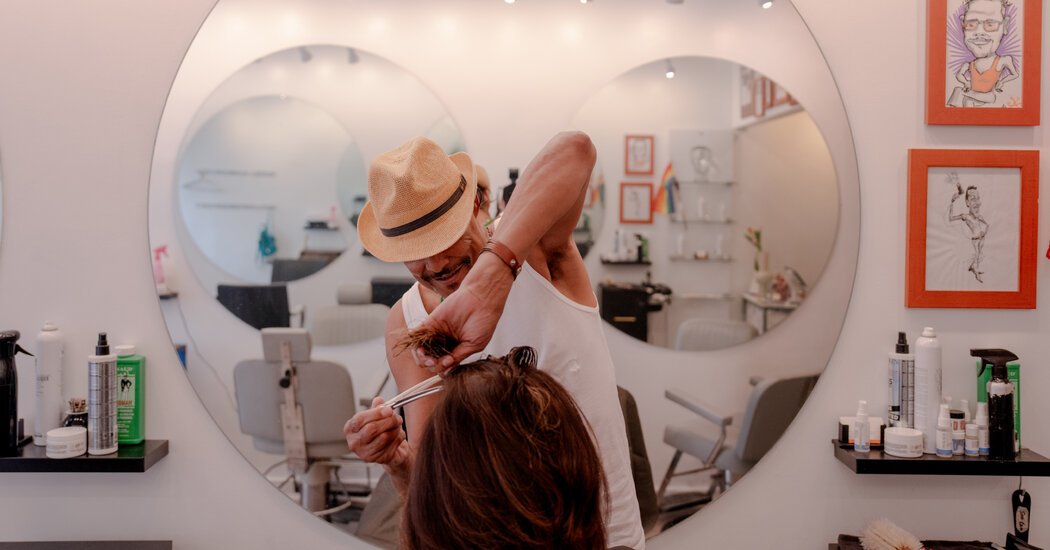
In the SoHo neighborhood of Manhattan, a part of town that has gone from artist haven to luxury shopping destination, an unremarkable-seeming hair salon has been doing steady business since the days when mullets and big perms were all the rage.
It occupies a narrow storefront at 105 Sullivan Street, between Spring and Prince. Fittingly, it goes by the name Anonymous Hair Salon. Walk a few blocks and you can find $6,000 handbags at Chanel, works of art worth millions at the Hauser & Wirth gallery and “farm-to-whisk” Japanese ice tea at the Matchaful cafe.
While the neighborhood around it has changed profoundly in the last 40 years, the salon looks much as it did when it opened in 1986. The only difference might be the metal chairs meant for waiting customers on the sidewalk out front, which recently got a fresh coat of orange spray paint.
Anonymous has withstood 9/11, the 2008 financial crisis and the pandemic. It has survived rising rents and the death of its founder, Patricia Winters-Liotta. It remains open, at least in part, because the building’s owner is that rare New York type — the generous landlord.
The salon’s current proprietor is Winters-Liotta’s son, Vincent Alfano, a Grammy Award-winning sound mixer for film and TV. A soft-spoken man, 32 years old, he has no experience cutting hair. But he more or less grew up in the salon, and he took over after his mother died of cancer in 2019.
Anonymous is not the kind of place that offers patrons sparkling water with lemon slices on the way to charging $400 for a cut and color. It’s a neighborhood spot whose regulars include teachers, accountants, freelancers and retired priests from the Padua Friary on Thompson Street. Customers pay $60 to $100 and leave satisfied.
On a recent afternoon, a longtime Anonymous stylist, Angelo Vega, 55, was the first to arrive at the salon. After setting up, he greeted his first client, Ron Hester, a freelance photographer who had taken the subway from Park Slope, Brooklyn.
“If I couldn’t meet with Angelo, I wouldn’t get a haircut,” Hester, 57, said as he climbed aboard one of the four swivel chairs.
Vega started doing Hester’s hair more than three decades ago, when he worked at an another salon. About 25 years ago, Vega joined Anonymous, and Hester followed.
“How long you been with me?” Vega teased. “Since you had a ponytail!”
“This is the longest relationship I’ve had,” Hester said, “other than my parents.”
The Chin
Pat Winters-Liotta was the glue that held Anonymous together. She grew up in Howard Beach, Queens, and got into the business in the early 1980s, when she was in her early twenties. At the time, she had a friend, Paulette Sconzo, whose father ran a barbershop on Spring Street. They apprenticed there together.
In 1986, they started their own place. It was originally two doors up, at 107 Sullivan Street. According to Alfano, his mother named it Anonymous Hair Salon so the name would appear before that of her competitors in the Yellow Pages. It was also a cheeky response to the name of a neighborhood salon called Who Cut Your Hair? Over time, Winters-Liotta became the sole owner.
Julie Salamon, a longtime customer, has lived on the block since the 1970s. At first, she was a little intimidated by Winters-Liotta, who had a pronounced Queens accent and a funky personal style. “Pat was so New York, in the best possible way,” Salamon, a journalist who previously worked for The New York Times, said. “And though I don’t think she was fearless, she came across as fearless.”
In those days, the neighborhood was predominantly Italian American. Nearby businesses included Pino’s butcher shop, Canapa’s bakery and Melampo sandwich shop. St. Anthony of Padua drew Catholic worshipers on Sundays, and many of the congregants got their hair set at Anonymous on Saturday.
“It was like a movie set, but more like Martin Scorsese’s ‘Mean Streets,’” Salamon said of the neighborhood.
The boss of the Genovese crime family, Vincent Gigante, nicknamed the Chin, grew up on Sullivan Street. In an effort to avoid prosecution, he was known to feign mental illness by roaming the neighborhood in his bathrobe and pajamas. He also held court at the Triangle Social Club, a mob hangout at 208 Sullivan Street. The club is long gone, replaced by Sullivan Street Tea & Spice Company, a boutique selling chaga chai mushroom tea and soy candles.
Winters-Liotta cut hair for the Cosa Nostra men and the priests from the friary. When a customer became too elderly or infirm to show up in person, she made house calls. Though she lived in Rockaway Beach, Queens and, later, on Long Island, she was a local fixture, often sleeping at a friend’s apartment behind the salon.
People in creative fields who paid low rents to reside in the neighborhood’s lofts (which had been factories in a previous New York) formed another part of the clientele. The rock promoter Norman Perry, the bassist Jaco Pastorius and the painter Debrah Feinn were all regulars. In the 1990s, the cartoonist Ann Decker published a strip called “Hairstories” in The Village Voice based on conversations overheard at Anonymous.
The revolving crew of stylists coalesced into a fixed cast, which includes: Irina Drevnyak, a Ukrainian barber; Yvonne Colmenares, a reserved woman who has a set way of doing things; and Vega, who learned his trade working for the celebrity hairdresser Stephen Knoll uptown.
“The night Celine Dion won her Grammy for ‘Beauty and the Beast,’ I washed her hair,” Vega said. “But the management was awful and made me cry once a week. Then I came downtown and met my people.”
Six Months Free
By the late 1990s, Prada and Ralph Lauren were setting up shop in SoHo, and lofts began selling for millions of dollars, to hedge funders and movie stars. That’s when Winters-Liotta began to worry.
She approached Peter DeLuca, a local building owner and the proprietor of Greenwich Village Funeral Home on nearby Bleecker Street. One of his properties, at 105 Sullivan Street, had a storefront available to rent — cheap.
“I gave Pat six months for free, because I liked her,” DeLuca, 75, said, sitting in the basement office of the funeral home, his gray hair matching his suit. There was no lease, he added, just a handshake deal.
In 2000, movers took the swivel chairs, the dryers and the mirrors to the nearby building owned by DeLuca. When the job was complete, the new Anonymous looked the same as the old one.
DeLuca has kept the rent affordable even as moneyed tourists flocked to the neighborhood. And when the salon was forced to close temporarily during the pandemic, DeLuca didn’t charge rent to help keep it afloat. Asked why he hasn’t tried to find a tenant willing to pay double or triple, he shared a personal story.
In the 1980s, he ran another funeral parlor, Nucciarone Funeral Home, at 177 Sullivan Street. He owned the five-story building that housed it, and he lived there, too, in an upstairs apartment with his family.
One morning in November 1987, during a sleet storm, a construction crew was doing work along the foundation. DeLuca had just returned from a morning memorial service when he saw the building buckle and crash to the street. His 13-month-old son died in the accident.
In the wake of the tragedy, the neighbors rallied around DeLuca, taking up a collection of more than $10,000 and lending emotional support. “I assisted people in their time of need and, in turn, they supported me when I lost my son,” DeLuca said. “I felt I owed this community a lot for embracing me.”
He still gets his hair cut at Anonymous. He used to go to Winters-Liotta, who refused to take his money. Now Vega is his stylist. DeLuca has the same handshake deal with Winters-Liotta’s son.
“I saw businesses slowly and surely have to leave,” DeLuca said. “It’s important to find people who will be good neighbors. It sounds old-fashioned. It’s a way of life.”
Welcome, Clooneys?
Winters-Liotta raised Alfano as a single mother. As a boy, he would sit at a desk dividing the styling area from the wash station. He would answer the phone and pencil in appointments in the big calendar book.
“My mom used to say, ‘I paid the rent again. I don’t know how, but I paid the rent again,’” Alfano said.
As the years went by, Winters-Liotta resisted change, running the place as a cash-only business and hanging onto the worn furniture and faded decorations. When Alfano bought a new chair for the dryer station, she chastised him from her hospital bed: “You can’t spend money! You’re going to tank the salon!”
With his mother growing sicker, Alfano assumed power of attorney so that he could manage the finances. He and his mother never spoke directly about whether he would run the salon after she was gone, he said. But he felt a responsibility to the employees and customers, who are like a family, and in a greater sense to New York itself.
“I don’t want to be on that list of places that’s been a legacy business for so long and has shuttered,” Alfano said. “The more that are gone, the worse off we’re going to be as a society. That’s a driving force for me.”
The block has remained a small oasis of a bygone New York, with a shoe repair, two dry cleaners and a magazine stand, but the new SoHo is creeping in. A townhouse has been home to John Legend and George and Amal Clooney. A new Italian restaurant on the corner sells $18 fries.
For its employees and customers, Anonymous is a minor urban miracle. “How many stores, how many restaurants, have had their leases not just doubled but quintupled?” said Salamon, who gets her hair cut by Vega.
Alfano stops in a few times a week to check on things. The hefty appointment books and cash wads are gone, replaced by booking software and a digital payment system. But the salon’s place in SoHo seems about as permanent as can be in a city of unsentimental change.
“As long as people keep coming,” Alfano said, “we’ll be open.”

