
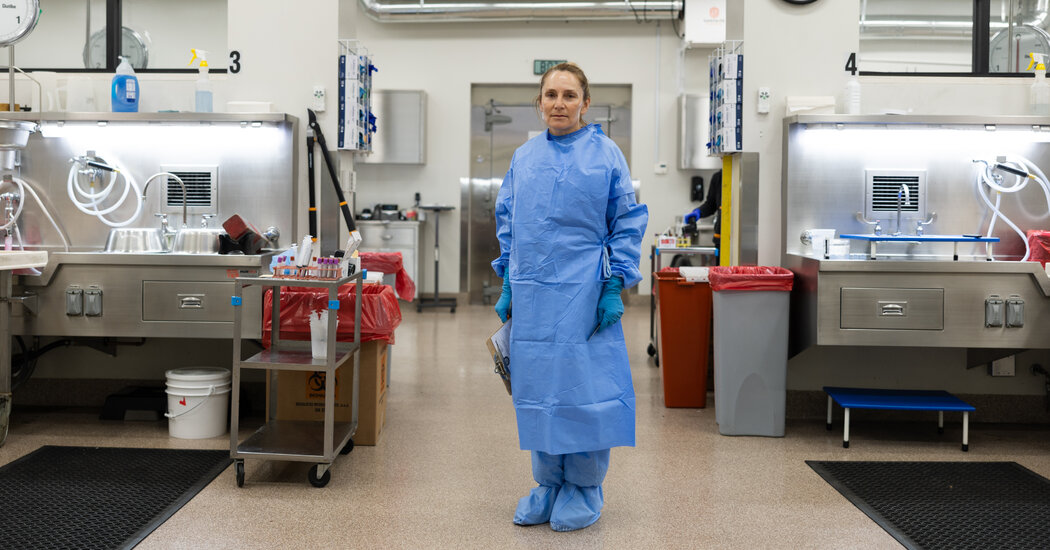
The chief medical examiner was not satisfied. The toxicology report on the dead man’s blood samples made no sense, given what her investigator had noted at the death scene:
Oct. 26, 2025, 2:43 a.m. Apartment, South Knoxville, Tenn. Decedent: white man, 52, supine on bed, in T-shirt, pants, belt, socks. In the bathroom: thumbnail-size baggies, cut straws, dollar bill, hollow pen, white powder.
But the only substances a lab found in his blood were nicotine and caffeine.
“Please look harder, please look harder,” implored Dr. Darinka Mileusnic-Polchan, the chief medical examiner for the greater Knoxville area. “Can’t we do something else?”
She sent the samples to a second lab. It found sedatives, but not enough to explain the death. She sent them to a third lab, which specializes in detecting novel drugs.
Those results were alarming: The victim had overdosed on cychlorphine, a compound in a new class of opioids called orphines that are 10 times more powerful than fentanyl.
In the six months since his death, at least 50 fatal overdoses involving cychlorphine have been confirmed in the greater Knoxville area. The largely unknown compound is on track to be the third-most-common drug involved in the region’s fatal overdoses this year, after fentanyl and methamphetamine.
Over that period, Knoxville became a national hot spot for cychlorphine. But if it were not for Dr. Mileusnic’s tenacity, the community would most likely not even know the drug was circulating.
As an ever-morphing stream of lethal opioids infiltrates the streets, medical examiners have become frontline drug detectives, pressing to identify the new substances causing deaths. The most persistent, like Dr. Mileusnic, are going beyond their traditional roles, coordinating with law enforcement and local health departments to swiftly warn communities about the latest killer in their midst. In that capacity, medical examiners perform another vital function: sentinels of public health.
But many medical examiners (and their lesser-trained counterparts, coroners) lack the money, technical resources and time to pinpoint each drug implicated in an overdose fatality. Since many novel compounds do not yet register on standard toxicology screens, they are listed on death certificates as “other and unspecified narcotics.” That means the prevalence and toll from new drugs like orphines are most likely being underreported.

