
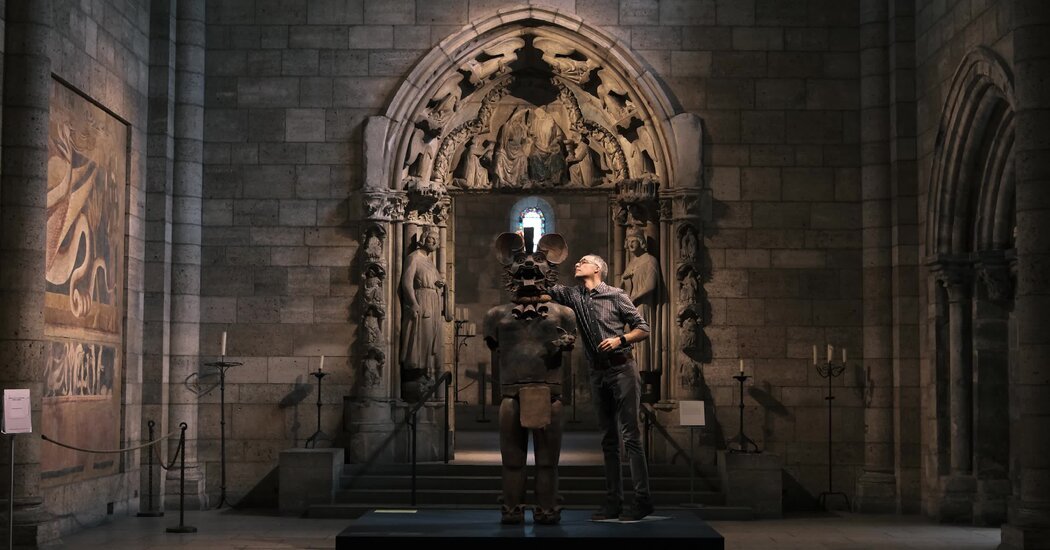
On a recent Wednesday at The Met Cloisters, the branch devoted to medieval art and architecture in Upper Manhattan, Andrew Winslow, the museum’s senior collections manager, steered me to an unusual visitor in a cavernous room with a vaulted ceiling: Tzinacantecuhtli, or Bat Lord, an almost 7-foot-tall, 9th-century sculpture of a hybrid creature — an upright man with a bat’s claws and head, large ears and a leaf-shaped tongue — on loan from Museo del Templo Mayor in Mexico City.
The massive sculpture was found in a small town southeast of Mexico City, at the foot of a volcano. Now it stands before a Gothic French doorway amid Spanish frescoes, the centerpiece of a new exhibition, “Creatures of Myth and Imagination” that heralds the arrival of the arts of the Ancient Americas at the Eurocentric museum.
In Zapotec cosmology, Bat Lord is associated with darkness, the underworld and rebirth, and the deity’s visit to the Cloisters marks a new era at the museum, most tangibly for Winslow, the 52-year-old art handler who is tasked with overseeing the sculpture’s care.
Winslow has been working at the Cloisters for 24 years. He started in 2002 selling tickets, and since 2007, he’s been responsible for the proper display and storage of the museum’s collection, which includes a variety of panel paintings, stone and wood sculptures, tapestries, manuscripts and metalwork — pieces secular and sacred. Several times a week, he walks through the galleries and studies every object, observing to see if anything looks off, from a piece of flaking paint on a sculpture to a barely perceptible cobweb. The job requires a good eye and a steady hand. (Winslow stopped drinking coffee, he says, after watching his hand shake one day while he was trying to turn the page of a medieval manuscript.)
I had met Winslow on a previous trip to the Cloisters, and his close attention to the art struck me. I wanted to see the museum through his eyes, since no one currently on staff has cared for the collection longer. He suggested I come up on a Wednesday, when the galleries are closed to visitors, who numbered some 290,000 last year.
When I arrived, Winslow — dressed in an untucked plaid shirt and rolled-up shirtsleeves, with a hake brush in his back pocket — walked me down to his small, windowless office in the museum’s labyrinthine basement. On the walls were his tools of the trade (rulers, a level, a hacksaw) beside objects from the museum’s history, including a black-and-white photograph of George Grey Barnard’s original, candlelit Cloisters museum not far from this location. It opened in 1914 with Barnard’s own art of the Middle Ages and operated until 1925, when its collection was acquired by John D. Rockefeller and became a branch of the Metropolitan Museum of Art (with Rockefeller adding some of his own works).
Next to Winslow’s tools were two rusted metal candle-snuffers, their cones caked in wax, that he suspects were used in Barnard’s era. Pinned to a corkboard above his desk were invitations to special exhibitions he’s worked on at the Cloisters, along with a handmade name tag from his early days selling tickets.
“I was a painter,” he said. “I needed a part-time job.” At the time, he lived in Washington Heights, a 20-minute walk to the museum, and his love for the Cloisters, he says, was “nearly instantaneous.” He admired the sweeping views of the Hudson River from its location atop Fort Tryon Park, one of the highest points in Manhattan, and he felt drawn to the building, which was created in the 1930s by incorporating medieval ruins into a structure that feels like a monastery. On his first day, he joined a public tour that played a looking game, which taught him how to tell the difference between the medieval and modern stones that make up the museum’s walls.
Winslow lends an artist’s eye to the roughly 10,000 objects in his care. He knows where the dust will settle on a sculpture of the Virgin Mary, how the light will change on a summer day in the Early Gothic Hall, and if he has to move a large object he knows the dimensions of every doorway and elevator. He is one of the only people on earth who is allowed to touch the objects, and he can tell you the weight of an ivory carving, say, or how the edges of 12th-century parchment feel. But he never forgets the number-one rule of art handling: “Don’t do it if you don’t have to.”
He sees himself as “one stop in a long line” of caretakers for objects that will outlive us, he said, “if we’re doing our jobs.” And he still stops to consider his luck at getting to work with the collection. “This is a piece of an animal skin that was stretched 500 years ago,” Winslow will say to himself. “This is a book that was made for a queen of France, and it’s in my hands.”
Winslow walked me through the museum’s chapels and halls. In the Bonnefont Cloister garden, he told me about the pleasurable mornings he spends sweeping the walkways, and down in the dimly lit Treasury Room, he rotated the oldest known complete set of playing cards, from the 16th century, which are changed every four months. One by one, Winslow carefully slid a piece of wax paper underneath each pasteboard card, then folded the flaps over the top of a king, queen, knave or pip.
For the first few years in his role as caretaker, he attended to galleries and objects that visitors perceived as largely static — the Cloisters hadn’t hosted a special exhibition since 1982. In November 2011, that changed when he helped install a small show that featured a famous medieval set of chess pieces. Since then, Winslow has worked on every special exhibition, which have increased in ambition and scope as departments at the Met are encouraged to collaborate more freely. Visitors are realizing the museum is a dynamic place, said C. Griffith Mann, curator in charge at the Met’s medieval department.
The Cloisters must convince lending institutions that their pieces will be safe at a place that looks like a monastery. “We have doors that are open to the outside gardens,” Winslow said. Because the open doors are crucial to The Cloisters’ monastic feeling, the staff is always defending against pests, including ants, clothes moths, carpet beetles, the occasional bird, and, once, a resident bat.
The small, tight-knit staff are interested in finding new ways to use the Cloisters as a setting. Last year, Winslow worked on the exhibition team for “Spectrum of Desire: Love, Sex, and Gender in the Middle Ages,” which explored the often-overlooked theme of sexuality in medieval art. There hadn’t been an exhibition at the Cloisters quite like it, Winslow said. (A newly commissioned performance by the artist duo Gerard & Kelly explored the Cloisters as a disco sanctuary.)
“Creatures,” which is the first collaboration with the Met’s Michael C. Rockefeller wing, brings together fields that have historically remained siloed — medieval European art and the arts of the Ancient Americas, signaling a fresh curatorial vision.
“Everything about our building and our collection speaks to Western Europe,” said Julia Perratore, associate curator at the Cloisters and a co-curator of the “Creatures” exhibition, on a video call. “There are expectations of what you’re going to find at the Cloisters that we’re excited to confound.”
The “Creatures” exhibition features more than 50 objects, mostly from the Cloisters’ permanent collection, seen anew alongside the Museum’s collection of art from Mesoamerica, Central America and the Andes, plus special loans from Mexico. Once the idea for the exhibition took shape, the curatorial team approached Winslow, whom they call their “secret weapon,” and who brings their ideas to life, often making sketches and scale models. “You’ll come up with a wild idea and you want this gigantic thing,” said Joanne Pillsbury, a curator with the Met’s Rockefeller Wing, “and he will try so hard to make it happen.”
His team had to remove the metal handles on the door to get Bat Lord inside. Another gigantic sculpture would have required removing a ceiling and lowering it into the gallery by crane.
“The best view is here,” said Winslow, waving me to where he was standing in the Romanesque Hall, facing the new sculpture at an angle. Bat Lord, who once adorned a public space in the town of San Mateo Tezoquipan Miraflores, was dramatically juxtaposed with a monumental 13th-century fresco of a dragon with a snake’s long body and a chicken’s knobby feet, from a Benedictine monastery in Spain. The curators had this vantage in mind from the show’s conception, Winslow said.
Here were two legendary creatures, side by side, from cultures that wouldn’t have contact for hundreds of years. Winslow’s eye went back and forth, as the Romanesque Hall transformed from a showcase for medieval European art into a celebration of the incredible capacity of the human imagination.

