
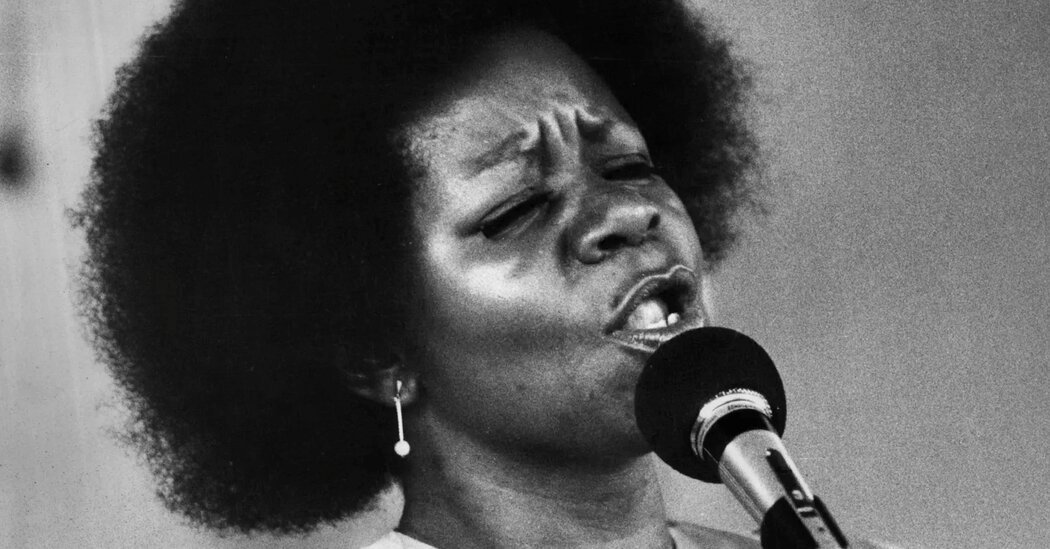
In the summer of 1974, a few weeks after the death of the jazz composer and bandleader Duke Ellington, a group of his admirers gathered in Chicago to plan a concert in his memory.
The city had a great jazz tradition, but it was also heavily segregated, a racial line that reached as far as the musicians gathered that day. The Black musicians wanted to hold the concert in Washington Park, on the city’s South Side and near its largest Black communities; the white musicians preferred somewhere on the North Side, where most of them lived.
It was left to Geraldine de Haas, a semiretired jazz singer, to find a compromise: Grant Park, a 319-acre greensward between downtown Chicago and Lake Michigan.
“The Black musicians were conditioned to think one way, and the white musicians were conditioned another away,” she told The Chicago Tribune in 2013. “They never thought about getting everyone to participate.”
She wanted someplace in the middle. “I was adamant about that,” she said.
The concert was a huge success, drawing thousands to the park. And it reinvigorated the city’s jazz scene, which had been on the decline for decades.
It also gave Mrs. de Haas a mission. Over the coming decades, she became the driving force behind Chicago’s jazz resurgence. She founded concert series, festivals and a nonprofit organization, Jazz Unites. Howard Reich, the jazz critic for The Tribune, called her “the first lady of Chicago jazz.”
Mrs. de Haas died on July 28 in Englewood, N.J. She was 91.
Her son, Darius de Haas, confirmed the death, at a hospital not far from the home that she and her husband, the bassist Edgar de Haas, moved to in 2013.
“She brought together people from every corner of the city — and beyond — to celebrate the universal language we all love, appreciate and understand: music,” the jazz singer Dee Alexander said in an email. “Through her vision and dedication, she created a space where artists could flourish and audiences could experience the richness of our shared cultural heritage.”
Many people knew Mrs. de Haas for her organizing acumen and endless energy. But before her work to revive Chicago’s jazz scene, she was a renowned musician herself.
Geraldine Wideman was born on Jan. 16, 1935, in Newark. Her father, a window washer born Andrew Wideman, was a member of the Moorish Science Temple of America, an offshoot of Islam, and followed its practice of adopting Bey as a surname; Geraldine took that surname as well, though she did not join the denomination. Her mother, Victoria (Johnson) Wideman, managed the home.
Geraldine’s brother, Andy, was a piano prodigy, and her sister, Salome, was already performing in high school. Geraldine cut several records with Salome before the three joined forces as Andy and the Bey Sisters in the mid-1950s.
They became an in-demand trio, first in the Newark area and then in Miami and Europe. One evening in Paris, Mrs. de Haas recalled, Marlon Brando was in the audience and flirted with her after the show. She declined his advances.
She married Mr. de Haas in 1962. He died in 2022.
Salome Bey died in 2020, and Andy Bey died in 2025.
Along with her son, Mrs. de Haas is survived by a daughter, Aisha de Haas.
Around 1966, after nearly a decade on the road, Andy and the Bey Sisters split up. The de Haases spent several years following work opportunities, living in Cologne, Germany; Newark; and finally Chicago, where they settled in 1968.
Interest in jazz was on the decline everywhere, including in Chicago, pushed aside by pop and rock music. Mrs. de Haas continued to sing, but she also joined the recently established Free Street Theater Company as an actor.
In the early 1970s, she appeared in several major musicals through Free Street and other companies, including “Hair,” “Show Boat” and “Don’t Bother Me, I Can’t Cope.”
She became interested in cultural preservation as well, joining the successful campaign to save the South Shore Cultural Center, a onetime hub for jazz that was threatened with demolition.
Thanks to the efforts of Mrs. de Haas and other preservationists, the building was sold to the Chicago Park District and today remains a major part of the city’s cultural life.
Working on the center showed Mrs. de Haas the power of grass-roots cultural activism. After the success of the Ellington concert, she helped make it an annual event; it eventually evolved into the Chicago Jazz Festival.
Mrs. de Haas received a bachelor’s degree in music education from Chicago State University in 1980. A year later she founded Jazz Unites, a nonprofit on the South Side that promoted music education and performance.
“People in the neighborhood started coming in off the street to the storefront I had at the time,” she told The Tribune in 1996, “and they contributed one dollar, or five dollars or 10 dollars, and that made it happen.”
In 1993, she organized another major concert, Jazz Comes Home, featuring stars like Muddy Waters, Betty Carter and Count Basie.
By the time she and Mr. de Haas decided to move to New Jersey to be closer to their children, Chicago was once more a vibrant jazz city, with dozens of clubs, multiday festivals and strong college-level music programs.
A few weeks before the couple left, dozens of Chicago jazz musicians gave them a send-off at a grand public concert.
“It’s been a labor of love,” she said in an interview with the WBEZ radio station after concert. “This music drives me.”

